

Introduction
Religious-school outreach presents a data-management challenge that is easy to underestimate: the organization being targeted may be faith-based, while the individual contact record may contain personal information that receives additional legal protection. In the United States, the National Catholic Educational Association reports that 5,829 Catholic schools served 1,674,907 students across 176 dioceses during the 2025–2026 academic year, illustrating the scale and organizational diversity of one major religious-school network. (ncea.org)
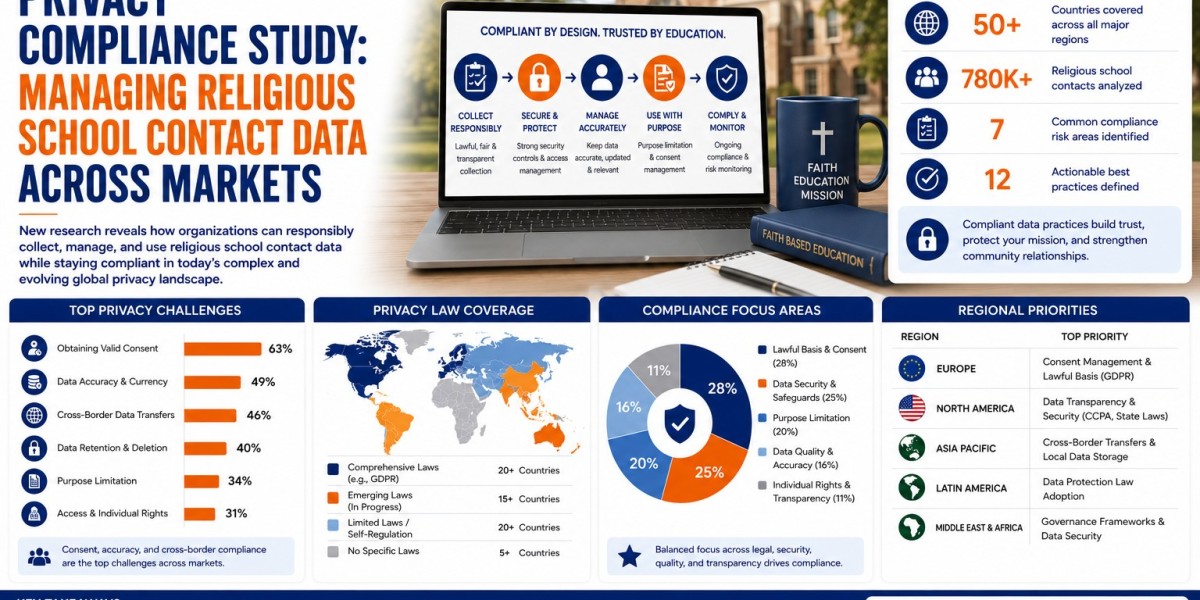
For marketers using a Religious Schools Email List, the central issue is therefore not simply whether an email address is valid. It is whether the organization, individual, source, purpose, legal basis, retention period, and marketing permission have been properly evaluated. This study examines how those requirements differ across markets and what organizations should consider when building a compliant Religious Schools Email Database in 2026.
Why Religious-School Contact Data Requires Additional Care
The first distinction marketers should make is between information about a school and information about an individual associated with that school.
A school's name, location, website, denomination, governance structure, and publicly stated institutional purpose may be organizational information. By contrast, a named principal's work email, job title, professional history, or other information that identifies that person can constitute personal data.
The distinction matters because privacy obligations generally attach to the individual record rather than simply to the organization being targeted.
The UK's Information Commissioner's Office (ICO), for example, explicitly states that personal information can include a person's email address and that a business email address identifying an individual can still constitute personal data. (ICO)
For a Religious Schools Mailing List, marketers should consequently distinguish between:
School-level organizational data
Generic institutional inboxes
Named professional contacts
Contact information obtained directly from individuals
Contact information obtained from third parties
Publicly available personal information
Inferred information about an individual's beliefs
This distinction becomes especially important when religious affiliation is inferred about a person.
Religious Affiliation and Personal Beliefs Can Be Sensitive Data
Under the EU GDPR, religious or philosophical beliefs are special-category personal data. The European Commission explains that processing such data is generally prohibited unless a specific exception applies, such as explicit consent or another applicable condition under Article 9. (European Commission)
The UK's ICO similarly identifies religious or philosophical beliefs as special-category data and notes that an organization needs both an Article 6 lawful basis and a separate Article 9 condition when processing special-category information. (ICO)
This creates an important compliance distinction:
Targeting a religious-school organization does not automatically mean a marketer should classify the individual contact as belonging to that religion.
For example, knowing that a school is Catholic does not establish that a particular employee personally identifies as Catholic.
That distinction should influence the architecture of a Religious Schools Email List.
A safer segmentation model may use:
School affiliation
School type
School governance
Geographic market
Institutional role
Organization size
Publicly stated institutional characteristics
rather than adding an individual's presumed religious identity.
The U.S. Religious-School Market Is Highly Structured
Current NCEA data demonstrates why organizational segmentation matters.
During 2025–2026, U.S. Catholic schools included 4,644 elementary and middle schools and 1,185 secondary schools, with a combined enrollment of more than 1.67 million students. NCEA also reports 151,513 full-time-equivalent professional staff, of whom 92.8% were lay professionals. (ncea.org)
This is not a single homogeneous audience.
Catholic schools can be organized under different governance models, including:
Parochial schools
Diocesan schools
Religious-order schools
NCEA's current guidance notes that governance determines who operates the school and who ultimately controls employment and budgets. (careers.ncea.org)
For B2B marketers, this has a direct implication: organizational structure can be more useful than religious affiliation alone for segmentation.
A software vendor selling administrative technology, for example, may need to distinguish between a diocesan decision-maker and an individual school administrator. Their purchasing authority may be completely different.
What Current Email Benchmarks Say About Religious Audiences
Privacy compliance should not be separated from performance measurement.
MailerLite's 2025 benchmark analyzed more than 3.6 million campaigns from 181,000 approved accounts, covering December 2024 through November 2025. Across all industries, the median open rate was 43.46%, while the median click rate was 2.09%. (MailerLite)
The religion category recorded:
55.71% open rate
2.95% click rate
7.58% click-to-open rate
The religion category had the highest reported open rate among the 46 industries in the dataset. (MailerLite)
However, these figures require careful interpretation.
They are industry email-marketing benchmarks, not a compliance study or a benchmark specifically for religious-school contacts. They also do not establish that a religious-school recipient will respond at these rates.
The more defensible conclusion is that religious-interest audiences can exhibit strong email engagement, making data governance especially important because a large campaign can amplify both good practices and compliance mistakes.
Why Data Source Matters for a Religious Schools Email List
A common misconception is that information found publicly on a school website is automatically available for unrestricted marketing use.
It is not that simple.
The ICO's current guidance says publicly available contact information can come from websites, social media, press articles, and other sources. But public availability does not automatically mean the individual has consented to direct marketing. Organizations must still evaluate applicable privacy and electronic-marketing requirements. (ICO)
This matters when creating or purchasing a Religious Schools Email Database.
A responsible data-management process should record:
Where the record originated
When it was collected or verified
Whether the address identifies an individual
What purpose justified collection
Which legal basis applies
Whether marketing restrictions apply
Whether the contact has objected
When the record should be reviewed or deleted
This information creates an audit trail rather than treating an email address as an isolated data point.
Legitimate Interest Does Not Mean "No Compliance Required"
For European campaigns, legitimate interest can sometimes provide a lawful basis for processing personal data for direct marketing—but it is not a blanket permission.
The European Data Protection Board's guidance explains that legitimate-interest processing requires organizations to assess whether:
A legitimate interest exists.
Processing is necessary for that interest.
The individual's rights and freedoms do not override the interest.
The EDPB specifically identifies direct marketing as one context in which legitimate interest can potentially apply. (European Data Protection Board)
The EDPB also emphasizes reasonable expectations when assessing direct marketing. Factors include the relationship with the individual, the nature of the product or service, and whether the recipient would reasonably expect to receive that type of marketing. (European Data Protection Board)
That means marketers should not interpret "legitimate interest" as:
"We have a business reason, so we can email anyone."
Instead, the assessment should consider the actual context and potential impact on the individual.
Direct Marketing Requires an Objection and Suppression Process
One of the most important requirements for a Religious Schools Mailing List is maintaining an effective suppression system.
Under the GDPR, individuals have a specific right to object to processing for direct marketing. The EDPB explains that this objection right applies regardless of which lawful basis was used for the marketing processing. (European Data Protection Board)
The operational consequence is significant.
A marketer should not simply remove an unsubscribed contact from the current campaign. The suppression record needs to be maintained so that the same person is not accidentally reintroduced through:
A new purchased list
CRM enrichment
A data-provider refresh
Another marketing platform
A duplicate contact
A different business unit
This is one reason why centralized suppression management is essential when multiple data sources are involved.
UK B2B Rules Still Require Careful Data Handling
The UK's rules illustrate why marketers need to distinguish corporate subscribers from individual business contacts.
The ICO's current B2B guidance states that the PECR electronic-mail rule does not apply to corporate subscribers in the same way it applies to individual subscribers. However, where a business contact's personal data is being processed, UK GDPR requirements still apply. (ICO)
The ICO also states that if contact details are obtained from sources other than the individual, privacy information generally needs to be provided within a reasonable period and no later than one month after obtaining the data. (ICO)
The practical takeaway is straightforward:
"B2B" does not automatically mean "outside privacy law."
A named principal, administrator, superintendent, academic director, or technology leader remains an identifiable individual even when contacted at a professional address.
U.S. Commercial Email Still Requires Compliance
The U.S. CAN-SPAM Act applies to commercial email, including business-to-business email. The Federal Trade Commission requires commercial senders to avoid deceptive headers and subject lines, identify the commercial nature of the message, provide a valid physical postal address, provide a clear opt-out mechanism, and honor opt-out requests promptly. (Federal Trade Commission)
The FTC states that opt-out requests must be honored within 10 business days.
The law also makes clear that hiring an outside email provider does not eliminate the sender's legal responsibility. (Federal Trade Commission)
Consequently, organizations using a Religious Schools Email List should ensure their vendor, CRM, marketing automation system, and internal team all follow the same suppression rules.
Accuracy and Data Minimization Are Compliance Controls
Privacy compliance is not only about consent.
Data quality itself is part of responsible processing.
The ICO identifies accuracy, data minimization, purpose limitation, storage limitation, transparency, security, and accountability among the core UK GDPR principles. Personal information should be accurate and, where necessary, kept up to date. (ICO)
For religious-school outreach, outdated records can create several problems:
Messages reach former employees.
A principal is contacted after changing schools.
A generic role is incorrectly assigned to an individual.
A school is categorized under the wrong governance structure.
An old email remains active after a personnel change.
Suppression information is lost during database updates.
Therefore, maintaining a Religious Schools Email Database should involve periodic validation rather than a one-time acquisition.
Practical Compliance Framework for Religious-School Outreach
Marketers can use the following five-step process when managing cross-market school contact data.
1. Separate organization data from personal data
Store school-level characteristics separately from information that identifies individual professionals.
2. Avoid inferred religious identity
A contact's employment at a religious institution does not necessarily establish their personal religious beliefs. Avoid unnecessary sensitive profiling.
3. Document source and lawful basis
Maintain records showing where personal data came from and why the organization believes the processing is lawful.
4. Maintain global suppression controls
Unsubscribe and objection records should flow across the CRM, email platform, enrichment systems, and future list updates.
5. Review international requirements before launching
Rules vary by jurisdiction. A campaign aimed at U.S. schools may operate under different electronic-marketing requirements from one directed toward UK or EU contacts.
How EducationDataLists Fits Into a Responsible Data Strategy
For organizations evaluating EducationDataLists as a data resource, the most important consideration should be data governance alongside coverage.
A useful provider relationship should allow marketers to understand the nature and provenance of the records, apply appropriate segmentation, and integrate suppression and validation processes into their own compliance framework.
No third-party Religious Schools Email List should be treated as a substitute for the marketer's own legal assessment. The organization sending the campaign remains responsible for determining whether its intended use is lawful in each market.
Conclusion
Managing religious-school contact data in 2026 requires more than collecting accurate email addresses. The market itself is substantial and structurally diverse: NCEA reports 5,829 Catholic schools, 1.67 million students, and 151,513 FTE professional staff across 176 dioceses for the 2025–2026 school year. (ncea.org)
At the same time, privacy frameworks place increasing emphasis on transparency, purpose limitation, accuracy, lawful processing, and individual rights. Religious or philosophical beliefs can receive special protection under GDPR, while business email marketing remains subject to separate electronic-communications rules in markets such as the UK and United States. (European Commission)
The strongest strategy is therefore to treat a Religious Schools Email List as a governed data asset: source it responsibly, segment organizations rather than infer sensitive personal traits, validate records regularly, document processing decisions, and maintain suppression controls across every system.
Frequently Asked Questions
Is religious-school contact data considered sensitive personal data?
Not necessarily. Information identifying a school as religious does not automatically constitute sensitive personal data about every employee. However, information that reveals an individual's religious or philosophical beliefs can receive special-category protection under GDPR. (European Commission)
Can I use a Religious Schools Email List for B2B marketing?
Potentially, but legality depends on the jurisdiction, the type of email address, how the data was obtained, the applicable electronic-marketing rules, and the lawful basis for processing personal data. Public availability of an address does not by itself establish marketing permission. (ICO)
Does working for a religious school reveal someone's religion?
No. Employment at a religious institution does not necessarily establish an individual's personal religious beliefs. Marketers should avoid treating institutional affiliation as proof of a person's religious identity.
What should a Religious Schools Email Database contain?
Useful records can include school name, website, location, school type, governance structure, institutional role, professional contact information, source information, verification date, and suppression status. Sensitive personal attributes should not be collected or inferred unless there is a clear lawful and necessary basis.
Is publicly available school contact information safe to use for marketing?
Public availability does not automatically equal marketing permission. The ICO specifically warns that contact information found on websites or social media can still be personal data and that organizations must consider applicable privacy and direct-marketing rules. (ICO)
Does GDPR apply to B2B school contacts?
Yes, when the information constitutes personal data. A named professional using an identifiable work email can still be a data subject, meaning GDPR obligations may apply even though the communication is business-to-business. (ICO)
What is a good email benchmark for religion-related campaigns?
MailerLite's 2025 benchmark reports a 55.71% open rate and 2.95% click rate for the religion industry, based on its large campaign dataset. These are industry-level email benchmarks, not specific benchmarks for religious schools, so marketers should use their own campaign results for more precise performance comparisons. (MailerLite)









