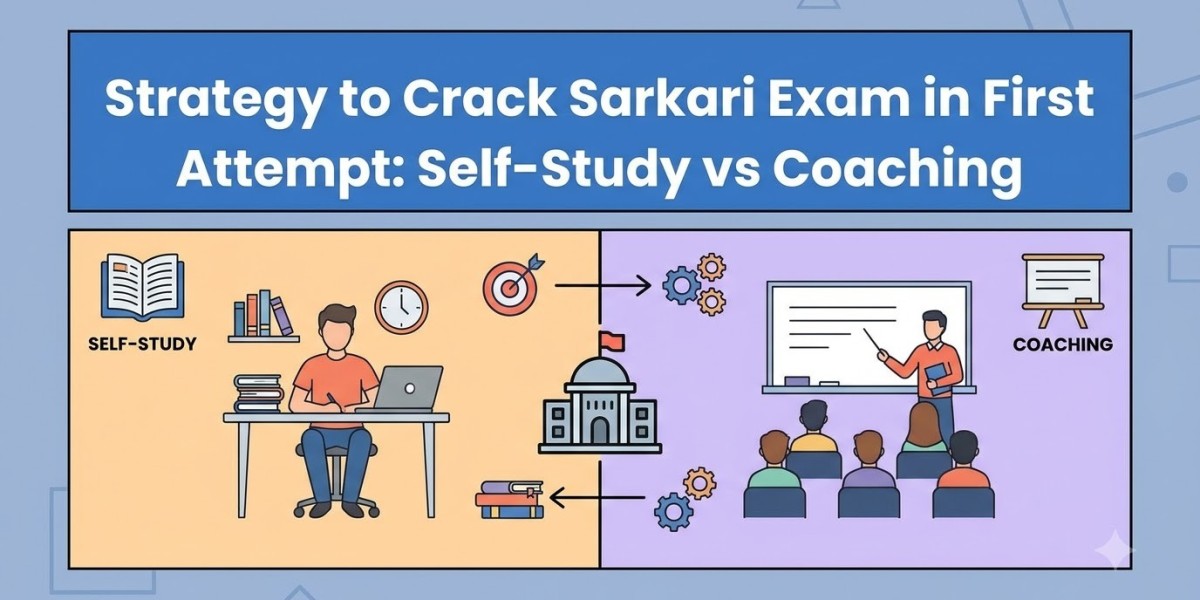


Selection in any Sarkari Exam at the first go does not depend upon how many hours you study daily and even the best coaching institute that you enroll into; what matters is the strategy you choose to adopt along with adhering to the syllabus, practising regularly and assessing yourself.
In case of preparing for any exam like SSC CGL, Banking, Railway, UPSC, Defence, Teaching or even State Government Exam, everything boils down to basics: knowing the exam, creating solid concepts and then solving questions over and over again; however, whether to adopt self-study or coaching makes a huge difference in preparation.
Step 1: Choose One Target Before Starting
The initial error that many aspirants make is that they study for multiple exams concurrently. Instead, select one primary exam according to your qualification, interests and career goal.
First of all, read the latest official notification, Syllabus and Exam pattern. This information always needs to be from the relevant examination body and not from coaching websites or social media. UPSC releases their examination notifications, timelines and questions papers on their official website, for instance.
After gaining an understanding of the syllabus, break each subject down into:
Topics you already know
Topics requiring practice
Completely weak topics
This is the easiest exercise to help you with the preparation plan rather than the random approach.
Build Your Preparation Around Previous-Year Papers
Prior to investing weeks into the preparation process, work on a few previous year’s question papers.
Previous year’s question papers are very important since there can be complex and varied patterns in competitive exams. SSC has a separate section called ‘syllabus’ for aspirants and UPSC publishes previous year’s question papers from their official portal.
However, it is not enough to merely count how many questions you got right. You must also analyse why you did not get the answer right:
Concept was unclear
Formula was forgotten
Question was misunderstood
Calculation took too long
You made a careless mistake
You did not know the answer
Such analysis must become an integral part of your preparation.
Is Self-Study Enough for a Sarkari Exam?
For most candidates, yes. Self-study works very effectively if you have self-discipline and are able to follow a set schedule.
The major benefit of self-study is the freedom to decide your study timings, sources of study, and pace of revision. Self-study is comparatively economical as you can use books, sources, online classes, practice papers, and test series.
Self-study is ideal when:
Your fundamentals are strong.
You are able to follow a routine without any outside pressure.
You are aware of what constitutes good study material.
You don’t mind studying through books and online lectures.
You can analyze your own errors.
Here, the trick lies in limiting the number of your sources. One good source and lots of practice with revision is far better than hoarding dozens of books and PDFs.
When Coaching Can Give You an Advantage
It is not mandatory, but coaching might be helpful for those candidates who want proper guidance.
The best coaching institute will give you a proper schedule, faculty assistance, periodic exams, and an atmosphere which will make you consistent. Coaching will help you save time if you are facing problems with comprehending any specific subject.
Coaching might prove helpful for those candidates who:
Are appearing in the exam for the first time and don’t know where to start.
Have poor concepts of one or more subjects.
Cannot remain consistent on their own.
Need doubt solving facilities regularly.
Face problems in analysing their preparation.
Need guidance in writing answers in descriptive exams.
The Hybrid Approach Can Be More Practical
There is no need to consider self-study and coaching as two entirely different options. For instance, you can do self-study for most topics and take online or offline classes only for tough subjects.
You can also opt for the test series rather than going for complete coaching if your concepts are clear.
In this way, you will get assistance wherever required without compromising on the self-study part.
Moreover, digital practice has also become easier. The Test Abhyas app of NTA is offering mock tests at the level of actual exams along with personalized reports, while the Test Practice Centre offers mock-test facilities intended to familiarise candidates with computer-based testing.
Follow a Three-Phase Preparation Strategy
The first attempt strategy should be divided into three general phases.
Phase 1: Learn the Concepts
Begin with basics only. Go through your syllabus and make small notes of revision. Do not try doing full-length mocks without grasping the basics properly.
For topics such as Quantitative Aptitude and Reasoning, learn the concept and then solve problems based on them. On the other hand, for General Awareness and current affairs topics, develop a revision technique rather than cramming all of it at the last minute.
Phase 2: Practice and Improving the Speed
After learning all the fundamentals, start with practicing more questions.
Try to solve previous year papers and sectional tests. Maintain a mistake diary having all the formulas, concepts, confusing facts and the questions which you do not solve correctly.
Your aim should gradually change from solving questions to solving questions within a given time.
Phase 3: Mock Tests and Revision
During the last preparation phase, take mock tests and revise simultaneously.
Analyze the mock test after taking it. Along with your scores, analyzing your accuracy and time management techniques are equally important.
As per the NTA official guidance on mock test practice, it suggests beginning with a plan and attempting the questions which you know.
Create a Realistic Daily Routine
But you don't always have to spend 12 hours on preparation. You can even make it work by following a 6 to 8-hour schedule every day.
One example for a regular day:
Morning: Difficult topics or basic concepts
Mid-morning: Quantitative aptitude / reasoning
Afternoon: English or any other language
Evening: General awareness/current affairs
Night: Last year questions and mocks
Avoid These First-Attempt Mistakes
One of the most common errors made by Sarkari Exam aspirants is the phenomenon of switching strategies. For one week they listen to one lecturer, for the next week they read another text, and ultimately, they end up with various unfinished sources.
Some of the other mistakes are:
Ignoring the official syllabus
Starting mock tests too late
Avoiding weak subjects
Studying without a timetable
Memorising without revision
Spending too much time on current affairs without prioritisation
Not analysing incorrect answers
Comparing preparation hours with other candidates
Changing the target examination repeatedly
Conclusion
First-time success in the Sarkari Exam does not depend as much on whether one opts for self-study or coaching but on the kind of preparation one undergoes. Self-study can prove to be very effective for well-organized and disciplined students, whereas coaching can help those who require some form of assistance to prepare for the exam. Even a combination of both self-study and coaching can help the candidates perform better. They should focus on studying the syllabus provided officially, solving last year’s question papers and revising.









