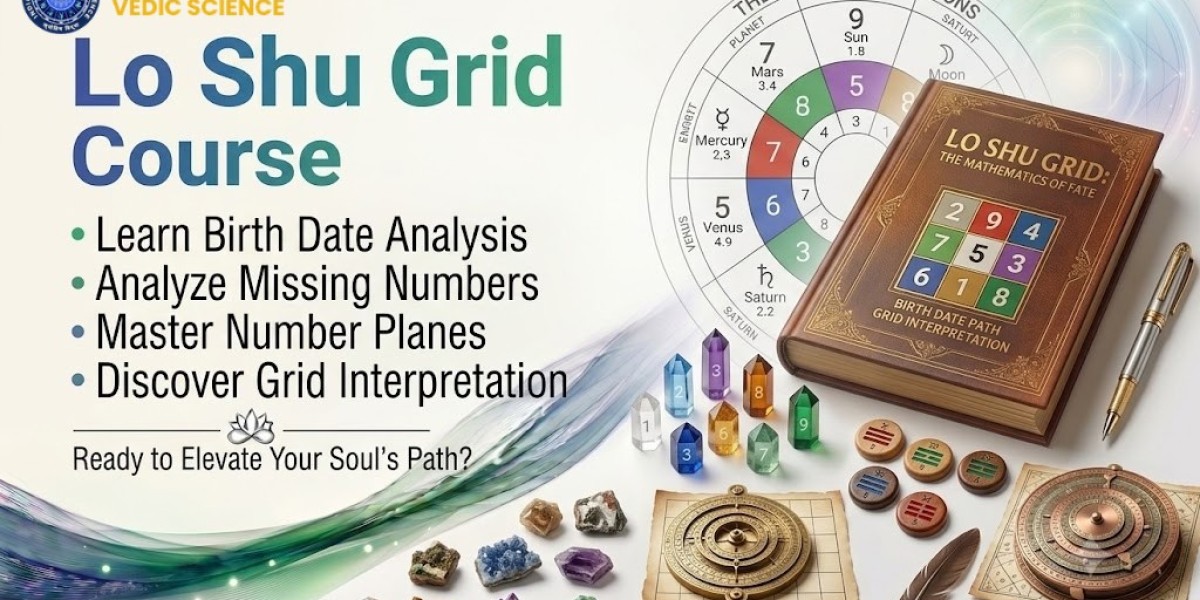


Lo Shu Grid Course: Learn Birth Date Analysis, Missing Numbers, Number Planes & Grid Interpretation
The Lo Shu Grid is a traditional numerological method that uses numbers derived from a person's date of birth to create a structured numerical grid. Learners often study it to understand number patterns, missing numbers, repeated numbers, number planes and the overall interpretation of a birth-date grid.
For beginners, learning the Lo Shu Grid can seem simple at first because the grid contains only a limited set of numbers. However, meaningful interpretation requires an understanding of how the grid is constructed, how birth-date numbers are placed, and how different numerical patterns are traditionally interpreted.
A structured Lo Shu Grid Course can help learners progress from basic calculations to complete grid interpretation.
If you want to learn Lo Shu Grid numerology, the goal should not be simply to memorise the position of numbers. You should learn how to calculate the grid accurately, identify patterns and develop a consistent approach to interpretation.
What Does a Lo Shu Grid Course Teach?
A structured Lo Shu Grid Course can introduce learners to:
Lo Shu Grid fundamentals
Birth-date calculations
Grid construction
Number placement
Missing numbers
Repeated numbers
Number planes
Individual number meanings
Numerical patterns
Grid interpretation
Practical birth-date analysis
Case-study practice
Responsible consultation and communication
The learning journey can be approached as:
Birth Date → Number Calculation → Grid Construction → Missing & Repeated Numbers → Number Planes → Pattern Analysis → Complete Grid Interpretation
This progression helps learners move from calculation to practical analysis.
What Is the Lo Shu Grid?
The Lo Shu Grid is a numerical grid used in certain numerological traditions. It provides a structured way of arranging numbers associated with a person's birth date.
Instead of interpreting numbers in isolation, the grid allows learners to examine:
Which numbers are present
Which numbers are missing
Which numbers appear repeatedly
How numbers are positioned
Which planes are formed
What patterns appear across the grid
This makes the Lo Shu Grid particularly interesting for students who prefer visual and structured methods of numerological analysis.
Why Learn Lo Shu Grid Numerology?
Many beginners start their numerology journey by learning individual number meanings. The Lo Shu Grid introduces another approach by organising birth-date numbers into a visual framework.
When you learn Lo Shu Grid numerology, you can gradually develop skills in:
Calculating birth-date numbers
Constructing a grid
Placing numbers correctly
Identifying missing numbers
Identifying repeated numbers
Studying number planes
Connecting different patterns
Developing an overall interpretation
This makes practical exercises particularly important.
A learner may understand what individual numbers traditionally represent but still struggle to interpret a complete grid. Working through different birth dates helps bridge that gap.
Birth Date Analysis: The Foundation of the Lo Shu Grid
Birth-date analysis is the starting point for creating a Lo Shu Grid.
The learner first needs to understand the relevant birth-date information and the numerical process used to prepare the grid according to the methodology being taught.
Accuracy matters because an incorrect calculation can affect the entire interpretation.
A structured learning exercise can involve:
Step 1: Record the Birth Date
Begin with the correct date of birth.
Step 2: Identify the Relevant Numbers
Apply the calculation method taught in the course.
Step 3: Construct the Grid
Place the relevant numbers in their corresponding positions.
Step 4: Review the Grid
Check for present, missing and repeated numbers.
Step 5: Analyse Patterns
Study the number planes and other relationships.
Step 6: Develop the Interpretation
Bring the observations together into a structured reading.
This step-by-step approach helps beginners understand the complete process rather than memorising isolated rules.
Understanding Missing Numbers
Missing numbers are one of the most commonly studied aspects of Lo Shu Grid interpretation.
A grid may not contain every number. Learners are therefore taught to identify which numbers are absent and understand how those absences are traditionally interpreted within the system being studied.
However, missing numbers should not automatically be treated as negative predictions.
A responsible learning approach asks:
Which number is missing?
What is its traditional significance?
Are other numbers providing additional context?
Are there repeated numbers or planes that change the overall pattern?
How should the observation be communicated?
This prevents the reading from becoming overly simplistic.
Practical Example
Suppose a learner constructs a birth-date grid and notices that one number is absent.
Instead of immediately assigning a fixed conclusion, the student can practise documenting the missing number, reviewing its traditional interpretation and then considering the rest of the grid.
This is where structured training becomes more useful than memorisation.
Repeated Numbers in the Grid
Missing numbers are only one side of grid analysis.
A learner should also identify numbers that appear more than once.
Repeated numbers can form an important part of traditional Lo Shu Grid interpretation.
Students can practise:
Counting occurrences
Identifying repeated values
Comparing repetitions with missing numbers
Studying their relationship with number planes
Developing a balanced interpretation
The aim is to examine the grid as a whole rather than focusing excessively on one numerical feature.
Understanding Number Planes
Number planes are another important concept within Lo Shu Grid learning.
A structured Lo Shu Grid online course can introduce students to the different planes formed by numbers within the grid and how these patterns are traditionally interpreted.
Learning about planes helps students move beyond individual numbers.
Instead of asking only:
“Which numbers are present?”
learners can also ask:
“How are these numbers positioned in relation to one another?”
This creates a more structured approach to grid analysis.
Students can practise identifying relevant planes and then studying what those combinations traditionally represent.
Grid Interpretation: Putting Everything Together
The real learning challenge begins when a student has to interpret the complete grid.
A practical interpretation can consider:
Individual numbers
Missing numbers
Repeated numbers
Number planes
Numerical patterns
Overall grid structure
A systematic reading may follow this order:
1. Construct the grid
2. Verify the calculations
3. Identify present numbers
4. Identify missing numbers
5. Identify repeated numbers
6. Examine number planes
7. Look for significant patterns
8. Build an overall interpretation
This process helps reduce the tendency to jump to conclusions based on a single number.
Learn Lo Shu Grid Online: Why Practical Training Matters
Someone who wants to learn Lo Shu Grid numerology should spend time practising actual birth-date examples.
Theory provides the foundation, but practical analysis develops confidence.
For example, students can be given several sample birth dates and asked to:
Construct each grid
Identify missing numbers
Count repetitions
Identify planes
Compare patterns
Write a short interpretation
As students work through different examples, they can see that two grids may contain very different combinations.
This makes case-study practice an important part of a structured Lo Shu Grid online course.
What Should You Look for in a Lo Shu Grid Course?
If you are comparing a Lo Shu Grid Course, look beyond the course title.
Consider whether it includes:
Clear Fundamentals
Does the course explain the underlying methodology before moving into interpretation?
Birth-Date Analysis
Are learners taught how to construct a grid accurately?
Missing Numbers
Does the programme explain how missing numbers are traditionally interpreted?
Repeated Numbers
Are students taught to identify and analyse repetitions?
Number Planes
Does the curriculum cover relevant planes and patterns?
Practical Examples
Are there sample birth dates or case studies?
Interpretation Practice
Can learners create complete readings rather than only perform calculations?
Guidance
Is there an opportunity to clarify questions during the learning process?
These factors can help learners select a programme based on actual educational value.
Lo Shu Grid and Vedic Numerology
Learners who learn Vedic numerology may encounter the Lo Shu Grid as one of several numerical analysis approaches.
However, it is important to understand the specific methodology taught by a particular course rather than assuming that every numerology programme uses exactly the same framework.
If your primary interest is birth-date-based grid analysis, look for a programme that specifically teaches:
Grid construction
Number placement
Missing numbers
Repeated numbers
Number planes
Pattern interpretation
Practical readings
This gives the learner a clearer pathway toward developing Lo Shu Grid skills.
Can Lo Shu Grid Be Studied with Astrology?
Learners sometimes search for terms such as Lo Shu astrology because they encounter numerology and astrology together across traditional knowledge and online learning resources.
However, Lo Shu Grid analysis and astrology should be understood as distinct methodologies.
The Lo Shu Grid is based on numerical patterns derived from birth-date information, while astrology uses an astrological framework involving concepts such as planets, signs, houses and charts.
A learner interested in both can study them separately and then understand how practitioners may choose to explore multiple traditional systems.
Exploring Online Astrology Courses Alongside Numerology
Students who develop an interest in broader traditional knowledge may also explore online astrology courses.
There are many online astrology courses in India, ranging from beginner programmes to specialised studies.
If you are considering an astrology course online, compare:
Curriculum
Course progression
Practical chart analysis
Teaching format
Faculty guidance
Assignments
Certification
Learning support
Similarly, astrology classes online can provide flexibility for learners who cannot attend traditional classroom sessions.
For beginners, online classes for astrology can be useful when they provide a clear progression from foundational concepts to practical chart interpretation.
The goal should be to understand astrology systematically rather than mixing unrelated concepts without understanding their individual methodologies.
Learn Astrology Online After Building Your Foundation
Some learners choose to learn astrology online after exploring numerology.
If you follow this route, consider keeping the learning pathways distinct:
Numerology → Lo Shu Grid → Birth-Date Analysis → Grid Interpretation
and separately:
Astrology Fundamentals → Birth Chart → Planets → Signs → Houses → Chart Interpretation
This allows you to understand each discipline on its own terms before exploring broader connections.
Who Can Learn a Lo Shu Grid Course?
A Lo Shu Grid programme can be suitable for:
Beginners interested in numerology
Students of Vedic numerology
Existing numerology learners
Astrology students
Traditional knowledge enthusiasts
Aspiring numerology consultants
Practitioners who want to expand their numerical-analysis skills
No advanced background is necessarily required for beginners if the course starts with foundational concepts.
Practical Lo Shu Grid Learning Roadmap
If you are starting from scratch, a structured roadmap can look like this:
Stage 1: Understand the Grid
Learn the basic structure and purpose of the Lo Shu Grid.
Stage 2: Learn Birth-Date Calculations
Understand how relevant numbers are derived from the date of birth according to the methodology taught.
Stage 3: Construct the Grid
Practise placing numbers correctly.
Stage 4: Identify Missing Numbers
Learn how absent numbers are recorded and traditionally interpreted.
Stage 5: Analyse Repeated Numbers
Study numerical repetitions and their contextual significance.
Stage 6: Study Number Planes
Learn how numbers form different planes and how those patterns are traditionally read.
Stage 7: Conduct Complete Readings
Combine individual numbers, missing numbers, repetitions and planes.
Stage 8: Practise Case Studies
Analyse multiple birth dates to improve consistency and interpretation skills.
Start Your Lo Shu Grid Learning Journey with IIVS
Learning the Lo Shu Grid is not simply about filling numbers into a nine-position structure. A strong learning process should help you understand birth-date calculations, identify missing and repeated numbers, recognise number planes and develop a systematic approach to complete grid interpretation.
At the Indian Institute of Vedic Science (IIVS), learners interested in traditional knowledge can explore structured learning pathways in numerology and related disciplines. A progressive approach can help you move from foundational concepts toward practical analysis and consultation-oriented skills.
Whether you want to learn Lo Shu Grid numerology, explore a Lo Shu Grid Course, or study a Lo Shu Grid online course alongside broader numerology education, evaluate the curriculum, practical exercises, learning support and application-based training before choosing a programme.
Ready to learn Lo Shu Grid in a structured way? Book your free counselling with IIVS to discuss your learning goals and explore the right learning pathway for you.
Start your journey from birth-date calculations to structured Lo Shu Grid analysis and practical interpretation.
Frequently Asked Questions
What is a Lo Shu Grid Course?
A Lo Shu Grid Course teaches learners how to construct and interpret a numerical grid using birth-date information, including missing numbers, repeated numbers, number planes and numerical patterns.
Can I learn Lo Shu Grid numerology online?
Yes. A structured Lo Shu Grid online course can teach the calculations, grid construction and interpretation process through online lessons and practical exercises.
What are missing numbers in the Lo Shu Grid?
Missing numbers are numbers that do not appear in the constructed grid. Their traditional interpretation depends on the methodology being taught and should be considered alongside the rest of the grid.
What are number planes?
Number planes refer to specific numerical arrangements within the grid. Learners study these patterns to understand how groups of numbers are traditionally interpreted together.
Do repeated numbers matter in Lo Shu Grid analysis?
Repeated numbers can form part of the traditional interpretation. Learners should examine them together with missing numbers, planes and the overall grid rather than interpreting them in isolation.
Is Lo Shu Grid the same as astrology?
No. Lo Shu Grid analysis and astrology are distinct methodologies. Learners interested in both can study them separately.
Can beginners learn the Lo Shu Grid?
Yes. Beginners can start with grid structure and birth-date calculations before progressing to missing numbers, repetitions, planes and complete interpretation.
Should I learn Vedic numerology before Lo Shu Grid?
It can be helpful to understand basic numerology concepts first, although a dedicated Lo Shu Grid course can also introduce the required foundations.
Can Lo Shu Grid be used for practical readings?
Learners can practise constructing and interpreting grids using sample birth dates as part of their training. Practical case studies can help develop consistency.






