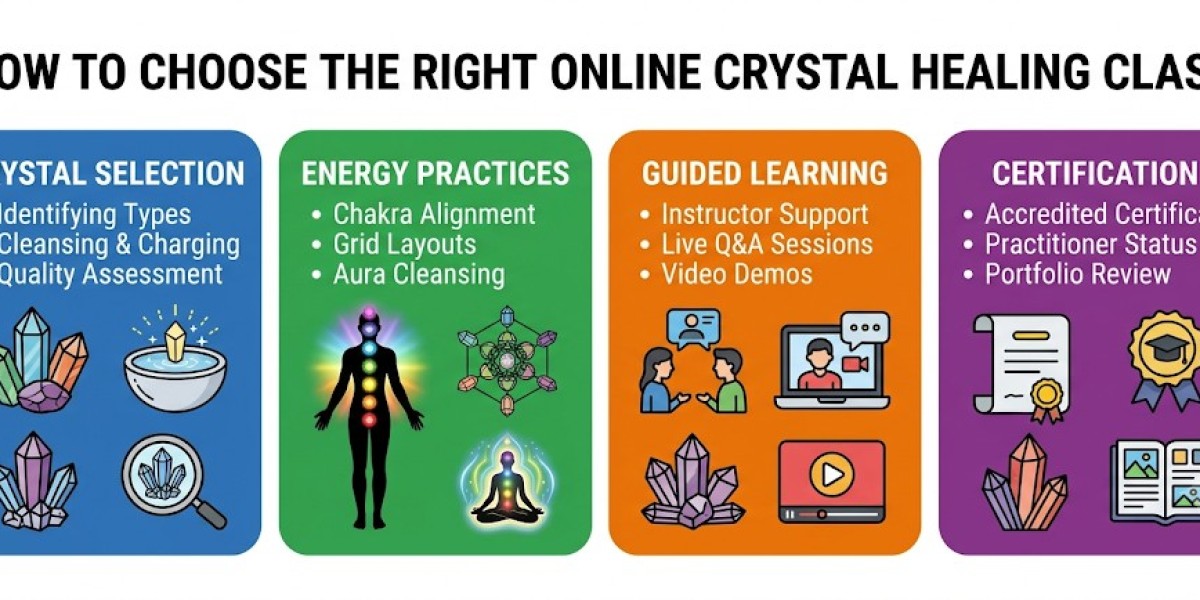


Crystal Healing Classes Online: How to Choose the Right Course for Crystal Selection, Energy Practices and Guided Learning
Interest in crystals, meditation and traditional energy practices has encouraged many learners to explore crystal healing as a subject of spiritual and holistic education. From understanding different types of crystals to learning about their traditional associations and uses, beginners often look for structured guidance before choosing a training programme. Online education has made this learning journey more accessible, allowing students to explore different subjects without travelling to a physical classroom.
However, selecting the right programme requires more than searching for crystal healing classes and comparing course titles. Learners should understand what the curriculum covers, how crystal selection is taught, whether practical demonstrations are included, what type of certification is offered and how instructors guide students throughout the learning process.
A structured crystal healing course can introduce learners to traditional crystal concepts, common crystal varieties, cleansing practices, placement techniques and meditation-related exercises. The right learning experience should also explain the limitations of these practices and encourage responsible understanding rather than making unsupported claims.
Whether you are a beginner, a holistic wellness enthusiast or someone interested in exploring traditional spiritual subjects, comparing available programmes can help you make an informed decision.
The Indian Institute of Vedic Science (IIVS) offers educational programmes in Vedic sciences and related learning areas. This guide explains the important factors to consider when evaluating online crystal healing education, including curriculum, certification, practical learning and course selection.
What Are Crystal Healing Classes Online?
Crystal healing is a traditional spiritual and complementary wellness practice involving the use of crystals and gemstones in activities such as meditation, intention-setting and symbolic energy practices. Different traditions associate particular crystals with specific meanings and qualities.
For example, rose quartz is commonly associated with love and compassion, amethyst with calmness and spiritual awareness, and clear quartz with clarity and intention. These associations come from traditional and spiritual belief systems. They should not be interpreted as scientifically established medical effects.
Crystal healing classes introduce learners to these concepts in a structured way. Instead of collecting information from unrelated online sources, students can follow a planned curriculum and understand how different ideas and practices are connected.
Depending on the programme, classes may introduce:
The traditional background of crystal healing.
Different types of crystals and gemstones.
Crystal identification and selection.
Traditional cleansing and charging concepts.
Crystal placement and arrangement techniques.
Meditation and intention-setting practices.
Basic crystal care and storage.
Practical demonstrations and guided exercises.
Ethical considerations and responsible communication.
The teaching approach and depth of these topics vary between institutions. Reviewing the syllabus before enrolling is therefore essential.
Why Choose Crystal Healing Courses Online?
Online education provides flexibility for people who want to explore a new subject while managing work, studies or other responsibilities. Students can access lessons from different locations and may be able to choose between live sessions, recorded lessons or self-paced learning.
Here are some reasons learners consider crystal healing courses online.
1. Flexible Learning Schedule
Online classes can make it easier to organise learning around personal and professional commitments. Depending on the institution, students may attend scheduled live sessions or access recorded material.
Before enrolling, check the class timings, availability of recordings and the process for asking questions.
2. Structured Learning for Beginners
Beginners may find it difficult to understand crystal terminology, traditional associations and different practices through scattered information. A planned curriculum can introduce foundational concepts before moving towards more detailed topics.
This helps students build an organised understanding of the subject.
3. Guided Demonstrations
Crystal selection and handling are easier to understand when learners can observe demonstrations. An instructor may explain how to identify commonly discussed stones, understand their physical characteristics and follow traditional practices.
Demonstrations also give students an opportunity to clarify doubts about individual techniques.
4. Learning From Any Location
Online learning allows students to explore a programme without relocating. This can be useful for learners from different cities who are interested in specialised subjects.
5. Opportunity to Explore Related Subjects
Some learners interested in crystal practices also explore meditation, Vedic sciences and other traditional disciplines. Online education can provide an accessible way to compare different learning opportunities.
However, each subject should be studied according to its own concepts and curriculum.
What Should You Learn in a Crystal Healing Course?
The curriculum is one of the most important factors when comparing courses on crystal healing. A good educational programme should explain its learning objectives, introduce relevant concepts and provide opportunities to understand techniques through demonstrations or guided exercises.
The following topics are useful areas to look for when evaluating a programme.
1. Introduction to Crystal Healing
A beginner-friendly course should explain what crystal healing means within traditional and spiritual practices.
Students may explore:
The historical and cultural background of crystals.
Common crystal healing terminology.
The role of gemstones in traditional practices.
Different interpretations of crystal-related energy concepts.
The distinction between spiritual beliefs and scientific evidence.
This foundation helps learners understand the subject in its appropriate context.
2. Crystal Identification and Selection
Crystal selection is an important part of learning about crystals. Students should understand that crystals differ in appearance, physical properties, composition and traditional associations.
A course may introduce commonly discussed stones such as:
Rose quartz.
Amethyst.
Clear quartz.
Citrine.
Black tourmaline.
Lapis lazuli.
Selenite.
Tiger's eye.
Green aventurine.
Learners may study their traditional names, common descriptions and symbolic meanings.
It is also useful to understand the difference between natural stones, treated stones, synthetic materials and imitations. A responsible programme should avoid presenting every attractive stone as a genuine natural crystal.
3. Traditional Crystal Associations
Different spiritual traditions connect crystals with different symbolic qualities. For example, some associate rose quartz with compassion, amethyst with spiritual awareness and citrine with positivity.
A curriculum may explain these traditional interpretations and how they are used in meditation or reflective exercises.
Students should understand that these associations are belief-based and do not establish that crystals can diagnose, prevent or treat medical conditions.
4. Crystal Cleansing and Charging Practices
Cleansing and charging are commonly discussed concepts in crystal-related traditions. Different practices describe different ways of preparing crystals for symbolic or spiritual use.
A course may cover:
Traditional cleansing methods.
Sound-based cleansing practices.
Moonlight and sunlight traditions.
Intention-based preparation.
Appropriate storage and handling.
Basic care requirements for different stones.
Physical care is especially important. Not all crystals are suitable for exposure to water, direct sunlight or other environmental conditions. Some stones can fade, dissolve, crack or become damaged. Learners should understand the care requirements of individual materials before applying any method.
5. Crystal Placement and Arrangement
Some traditional practices involve arranging crystals in particular patterns or placing them in specific spaces.
Students may be introduced to crystal grids, symbolic arrangements and placement concepts. Demonstrations can help learners understand the sequence and purpose of different arrangements within the relevant tradition.
6. Meditation and Intention-Setting
Crystal-related meditation practices may involve using a stone as a symbolic object while focusing attention or setting an intention.
A curriculum may include:
Preparing a quiet space.
Basic meditation techniques.
Intention-setting exercises.
Focus and observation.
Guided reflection.
Journaling and personal practice.
These exercises should be understood as spiritual or reflective activities rather than proven medical treatments.
7. Practical Exercises and Guided Learning
A programme should ideally explain how students can practise the concepts introduced during lessons.
Practical learning may include crystal identification, handling demonstrations, traditional arrangements, storage guidance and guided meditation exercises.
Ask whether these activities are instructor-led, self-directed or supported by feedback.
How to Choose the Right Crystal Healing Certification Course
Certification is an important consideration for learners who want documented evidence of course completion. However, not every certificate has the same purpose, recognition or scope.
Before selecting a crystal healing certification course, review the following factors.
1. Check the Complete Curriculum
The course provider should explain the topics included in the programme. Look for a syllabus that covers foundational concepts, crystal selection, traditional practices and appropriate practical activities.
If the syllabus is unavailable, request it before enrolling.
2. Understand the Certification Process
Ask how the certificate is awarded. Some programmes may provide a certificate after completing lessons, while others may include assignments, attendance requirements or assessments.
Understand what the certificate confirms and whether it represents course participation, successful completion or assessed learning.
3. Evaluate Practical Learning
A useful programme should explain how practical activities are organised. Check whether students receive demonstrations, exercises, assignments or opportunities to discuss their practice with an instructor.
4. Review Instructor Support
Students may have questions about crystal identification, traditional associations and the correct context of different techniques. A clear doubt-resolution process can improve the learning experience.
5. Verify Recognition and Scope
Do not assume that a certificate is equivalent to a government-recognised academic qualification, professional licence or healthcare credential.
Ask the institution to clarify the certificate's issuing authority, nature and scope. Completion of a crystal healing programme does not authorise someone to diagnose or treat medical conditions.
What Is Crystal Healing Certification Online?
A crystal healing certification online programme allows learners to study the subject through an online teaching format. Depending on the provider, this may involve live classes, recorded sessions, study material and guided demonstrations.
When comparing online certification options, consider the following:
Whether lessons are live or recorded.
Whether students can interact with instructors.
Whether the programme includes demonstrations.
Whether learning material is provided.
Whether assignments or assessments are required.
How the certificate is issued.
Whether students can clarify doubts after classes.
Online certification can be convenient, but the learning experience depends on the actual programme structure. A clear curriculum and accessible teaching support are more useful indicators than promotional claims alone.
Crystal Healing Diploma: Is a Longer Programme Better?
A crystal healing diploma may be considered by learners who want to explore a broader range of concepts in a structured educational format.
A diploma-style programme may cover more topics than a short introductory course, depending on the institution. However, a longer duration does not automatically mean better educational quality.
Before selecting a diploma programme, compare its learning objectives and syllabus.
A broader programme may include:
Foundational Learning
Students may study basic crystal terminology, common varieties, traditional associations and the background of crystal-related practices.
Crystal Selection and Identification
This area may introduce different stones, their physical characteristics and traditional symbolic meanings.
Traditional Energy Practices
Students may explore cleansing concepts, crystal arrangements, meditation and intention-setting activities within the relevant spiritual traditions.
Practical Demonstrations
Demonstrations can help learners understand the steps involved in different activities and clarify questions about their application.
Responsible Practice
A good programme should explain ethical communication, limitations of traditional practices and the importance of avoiding unsupported health claims.
Compare these learning areas with the actual course outline rather than assuming that every diploma covers the same subjects.
How Important Is Guided Learning in Crystal Healing?
Guided learning can help students understand concepts more clearly, particularly when a subject includes traditional techniques and practical activities.
When comparing crystal healing classes, check whether the teaching approach provides opportunities for interaction and clarification.
Instructor-Led Demonstrations
Demonstrations can show students how to identify, handle and arrange crystals. They also provide an opportunity to observe the sequence of a particular activity.
Practice-Based Exercises
Students may be asked to practise basic identification, arrangement or meditation exercises. These activities help connect theoretical learning with practical understanding.
Doubt Resolution
A learner should be able to ask questions about the lessons and receive relevant explanations. Check whether doubt-clearing sessions or instructor interactions are included.
Learning Resources
Study notes, lesson recordings and reference materials can help students revise important concepts after class.
Feedback and Assessment
Assignments or guided practice reviews may help learners understand what they have learned and identify areas that require further study.
Common Mistakes to Avoid When Selecting Crystal Healing Courses
Before choosing a programme, consider these common mistakes.
1. Choosing Only on the Basis of Price
Course fees should be considered alongside curriculum quality, class format, practical activities and instructor support.
2. Ignoring Crystal Selection
A programme that discusses crystal meanings without explaining identification, physical properties and appropriate care may not provide the depth some learners expect.
3. Assuming Every Certificate Has Equal Value
Certification requirements and recognition vary. Verify the issuing institution and understand exactly what the certificate represents.
4. Believing Guaranteed Healing Claims
Be cautious of programmes that promise guaranteed medical, emotional or financial outcomes through crystals. Traditional spiritual practices should not be presented as substitutes for professional healthcare.
5. Not Checking the Online Format
Understand whether classes are live, recorded or self-paced. Also check whether students can ask questions and access learning resources.
6. Enrolling Without Reviewing the Syllabus
A clear syllabus helps you understand what you will actually study. Request the complete course outline before making a decision.
Who Can Consider Learning Crystal Healing?
A crystal healing programme may interest different types of learners.
Beginners Interested in Spiritual Learning
People who are new to crystals may want to understand their traditional meanings, varieties and common practices through an organised learning experience.
Holistic Wellness Enthusiasts
Individuals interested in meditation, reflective activities and traditional wellness concepts may explore crystal healing as a subject of personal learning.
Students Exploring Traditional Disciplines
Learners interested in Vedic sciences or other spiritual subjects may want to understand crystal-related traditions as a separate area of study.
Working Professionals
Online classes may be convenient for people who want to study alongside their existing professional commitments.
Individuals Interested in Further Education
Some learners may wish to explore additional subjects after completing introductory training. Their next course should be selected according to its curriculum and relevance to their learning goals.
Exploring Astrology Alongside Crystal Healing
People interested in spiritual and traditional subjects sometimes explore astrology as another area of learning. However, astrology is a separate discipline with its own terminology, concepts and methods.
If you are interested in astrology education, compare its curriculum independently rather than assuming that it is part of crystal healing training.
An astrology certificate course online may introduce learners to foundational astrology concepts, depending on the programme. Before enrolling, review the topics, teaching format and completion requirements.
For students seeking more extensive study, an astrology diploma course online may offer a broader curriculum. Compare the modules and practical learning opportunities rather than choosing based only on the course title.
An online astrology course with certificate may appeal to learners who want documented evidence of completing a programme. It is important to verify the certificate's issuing institution and understand its scope.
Students searching for the best astrology courses should compare syllabus depth, teaching quality, instructor guidance and opportunities for practical horoscope analysis.
Similarly, when evaluating the best astrology courses online, check whether the programme follows a structured progression from basic concepts to more advanced learning.
For learners comparing options across institutions, the best astrology courses in india online may differ in curriculum, teaching format, duration and certification requirements.
Those searching for the best online astrology courses in india should review the course structure and ask whether practical sessions and doubt-clearing support are included.
The best online astrology classes for a particular student are those that match their current knowledge, learning schedule and educational objectives.
If you are new to astrology, understanding the best online course for astrology requires checking whether it begins with foundational concepts and gradually introduces more detailed topics.
For beginners, the best way to learn astrology is generally to follow a structured learning path, understand the basic terminology and practise interpreting concepts under appropriate guidance.
Astrology and crystal healing should be treated as separate areas of study, each requiring its own curriculum and learning objectives.
Why Explore Learning Opportunities at IIVS?
Choosing an institution is an important part of beginning any educational journey. Students should look for transparent course information, an organised learning approach and a clear explanation of the programme's scope.
The Indian Institute of Vedic Science (IIVS) provides educational programmes across Vedic sciences and related learning areas. Learners interested in traditional and holistic subjects can explore the institute's available courses and request information about relevant programmes.
Before making an enrolment decision, consider asking about:
The complete course curriculum.
Online class format and schedule.
Course duration and learning requirements.
Crystal selection and practical demonstrations, where included.
Instructor interaction and doubt resolution.
Certification and completion requirements.
Course fees and available learning support.
Conclusion: Choose the Right Crystal Healing Classes for Structured Learning
Selecting the right programme involves more than finding a course title that matches your interests. Learners should compare the curriculum, crystal selection topics, traditional energy practices, practical demonstrations, instructor support and certification requirements.
Whether you are exploring introductory crystal healing classes, comparing crystal healing courses online or considering a diploma-style programme, focus on the actual learning experience and the transparency of the institution.
A structured programme should help you understand crystal varieties, traditional associations, appropriate handling and the context of different practices. It should also communicate the limitations of crystal-related beliefs and avoid unsupported promises.
The Indian Institute of Vedic Science (IIVS) can be a starting point for exploring educational opportunities in Vedic sciences and related subjects. Visit https://iivs.com/ to learn more about the institute and its available courses.
Ready to take the next step in your learning journey? Book your free counselling. Connect with the IIVS team, discuss your interests and understand the available course information before making your decision.
Frequently Asked Questions
1. What are crystal healing classes online?
Crystal healing classes are educational sessions that introduce learners to crystals, their traditional associations, selection, handling and common spiritual practices. Online classes may include live teaching, recorded lessons, demonstrations and guided exercises, depending on the institution.
2. Are crystal healing courses online suitable for beginners?
Yes, many crystal healing courses online are designed for beginners. Students should check whether the curriculum introduces basic terminology, crystal varieties and traditional concepts before moving towards more detailed techniques.
3. What topics are included in a crystal healing course?
A crystal healing course may cover crystal identification, traditional associations, cleansing concepts, placement techniques, meditation and practical demonstrations. The exact topics vary between providers, so reviewing the syllabus is important.
4. How do I choose the best crystal healing course?
To find the best crystal healing course, compare the syllabus, teaching format, practical exercises, instructor support, duration, fees and certification requirements. Choose a programme that matches your learning objectives and provides transparent course information.
5. What is included in a crystal healing certification course?
A crystal healing certification course may introduce common crystal types, traditional practices, handling methods, meditation-related exercises and practical demonstrations. Some programmes may also include assignments or assessments.
6. Can I get crystal healing certification online?
Yes, some institutions offer crystal healing certification online through live classes, recorded lessons or other online learning formats. Check the assessment process, practical learning opportunities and certificate details before enrolling.
7. What is the difference between a crystal healing diploma and certification?
A crystal healing diploma may offer a broader curriculum than a shorter certification programme, depending on the provider. However, the actual difference depends on the syllabus, duration, assessments and completion requirements. Compare the course content rather than relying only on the title.
8. What should I check before enrolling in courses on crystal healing?
When comparing courses on crystal healing, review the curriculum, crystal selection topics, practical demonstrations, instructor guidance, course schedule and certification details. Also ask about the scope of the certificate and the support available to students.
9. How important is practical training in crystal healing?
Practical training can help students understand crystal identification, handling, storage and traditional arrangements through demonstrations and exercises. Ask whether the course includes instructor-led activities or opportunities to receive feedback.
10. Can crystal healing replace medical treatment?
No. Crystal healing is associated with traditional and spiritual practices. It is not a substitute for qualified medical diagnosis or treatment. Anyone with a health concern should consult an appropriate healthcare professional.
11. How do I know whether a crystal is suitable for a particular practice?
Students should understand the physical characteristics, care requirements and traditional associations of different stones. The selection process may depend on the particular activity and the tradition being studied. A course should explain these factors without making unsupported claims.
12. Can I study crystal healing while working full-time?
Yes, online learning may provide flexibility for working professionals. Before enrolling, check class timings, session recordings, assignments and the time required for practice.
13. Is astrology included in a crystal healing course?
Not necessarily. Crystal healing and astrology are separate subjects. Some institutions may offer both as independent programmes, but learners should check the syllabus to understand exactly what each course includes.
14. How can I choose an astrology course with certification?
Compare the curriculum, instructor guidance, practical exercises, teaching format and certification requirements. An online programme should clearly explain what the certificate represents and how students complete the course.







