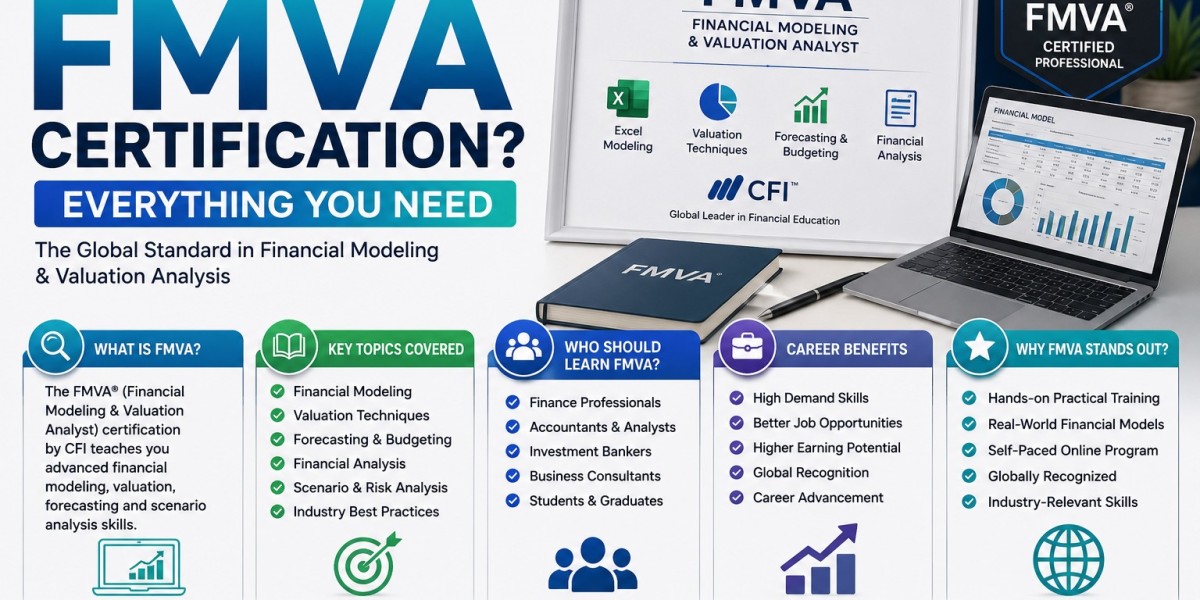


The Financial Modeling & Valuation Analyst (FMVA) certification is a professional credential designed for individuals who want to develop practical skills in financial modeling, business valuation, budgeting, forecasting, and financial analysis. Unlike qualifications that focus heavily on theory, FMVA emphasizes real-world applications that finance professionals use every day when making business and investment decisions.
As organizations increasingly rely on data-driven financial planning, professionals with strong analytical and modeling skills continue to be in demand. Whether you are a student planning your finance career, a recent graduate seeking your first analyst role, or an experienced professional looking to strengthen your expertise, FMVA can help you build practical knowledge that is useful across many industries.
This guide explains what the FMVA certification is, who should pursue it, the skills it develops, career opportunities, and how you can prepare successfully.
Understanding the FMVA Certification
FMVA is designed to teach professionals how financial models are built and used to support business decisions. The program combines accounting knowledge, corporate finance principles, valuation techniques, and spreadsheet modeling to help candidates analyze companies and forecast financial performance.
Rather than focusing only on calculations, the certification also develops problem-solving, analytical thinking, and decision-making skills. Candidates learn how financial information supports investment decisions, budgeting, mergers and acquisitions, and long-term business planning.
Because these skills are widely used across finance roles, the certification remains relevant for professionals working in many sectors.
Learn about FMVA Certification on Cert Mage YouTube.
What Will You Learn?
The certification curriculum covers a broad range of practical finance topics.
Common learning areas include:
Financial statement analysis
Financial modeling
Business valuation
Budgeting
Forecasting
Cash flow analysis
Scenario and sensitivity analysis
Microsoft Excel for finance
Corporate finance concepts
Presentation of financial insights
The goal is to prepare candidates to solve real business problems using structured financial analysis rather than memorizing formulas alone.
Key Skills Developed
FMVA focuses on building practical workplace skills that finance professionals regularly use.
Skill | How It Helps |
Financial Modeling | Build business and forecasting models |
Valuation | Estimate company and investment value |
Financial Analysis | Interpret financial performance |
Budgeting | Support business planning |
Forecasting | Predict future financial outcomes |
Excel Skills | Improve efficiency in financial work |
These competencies are useful across corporate finance, investment analysis, consulting, and business planning roles.
Who Should Pursue FMVA?
The certification is suitable for a wide range of learners.
It is particularly valuable for:
Finance students
Recent graduates
Financial analysts
Investment banking professionals
Corporate finance teams
FP&A professionals
Accountants
Business analysts
Professionals changing careers into finance
Although prior finance knowledge can be helpful, many candidates begin the certification to strengthen their practical understanding before moving into more advanced finance positions.
Career Opportunities
Financial modeling is an essential skill in many industries.
Professionals with FMVA knowledge commonly pursue roles such as:
Financial Analyst
Corporate Finance Analyst
FP&A Analyst
Investment Banking Analyst
Equity Research Analyst
Business Analyst
Treasury Analyst
Financial Consultant
Because organizations of all sizes require financial planning and analysis, these skills remain useful across banking, manufacturing, consulting, healthcare, technology, and other sectors.
Benefits of the Certification
Earning the certification can provide several professional advantages.
Some of the most important benefits include:
Develops practical finance skills
Improves analytical thinking
Strengthens Excel proficiency
Enhances professional credibility
Supports career development
Builds confidence in financial decision-making
Provides structured learning
The certification can also help professionals demonstrate their commitment to continuous learning when applying for finance-related positions.
Is FMVA Difficult?
The level of difficulty depends largely on your background.
Candidates with accounting or finance education may already understand many of the underlying concepts. Beginners may require additional study time to become familiar with financial statements, valuation methods, and spreadsheet modeling.
The practical nature of the certification means regular practice is often more valuable than simply reading study materials. Building financial models repeatedly helps reinforce learning and improves confidence.
A consistent study schedule usually produces better results than trying to complete the program quickly.
How to Prepare Successfully
Successful preparation begins with understanding the complete curriculum before creating a study plan.
Study one topic at a time and apply new concepts through practical exercises. Rebuilding financial models, reviewing case studies, and practicing forecasting techniques help develop stronger analytical skills.
Regular revision is equally important because many concepts build upon one another throughout the program.
Many candidates also strengthen their preparation using structured study resources, practice exercises, and mock assessments available through Cert Mage alongside their regular learning plan.
Looking Ahead
Demand for professionals with financial modeling and valuation skills is expected to remain strong as organizations continue relying on financial forecasting, investment analysis, and business planning.
While automation and artificial intelligence are transforming finance, professionals who can interpret financial data, evaluate business performance, and communicate strategic recommendations will continue to play an important role.
Developing practical financial expertise alongside certification helps prepare candidates for long-term career growth.
Conclusion
The FMVA certification is an excellent choice for professionals who want to build practical financial modeling, valuation, and analytical skills. It provides structured learning that supports careers across corporate finance, investment banking, business analysis, and financial planning.
Although certification alone does not guarantee employment, combining FMVA with practical experience, continuous learning, and strong analytical abilities can significantly strengthen your professional profile and prepare you for future opportunities in the finance industry.
FAQs
What is the primary purpose of the FMVA certification?
The FMVA certification develops practical financial modeling, valuation, forecasting, and analytical skills that help professionals make informed business decisions and support corporate finance, investment, and planning activities.
Is FMVA suitable for students?
Yes. Students interested in finance, accounting, investment banking, or corporate finance can use FMVA to develop practical workplace skills before beginning their professional careers.
Do I need prior finance experience to earn FMVA?
No. Although basic accounting knowledge is helpful, motivated beginners can complete the certification by following a structured study plan and practicing financial modeling regularly.
What careers can FMVA support?
FMVA supports careers in financial analysis, corporate finance, investment banking, equity research, financial planning and analysis, consulting, and other business roles requiring financial modeling expertise.
Is FMVA worth pursuing in 2026?
Yes. Financial modeling, valuation, and forecasting remain valuable skills across many industries, making FMVA a worthwhile certification for professionals seeking long-term growth in finance-related careers.
Learn More: https://thewion.com/read-blog/228152