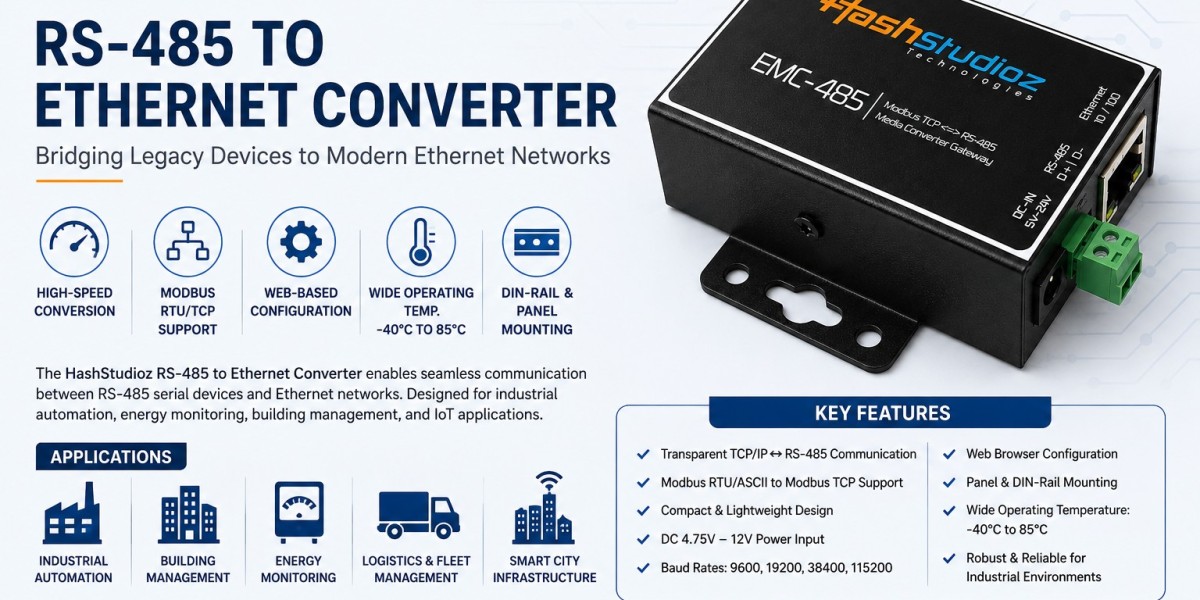


Industrial environments often rely on legacy equipment such as PLCs, energy meters, sensors, controllers, and other RS-485-based devices. While these systems are reliable, connecting them to modern IP networks can be challenging. An RS-485 to Ethernet Converter provides a practical solution by creating a communication bridge between RS-485 serial devices and Ethernet networks.
The RS-485 to Ethernet Converter is designed to provide reliable and cost-effective connectivity for industrial automation, building management, energy monitoring, logistics, and smart city applications. The device supports transparent RS-485-to-TCP/IP communication and is designed for integration into existing industrial infrastructure.
What Is an RS-485 to Ethernet Converter
An RS-485 to Ethernet Converter is a communication device that connects equipment using the RS-485 serial interface to an Ethernet/IP network. Instead of replacing existing serial equipment, organizations can use the converter to make these devices accessible through a network.
For example, a PLC communicating through RS-485 can be connected to an Ethernet network through the converter. Data can then travel between the serial device and network-based applications without requiring major changes to the existing equipment.
This makes the technology particularly useful for industrial modernization and IoT projects.
Why Is RS-485 Connectivity Still Important
RS-485 remains widely used in industrial communication because it is suitable for reliable communication between devices and can work effectively in demanding environments.
Many industrial machines and field devices already use RS-485 interfaces. Replacing these devices simply to introduce Ethernet connectivity can be expensive and disruptive.
An RS-485 to Ethernet converter helps organizations extend the useful life of existing equipment while integrating it into modern network infrastructure.
How Does an RS-485 to Ethernet Converter Work?
The basic communication process is straightforward:
RS-485 Device → RS-485 Interface → Converter → Ethernet/TCP-IP Network → Monitoring or Control Application
The converter receives serial data from an RS-485 device and transfers it through an Ethernet connection. Network data can similarly be converted back into RS-485 communication for the connected field device.
The converter supports transparent TCP/IP ↔ RS-485 communication and can be configured through a web browser.
Key Features of the RS-485 to Ethernet Converter
1. High-Speed Serial-to-Ethernet Conversion
The device enables transparent communication between RS-485 equipment and Ethernet networks, helping industrial systems exchange data efficiently.
2. Modbus Compatibility
The converter supports Modbus RTU/ASCII to Modbus TCP communication, making it suitable for many industrial automation and monitoring environments.
3. Compact and Lightweight Design
Its compact form factor makes it easier to integrate into existing control panels and industrial installations. The product page also specifies suitability for panel and DIN-rail mounting.
4. Flexible Power Input
The converter operates on DC 4.75–12V, providing flexibility for different installation environments and power arrangements.
5. Wide Operating Temperature Range
The specified operating temperature range is -40°C to 85°C, making the device suitable for a variety of industrial environments.
6. Web-Based Configuration
Configuration can be performed through a web browser, simplifying setup and management without requiring specialized configuration software.
Applications of RS-485 to Ethernet Converters
Industrial Automation
Factories often use PLCs, HMIs, controllers, and industrial instruments that communicate through serial interfaces. An RS-485 to Ethernet converter can connect these devices to an Ethernet-based control or monitoring infrastructure.
Building Management Systems
Building automation systems can use the converter to connect HVAC controllers, lighting systems, access control equipment, and other RS-485 devices to an IP network.
Energy Monitoring
Energy meters and monitoring equipment can be integrated into centralized Ethernet networks, helping organizations collect and manage energy-related data.
Logistics and Fleet Management
RS-485-connected monitoring equipment can be connected to network infrastructure for centralized data collection and operational monitoring.
Smart City Infrastructure
Smart city deployments often involve distributed sensors, meters, controllers, and connected utilities. RS-485-to-Ethernet connectivity can help integrate these field devices into larger IP-based systems.










