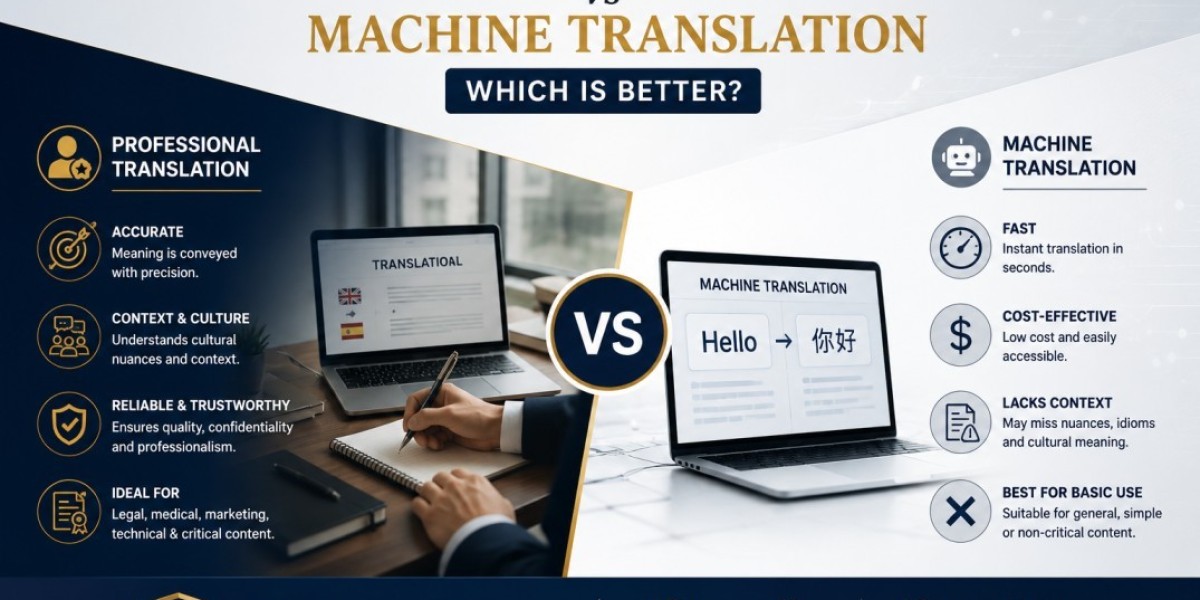


Translation has become an essential part of global communication. Businesses, students, professionals, and organizations regularly need to communicate across different languages. With the growth of artificial intelligence, machine translation tools have made translation faster and more accessible than ever.
However, machine translation is not always the best choice for every type of content. Professional human translation continues to play an important role when accuracy, context, cultural sensitivity, and confidentiality matter.
So, which is better: professional translation or machine translation? The answer depends on the purpose, complexity, and importance of the content.
What Is Machine Translation?
Machine translation uses software, artificial intelligence, and language-processing technologies to convert text from one language into another.
Popular online tools can translate sentences, websites, emails, and short documents within seconds. This makes machine translation useful when someone needs to understand the general meaning of content quickly.
For example, machine translation can be helpful for:
- Understanding a foreign-language website
- Translating simple messages
- Getting the general meaning of an email
- Translating informal content
- Quickly processing large amounts of basic text
However, speed does not always mean accuracy.
What Is Professional Human Translation?
Professional translation is performed by skilled translators who understand both the source and target languages. Unlike automated systems, professional translators can evaluate context, terminology, tone, cultural meaning, and the purpose of the content.
For important documents, working with a professional translation provider can help maintain the original meaning while adapting the content appropriately for the target audience.
Companies such as Honey Translations provide human-powered translation services designed around accuracy, cultural relevance, and professional requirements. Their services include document translation, certified translation, localization, and website translation.
Professional Translation vs Machine Translation
1. Accuracy
Machine translation can produce impressive results for common phrases and straightforward sentences. However, it can struggle with complex terminology, unusual sentence structures, and words that have multiple meanings.
Professional translators can understand the complete context and choose terminology that accurately reflects the intended meaning.
This is particularly important for legal, medical, technical, academic, and business documents.
2. Cultural Context
Language is more than simply replacing words from one language with words from another.
Expressions, humor, idioms, cultural references, and communication styles can vary significantly between countries and communities.
A professional translator can adapt content according to the cultural expectations of the target audience. This process is particularly valuable for marketing campaigns, websites, advertisements, and international business communication.
3. Legal and Official Documents
Official documents often require a high level of accuracy. A small translation mistake could create confusion or cause delays during an application or documentation process.
Documents such as certificates, contracts, academic records, immigration documents, and legal paperwork may require professional or certified translation depending on the receiving authority.
Professional translation providers may also offer certification, notarization, or apostille-related support where applicable.
4. Speed
One major advantage of machine translation is speed.
A machine can translate thousands of words within a very short period. This makes it useful when someone needs a quick understanding of large amounts of content.
Professional translation usually takes more time because a translator needs to review the source material, translate it, and potentially proofread or edit the final version.
For important content, however, accuracy is often more valuable than simply receiving a translation quickly.
5. Consistency
Machine translation can provide consistent terminology when properly configured, but it may still interpret the same term differently depending on the surrounding context.
Professional translators can maintain terminology throughout a project by using glossaries, style guides, and translation memories.
This is especially useful for businesses that regularly translate product information, technical documentation, websites, and marketing materials.
6. Confidentiality
Confidentiality can be an important consideration when translating sensitive documents.
Businesses and individuals may handle contracts, financial documents, personal certificates, employment records, or other private information.
When choosing a translation provider, it is important to understand how documents are handled and what confidentiality measures are in place.
When Should You Use Machine Translation?
Machine translation can be a practical option when accuracy is not mission-critical.
It may work well for:
- Casual conversations
- Simple internal messages
- General research
- Understanding foreign-language content
- Rough drafts
- Informal communication
For these situations, convenience and speed may be the most important factors.
When Should You Choose Professional Translation?
Professional translation is generally a better choice when the content has legal, financial, academic, medical, business, or reputational importance.
Consider professional translation for:
- Legal documents
- Academic certificates and transcripts
- Immigration documents
- Business contracts
- Medical documents
- Technical manuals
- Websites
- Marketing campaigns
- Official certificates
- International business communication
For documents that require certification or official acceptance, professional translation is especially important. Honey Translations offers certified translation services alongside other translation solutions for different personal and business requirements.
Can Businesses Use Both?
Yes. Businesses do not necessarily have to choose only one method.
A practical approach can be to use machine translation for low-risk, high-volume content and professional translators for important or customer-facing material.
For example, an organization might use machine translation to understand an incoming email quickly, while using a professional translator for a legal agreement or website that will be published publicly.
This combination can help businesses balance speed, cost, and quality.
Final Thoughts
Machine translation has made multilingual communication faster and more accessible. It can be extremely useful for simple, informal, and low-risk content.
However, professional human translation remains important when accuracy, cultural understanding, terminology, confidentiality, and official requirements matter.
The best choice depends on the content and its purpose. For everyday communication, machine translation may be sufficient. For important documents and professional communication, working with an experienced human translation provider can provide greater confidence and accuracy.
When the meaning of your words really matters, choosing the right translation approach can make a significant difference.








