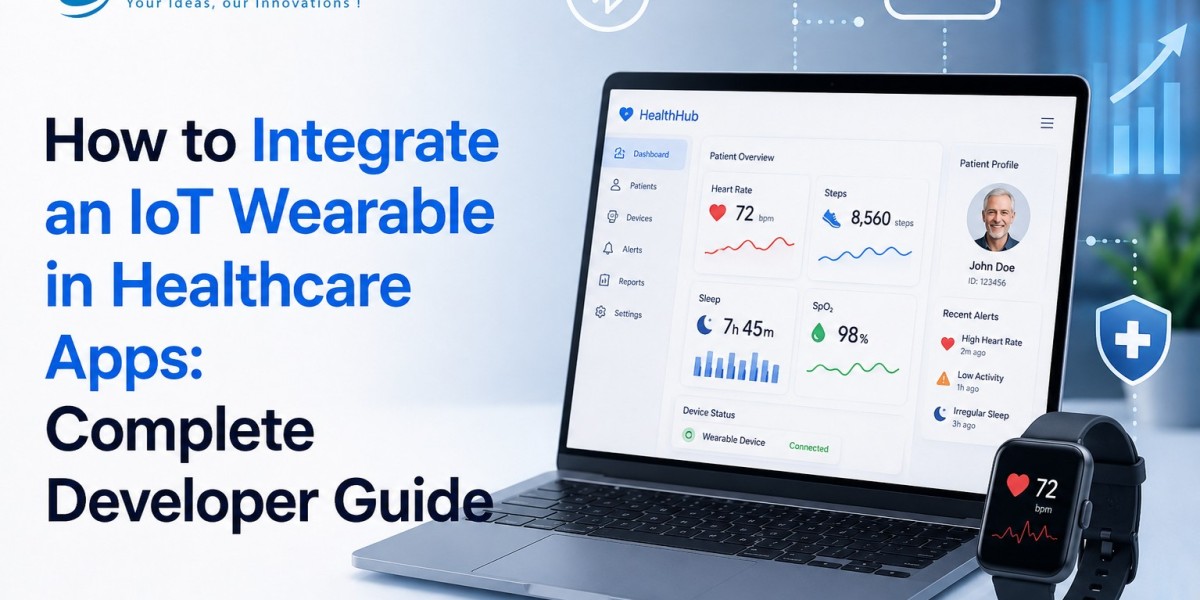


IoT wearables are changing how healthcare applications collect and use patient data. Smartwatches, fitness trackers, medical sensors, and connected monitoring devices can continuously capture information such as heart rate, blood oxygen levels, sleep patterns, activity, and temperature. When integrated with a healthcare app, this data can support remote patient monitoring, chronic disease management, preventive care, and personalized health services.
However, connecting a wearable to an app is more than pairing a Bluetooth device. Developers need to consider device compatibility, APIs, data synchronization, backend architecture, security, interoperability, and healthcare regulations. This guide explains how to integrate an IoT wearable with a healthcare app, the technologies involved, common challenges, and the best practices to follow in 2026.
What Is IoT Wearable Integration in Healthcare Apps?
IoT wearable integration connects wearable devices with a healthcare application's mobile, backend, and data infrastructure, allowing health information to be collected, transferred, processed, and presented to patients or healthcare professionals. This is one of the practical applications of IoT in the healthcare industry, where connected devices help support continuous health monitoring and more data-driven care.
A typical architecture looks like this:
Wearable Device → Connectivity Layer → Mobile App → API/Backend → Cloud → Healthcare System
The wearable collects data through built-in sensors. The mobile application receives the information through technologies such as Bluetooth Low Energy (BLE), while APIs transfer relevant data to backend systems. The backend can then store, process, analyze, and synchronize the information with healthcare dashboards or electronic health record (EHR) systems.
The complexity depends on the use case. A wellness application that tracks daily steps is relatively straightforward, while a remote patient monitoring solution that processes continuous vital-sign data requires significantly stronger infrastructure, validation, security, and regulatory controls.
Common examples include:
Smartwatches
Fitness trackers
Continuous glucose monitors
ECG-enabled devices
Pulse oximeters
Blood-pressure monitors
Smart patches
Connected medical sensors
What Data Can Healthcare Apps Collect From IoT Wearables?
The type of information collected depends on the wearable's sensors and intended healthcare use case.
Vital Health Data
Healthcare wearables can capture metrics such as:
Heart rate
Blood oxygen saturation (SpO2)
Body temperature
Blood pressure, where supported
Respiratory rate
Electrocardiogram (ECG), on supported devices
These measurements can help create a continuous picture of a patient's health rather than relying only on occasional clinical visits.
Activity and Behavioral Data
Wearables can also track:
Steps and movement
Physical activity
Sleep duration and patterns
Calories and energy expenditure
Exercise sessions
Falls and unusual movement
Why Data Context Matters
Raw sensor readings are not automatically clinically meaningful. Applications should associate measurements with timestamps, device information, measurement conditions, and other relevant context. Data validation and normalization are particularly important when information from multiple wearable manufacturers is combined.
How to Integrate an IoT Wearable With a Healthcare App
A structured integration process helps avoid compatibility, security, and scalability problems later.
1. Define the Healthcare Use Case
Start by identifying exactly what the wearable needs to accomplish.
Common use cases include:
Remote patient monitoring
Chronic disease management
Elderly care
Post-treatment monitoring
Fitness and wellness
Preventive healthcare
The use case determines which sensors are required, how frequently data should be collected, how quickly it needs to be processed, and whether clinical systems need access to it.
2. Select the Right Wearable
Choose the device based on the required health metrics rather than popularity alone.
Consider:
Available sensors
Data accuracy
Supported operating systems
API and SDK availability
Battery life
Connectivity options
Manufacturer support
Regulatory status, where applicable
For clinical applications, developers should also determine whether the device is appropriate for the intended medical purpose.
3. Choose the Connectivity Method
Bluetooth Low Energy is commonly used for short-range communication between wearables and smartphones because it can transfer data while consuming relatively little power.
Other options include Wi-Fi and cellular connectivity. The right choice depends on whether the wearable needs direct internet access, how frequently data must be transmitted, and whether the device needs to operate independently from a smartphone.
Connectivity should also account for interruptions. A healthcare app should not assume that a wearable will remain continuously connected.
4. Integrate APIs and SDKs
Wearable manufacturers often provide APIs or software development kits that allow applications to access device data.
The integration layer should handle:
Authentication
Permission management
Device pairing
Data retrieval
Data synchronization
API errors
Version changes
Developers should avoid tightly coupling the entire application to one manufacturer's API when supporting multiple wearable ecosystems is part of the product roadmap.
5. Build the Data Processing Layer
Once data reaches the application, it needs to be processed before it becomes useful.
The processing layer can perform:
Data ingestion
Validation
Normalization
Duplicate detection
Unit conversion
Timestamp management
Data filtering
Real-time processing
For example, heart-rate data from two different devices may use different formats or measurement intervals. Normalizing the data allows the application to present it consistently.
6. Connect the Backend and Healthcare Systems
The backend acts as the central layer between wearable data and healthcare workflows.
It can manage:
Patient profiles
Device records
Health measurements
Alerts
Data history
User permissions
Analytics
Where appropriate, the application can connect with EHR and EMR platforms through healthcare APIs and standards such as FHIR. This enables relevant wearable information to become part of a broader healthcare data ecosystem.
7. Test and Deploy
Testing should cover both normal and failure scenarios.
Developers should test:
Device pairing
Data accuracy
API failures
Bluetooth disconnections
Offline synchronization
Battery consumption
Background data collection
Security
Multiple device models
Android and iOS compatibility
Testing with only one wearable model is not enough if the application is intended to support a broader device ecosystem.
Key Technologies Used for IoT Wearable Integration
Several technologies typically work together in a connected healthcare application.
BLE: Enables low-power communication between wearable devices and smartphones.
APIs and SDKs: Provide access to device and health-platform data.
Cloud infrastructure: Supports scalable data storage, processing, and application services.
Real-time databases: Help synchronize frequently changing health information.
FHIR: Provides standardized structures for exchanging healthcare information between systems.
Encryption: Protects sensitive data during transmission and storage.
AI and machine learning: Can identify patterns in large datasets and support predictive analytics.
Push notifications: Enable applications to send reminders, alerts, and other time-sensitive information.
The technology stack should be selected around the healthcare use case rather than adding technologies simply because they are currently popular.
How to Secure IoT Wearable Health Data
Wearable applications handle potentially sensitive information, making security a core architectural requirement.
Data Encryption
Health data should be encrypted both during transmission and when stored. Secure communication protocols help protect information moving between the wearable, mobile application, APIs, and backend infrastructure.
Authentication and Access Control
Applications should use strong authentication mechanisms and role-based access controls. A patient, clinician, administrator, and support user should not automatically receive the same level of access.
Device authentication is also important because unauthorized devices should not be able to inject or retrieve patient information.
API Security
APIs connecting wearable platforms with healthcare applications should use secure authentication, authorization, validation, and monitoring mechanisms. Rate limiting and appropriate logging can help reduce abuse and improve visibility into suspicious activity.
Consent and Data Privacy
Users should understand what information is collected, why it is collected, and who can access it. Applications should collect only the data necessary for the intended purpose and provide appropriate controls for data sharing and permissions.
Healthcare Compliance Requirements
Compliance requirements depend on the application's business model, location, users, data flows, and intended functionality.
HIPAA
HIPAA may apply when healthcare applications handle protected health information within covered healthcare relationships. Developers need to understand whether the application owner or service provider falls within HIPAA's scope and whether business associate obligations apply.
GDPR and Regional Privacy Regulations
Applications operating in jurisdictions covered by GDPR or similar privacy frameworks need to consider requirements around consent, transparency, data access, deletion, processing, and storage.
Medical Device Considerations
An important distinction is whether a wearable application simply displays wellness information or uses data for diagnosis, treatment, or clinical decision-making. Medical functionality can introduce additional regulatory requirements, so regulatory assessment should happen early in development rather than after the product has been built.
Best Practices for Building an IoT-Enabled Healthcare App
Follow these practices to create a more reliable wearable integration:
Define the healthcare use case before selecting devices.
Choose wearables based on required sensors and data quality.
Use standardized healthcare data formats where possible.
Design for intermittent connectivity.
Validate and normalize incoming data.
Separate wearable, application, and clinical data layers.
Apply security controls throughout the architecture.
Minimize unnecessary data collection.
Test across multiple devices and operating systems.
Build APIs and backend services for scalability.
Provide transparent patient controls for data sharing.
Monitor integrations after deployment for API and device changes.
How Much Does IoT Wearable Integration Cost?
The cost of integrating an IoT wearable with a healthcare app typically ranges from $30,000 to $150,000+, depending on the complexity of the wearable ecosystem, healthcare functionality, integrations, and compliance requirements. A basic wearable integration can cost significantly less than a multi-device healthcare platform with real-time monitoring and clinical system integration.
The major factors affecting the development cost include:
Number and type of supported devices: Supporting multiple wearable brands and device types increases development and testing requirements.
API and SDK complexity: Custom or complex device APIs can require additional integration work.
iOS and Android support: Building and testing integrations across both platforms can increase development effort.
Backend architecture: Scalable infrastructure is required to process and store continuous wearable data.
Real-time processing: Live monitoring, alerts, and continuous data synchronization require additional infrastructure.
EHR/FHIR integration: Connecting wearable data with healthcare systems adds integration and interoperability requirements.
Security and compliance: Encryption, authentication, privacy controls, and HIPAA-related requirements can increase development costs.
AI functionality: Predictive analytics, anomaly detection, and personalized health insights require additional development expertise.
Testing and ongoing maintenance: Device compatibility testing, API updates, bug fixes, and post-launch support contribute to the overall investment.
For example, a basic wellness tracker integration may cost around $30,000–$50,000, while a multi-device remote patient monitoring platform with real-time data, EHR integration, advanced security, and AI capabilities can exceed $150,000.
Conclusion
Integrating an IoT wearable into a healthcare app requires much more than connecting a device and displaying sensor readings. Developers need a reliable architecture for connectivity, data processing, security, interoperability, compliance, and scalability. The right approach starts with a clearly defined healthcare use case and selects devices and technologies around that requirement, which is often where working with an established healthcare app development company makes the biggest difference.
EmizenTech brings 12+ years of experience in healthcare app development, helping organizations build secure, scalable, and user-focused digital healthcare applications with connected technologies.
FAQs
How do I connect an IoT wearable to a healthcare app?
Most integrations use Bluetooth Low Energy, manufacturer APIs, SDKs, or health-platform APIs to transfer wearable data to a mobile application and backend system.
Which APIs are used for healthcare wearable integration?
The appropriate API depends on the wearable and ecosystem. Developers may use manufacturer APIs, mobile health APIs, cloud APIs, and healthcare interoperability APIs such as FHIR-based services.
Is wearable health data HIPAA compliant?
HIPAA applicability depends on the organizations involved, the type of information handled, and the nature of the healthcare relationship. A wearable itself does not automatically make an application HIPAA compliant.
Can wearable data be integrated with an EHR?
Yes. Where the EHR supports appropriate interoperability capabilities, wearable data can be transferred through APIs and standardized healthcare data models such as FHIR.
How much does IoT wearable integration cost?
Cost depends on device support, platform complexity, backend requirements, security, compliance, EHR integration, and the level of real-time processing required.






