

Compliance can easily become associated with deadlines. A review is scheduled. Documents are collected. Policies are checked. Evidence is organized. Outstanding issues are addressed. A report is completed.
Then everyone moves on. The problem is that compliance obligations do not stop changing once the review is finished.
Regulations evolve. Business processes change. New technology is introduced. Employees take on new responsibilities. Vendors change how they deliver services. New products can introduce entirely different compliance considerations.
This raises an important question: what happens when compliance is treated as a year-end exercise rather than an ongoing process?
Why Can Annual Compliance Reviews Create Blind Spots?
An annual review provides a useful point-in-time assessment. But the longer the gap between reviews, the greater the possibility that important changes will go unnoticed.
For example, an organization may introduce a new system that processes personal information shortly after completing its compliance review. If nobody evaluates the privacy implications until the following year, an important risk could remain unidentified for months.
The OAIC recommends that privacy impact assessments form part of risk management and planning when projects involve new or changed ways of handling personal information.
The lesson is broader than privacy: significant changes should be evaluated when they happen rather than waiting for the next scheduled review.
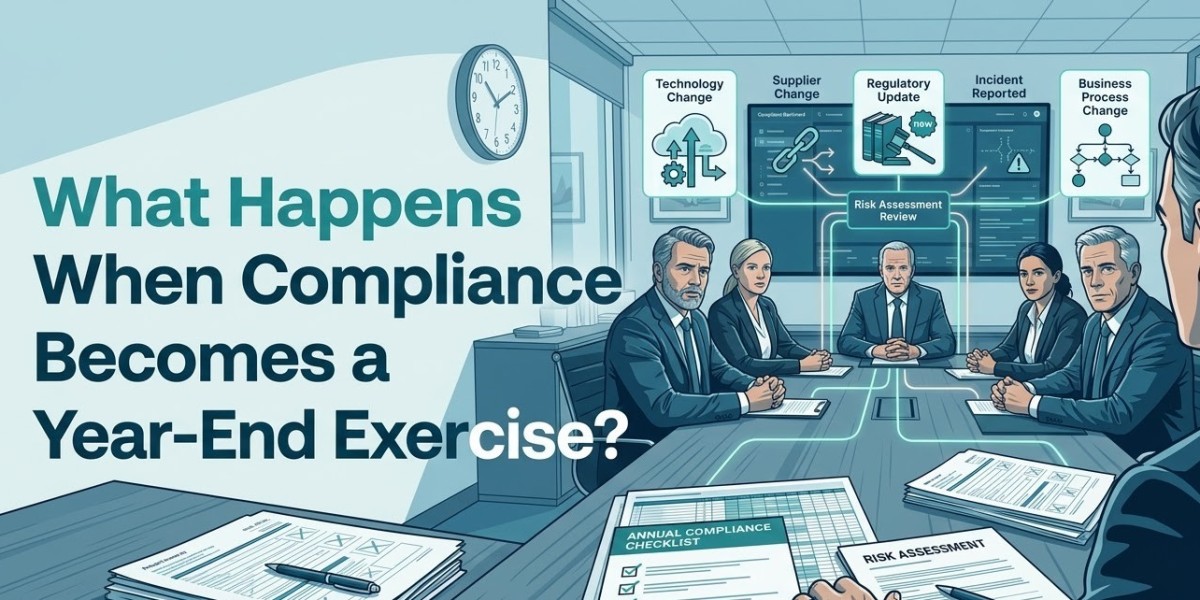
What Should Trigger a Compliance Review?
A compliance review may be appropriate when an organization changes something that affects an existing obligation. New technology is one example.
A new application could change how personal information is collected, stored, transferred, or accessed. A new AI tool could introduce questions around data handling and security.
Business expansion can also create new obligations. Entering a new market, launching a new product, or changing a service model may affect the regulatory requirements that apply to the organization.
Changes to suppliers should also receive attention where third parties handle regulated information or perform activities that affect compliance.
The goal is not to review every business decision through a compliance lens. It is to identify changes that could materially affect obligations or controls.
Can Compliance Information Be Connected to Risk?
Compliance risks are often connected to broader organizational risks.
A regulatory requirement may depend on a specific control. That control may also protect against an operational risk. An incident could reveal that the control is not working properly.
If compliance information sits separately from risk and incident information, these relationships can be difficult to identify. A connected GRC approach can provide greater visibility across these areas.
AssurePlus describes its GRC platform as connecting risk, compliance, incidents, audits, vendor risk, and resilience information within a shared environment.
This type of connection can help organizations understand not only whether a requirement exists, but also how that requirement relates to the controls and risks affecting the business.
How Can Organizations Monitor Compliance More Effectively?
Continuous compliance does not mean checking every requirement every day.
Instead, organizations can identify the obligations and controls that require ongoing attention and establish appropriate monitoring activities.
For some requirements, this may involve scheduled control reviews. For others, it could mean monitoring incidents, policy changes, supplier information, or regulatory developments.
Technology can reduce the administrative burden by keeping obligations, controls, evidence, owners, and actions connected.
This also makes it easier to identify overdue reviews or unresolved compliance issues before they become larger problems.
What Role Do Audits Play in Continuous Compliance?
Audits remain important because they provide an independent or structured assessment of whether controls are operating as intended.
But audit findings should not exist separately from compliance management.
A finding may identify a control weakness that affects a regulatory obligation. That weakness may also increase an organization's broader risk exposure.
A structured audit and assessment workflow can help organizations organize assessments, evidence, findings, and follow-up actions. AssurePlus describes its audit capabilities as helping organizations automate fieldwork and assessments while identifying control gaps.
The real value comes when those findings are fed back into the wider compliance and risk process.
Why Does a Risk-Based Approach Matter?
Not every compliance issue carries the same potential impact. Organizations have limited resources, so they need to understand where attention is most important.
ISO 31000:2018 provides a framework for identifying, analysing, evaluating, treating, monitoring, and communicating risk. It also notes that risk management can be customized to an organization's context rather than applied identically everywhere.
This supports a risk-based approach to compliance. A critical obligation connected to sensitive information or a high-impact business process may deserve more frequent monitoring than a low-impact administrative requirement.
What Does Continuous Compliance Actually Look Like?
Continuous compliance is ultimately about keeping compliance connected to everyday business activity.
When a major change occurs, its compliance implications are considered. When an incident occurs, relevant obligations and controls can be reviewed. When an audit identifies a weakness, the finding can feed into corrective actions and risk management.
This creates a cycle:
Change → Assessment → Control → Monitoring → Finding → Improvement
The exact process will differ between organizations, but the principle remains the same.
Compliance becomes part of operational decision-making rather than something that appears only when an annual review approaches.
Conclusion
Compliance does not become irrelevant between audits. The business continues changing, and those changes can affect regulatory obligations, controls, risks, and responsibilities.
Organizations can reduce blind spots by combining scheduled compliance reviews with event-driven assessments and ongoing monitoring of important controls.
The objective is not to create more compliance paperwork. It is to make sure that compliance information remains relevant when business decisions are being made, risks are changing, and new challenges emerge.