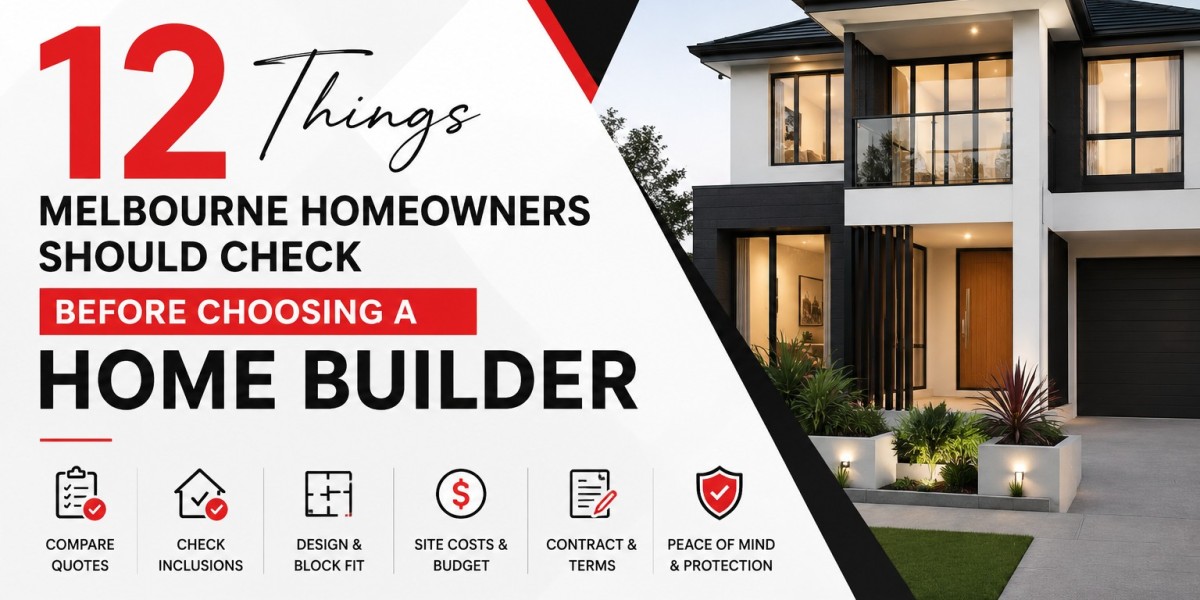


Choosing a home builder in Melbourne can look easy at first.
You find a few designs you like, check the advertised prices, read some reviews and start comparing builders.
The reality is a little different.
Two builders can show a similar-looking house but quote very different amounts once you look at the plans, specifications, site costs and inclusions. One may also suit your block and building goals much better than another.
That is why choosing between home builders in Melbourne should involve more than comparing the biggest number on a website.
There are also some important things Melbourne homeowners need to understand before signing a building contract, including builder registration, site conditions, energy requirements, variations and what is actually included in the price.
Consumer Affairs Victoria currently recommends comparing at least three written quotes based on the same plans and specifications before making a decision.
Here are 12 things worth checking first.
1. Check That the Builder Is Properly Registered
This is the boring part of the process, but it should be one of the first checks.
For building work over $10,000, Consumer Affairs Victoria advises homeowners to check that the prospective builder is registered with the Building and Plumbing Commission (BPC).
Don't assume registration because a company has a professional website or has been operating for years.
Check it.
You can also look into the builder's business history and any available disciplinary or prosecution information.
Consumer Affairs Victoria recommends checking references and asking recent customers about things such as communication, timing, price increases and the quality of completed work.
A good starting checklist is:
- Is the builder currently registered?
- How long has the business operated?
- Can you inspect recent work?
- Can you speak with recent customers?
- How does the builder handle changes?
- Who will communicate with you during the build?
These checks don't guarantee a perfect building experience, but they give you a much better starting point.
2. Get at Least Three Quotes
I'd strongly recommend not stopping at the first quote that looks reasonable.
Consumer Affairs Victoria specifically recommends getting at least three quotes for the same plans and specifications.
That last part matters.
If Builder A prices a three-bedroom house with one set of specifications and Builder B prices a slightly different house with different inclusions, you're not really comparing builders.
You're comparing different products.
When you request quotes, try to keep the following consistent:
- Same floor plan
- Same specifications
- Similar finishes
- Similar appliances
- Same site information
- Same energy requirements
Then compare what each builder has actually allowed for.
The cheapest quote isn't automatically the best value. Consumer Affairs Victoria specifically warns that a low quote may leave out items or use base allowances that don't cover the materials and finishes you actually want.
3. Find Out What the Price Actually Includes
This is particularly important if you're comparing Fixed price home builders Melbourne.
The words “fixed price” can sound reassuring, but you still need to understand the contract.
Ask the builder to explain:
What is included?
Then ask:
What isn't included?
Look closely at:
- Flooring
- Heating and cooling
- Appliances
- Electrical items
- Kitchen finishes
- Bathroom fittings
- Landscaping
- Driveway
- Site works
- Connections
- Upgrades
- Provisional sums
- Prime cost items
Victoria's current consumer guidance says contracts should clearly document plans, specifications, fixtures, fittings and finishes.
This is where a side-by-side comparison becomes useful.
Don't compare only:
$X vs $Y
Compare:
What do I actually get for $X vs $Y?
4. Don't Choose a House Just Because the Facade Looks Good
A beautiful façade gets the attention.
The floor plan determines how you live.
When comparing new home builders Melbourne, spend time looking at the actual layout.
Imagine an ordinary weekday.
Where will the school bags go?
Can someone cook dinner while another person is watching television?
Is there somewhere quiet to work?
Can you get from the garage to the kitchen easily?
Where will the vacuum cleaner and cleaning supplies live?
Is the laundry practical?
Where will visitors sit?
These details sound small when you're looking at a glossy house image.
They become much more important once you actually live there.
A floor plan that looks impressive on paper can feel very different when you start placing real furniture into it.
5. Make Sure the Design Works on Your Block
This is one of the biggest things people overlook.
A house design isn't separate from the land.
The block can affect what you can build and how the home should be positioned.
Before settling on a design, consider:
- Block width
- Block depth
- Orientation
- Slope
- Easements
- Existing trees
- Driveway access
- Neighbouring homes
- Setbacks
- Site coverage
- Private open space
- Planning controls
Victoria's residential development standards cover matters including setbacks, building height, site coverage, permeability, tree canopy, daylight, solar access and private open space.
So a design that works well on a wide block in one Melbourne suburb may not be the right solution for a narrower or differently oriented block elsewhere.
This is especially relevant when comparing builders servicing growth areas and established suburbs across Melbourne.
6. Think Carefully About Single Storey vs Double Storey
The single-storey versus double-storey decision shouldn't simply come down to the number of bedrooms.
Think about how your household actually uses space.
Single storey homes may suit families who prefer:
- Everything on one level
- Easy movement around the house
- Direct access to the backyard
- No internal staircase
- Straightforward day-to-day living
Double storey homes may suit families who want:
- More floor space
- Greater separation between bedrooms and living areas
- More privacy
- Additional bedrooms
- A smaller building footprint
Neither is automatically better.
A well-designed single-storey home can work beautifully for one family, while a double-storey layout may make much more sense for another.
If you're researching Single Storey Home Designs in Melbourne, compare the relationship between living areas, bedrooms, storage and outdoor space.
If you're considering Double Storey Home Designs, look at the staircase, circulation areas and how the upper level affects privacy and family living.
You can compare different layout approaches through Truland Homes' Single Storey Home Designs and Double Storey Home Designs pages.
7. Ask How the Design Meets Current Energy Requirements
Energy efficiency shouldn't be an afterthought.
Victoria's 7-star minimum thermal performance requirement for new homes has applied since 1 May 2024, alongside Whole-of-Home energy requirements covering fixed services such as heating, cooling, hot water and lighting.
So when discussing a design with a builder, ask how the home will meet the applicable requirements.
Things that can affect performance include:
- Orientation
- Insulation
- Windows
- Glazing
- Shading
- Heating
- Cooling
- Hot water
- Solar
- Overall layout
This matters when comparing floor plans too.
A home design isn't just about how many bedrooms fit inside the walls. Its orientation, glazing and layout can influence how the house performs.
For Melbourne homeowners, this is worth discussing before the design is finalised rather than trying to solve it after construction has already started.
8. Read the Building Contract Properly
Don't rush this part.
The building contract is not just paperwork between the quote and construction.
It sets out the agreement between you and the builder.
Consumer Affairs Victoria recommends checking the builder's registration, understanding how plans and specifications can be changed, ensuring progress payments relate to completed stages and having enough time to properly review the contract before signing. It also recommends considering independent legal advice.
Pay particular attention to:
Contract price
What exactly are you paying?
Inclusions
Are the products and finishes you discussed actually documented?
Variations
What happens if something changes?
Allowances
Are there provisional sums or prime cost items?
Progress payments
Are payments linked to completed stages?
Delays
What circumstances can affect the construction timeframe?
If something is important to you, don't rely on a verbal promise.
Get it written into the relevant documentation.
9. Don't Ignore Site Costs
This is where two seemingly similar building quotes can start looking very different.
Your land isn't necessarily straightforward just because it looks flat from the street.
Site conditions can affect excavation, foundations and other preliminary work.
Potential issues include:
- Soil conditions
- Rock
- Sloping land
- Excavation
- Retaining
- Drainage
- Site access
- Demolition
- Service connections
Consumer Affairs Victoria specifically warns homeowners about provisional sums, including excavation, because the final cost can increase if the actual site conditions differ from the estimate. It recommends having appropriate site and soil information available so costs can be estimated more accurately.
So before comparing quotes, ask:
“What site information has been used to calculate this price?”
That's a much better question than simply asking which builder has the lowest starting price.
10. Look at the Builder's Home Design Range
The biggest design catalogue isn't necessarily the best.
But you do want enough choice to find something that suits your household and block.
Look at whether the builder offers:
- Single-storey options
- Double-storey options
- Different bedroom configurations
- Practical living layouts
- Storage options
- Different façade styles
- Designs for different block types
Also think about whether you actually want a fully custom home.
Some homeowners enjoy designing almost every element from scratch.
Others would rather choose an established design and spend less time making hundreds of individual decisions.
Neither approach is automatically right.
The important thing is knowing which building model suits you.
11. Understand How Variations Work
Even when you start with a clear design, changes can happen.
You might want different flooring.
A different appliance.
An extra electrical point.
A change to cabinetry.
Or you may decide that a room needs to be configured differently.
Before signing, understand how those changes are handled.
Ask:
- How is the variation priced?
- Can it affect the build timeframe?
- Does it need written approval?
- Who signs off on it?
- When does the revised price become part of the contract?
Consumer Affairs Victoria recommends understanding the process for changing plans and specifications before signing.
And there's a practical rule worth remembering:
If you agree to a change, don't leave it as a handshake conversation.
Make sure the change and its cost are properly documented.
12. Decide Whether the Builder's Approach Fits You
This is probably the most personal point on the list.
There isn't one type of builder that suits everyone.
A family wanting extensive customisation may look for something very different from a buyer who wants an established home design and greater price clarity.
Think about your priorities.
Do you want:
- A fixed-price approach?
- A particular home design?
- Single-storey living?
- Double-storey space?
- A straightforward design process?
- More customisation?
- A large design range?
- A builder familiar with your area?
- A knockdown rebuild?
- A home that can accommodate your family for the next 10 years?
For example, someone researching a knockdown rebuild Melbourne project has a different set of questions from someone building on vacant land.
The right builder is ultimately the one whose process matches what you're trying to achieve.
What If You're Considering a Knockdown Rebuild?
If you're buying or already own an established Melbourne property, you don't necessarily have to move to get the type of home you want.
A knockdown rebuild in Melbourne can allow homeowners to keep the location while replacing an outdated home with a new design.
But there are additional things to investigate.
These can include:
- Existing planning controls
- Demolition requirements
- Site access
- Existing services
- Soil conditions
- Easements
- Neighbouring properties
- New-home energy requirements
- The suitability of the proposed design
It is worth treating a knockdown rebuild as its own project rather than simply “building a new house where the old one was.”
For homeowners considering this route, Truland Homes also has a dedicated knockdown rebuild service.
Questions to Ask Before Choosing a Home Builder
Before your first serious meeting, I'd have these questions written down.
About the price
What exactly is included in the quoted price?
Which costs are allowances?
Are site costs included?
About the design
Will this design suit my block?
Can I compare single-storey and double-storey options?
How will the design address energy requirements?
About the contract
How are variations handled?
What happens if the construction timeframe changes?
Are all agreed selections documented?
About the builder
Is the builder currently registered?
Can I see recent completed projects?
Can I speak with recent customers?
Who will be my main contact during the build?
Consumer Affairs Victoria suggests asking recent clients about timing, communication, price increases, quality and whether changes were properly documented.
Those conversations can sometimes tell you more than a display home.
Frequently Asked Questions
How do I choose the right home builder in Melbourne?
Start by comparing at least three builders using the same plans and specifications. Then look at registration, inclusions, site costs, contract conditions, design suitability, communication and previous customer experiences. Consumer Affairs Victoria recommends comparing at least three written quotes.
Is the cheapest home builder quote usually the best?
No. A cheaper quote may exclude items or use lower allowances. Compare the complete scope, specifications, inclusions, site costs and contract terms rather than just the headline price.
What does a fixed-price home builder mean?
A fixed-price approach generally aims to provide greater clarity around the agreed construction price, but homeowners still need to understand exclusions, allowances, provisional sums, prime cost items and variations. The contract should clearly document what is included.
Should I compare single-storey and double-storey home designs?
Yes, if both suit your block. Compare them based on how your family uses space, the available land, privacy, outdoor connection, storage, stairs and long-term lifestyle rather than simply the number of bedrooms.
What should I check in a building quote?
Check the plans, specifications, inclusions, site costs, allowances, appliances, finishes, energy requirements, provisional sums, prime cost items and any exclusions. Make sure you're comparing the same scope of work across builders.
What are provisional sums?
A provisional sum is an estimated amount for work where the builder cannot determine the exact cost when the contract is signed. Excavation is a common example. The final amount can increase if the actual work costs more than the allowance.
Should I get a soil report before choosing a builder?
Site and soil information can be important for estimating foundation and excavation requirements. Consumer Affairs Victoria says builders must obtain a soil report and foundation data for designing footings and providing an adequate cost estimate.
What should I know about Victoria's current building requirements?
New homes in Victoria have been subject to a 7-star thermal performance requirement since 1 May 2024, alongside Whole-of-Home energy requirements. Planning and building requirements can vary depending on the property and the applicable controls, so homeowners should confirm the requirements for their particular project.
Can I change my house design after signing the contract?
Changes may be possible, but they can affect the price and construction timeframe. The contract should explain how variations are handled. It's better to understand this process before signing than assume changes will be simple later.
Is a smaller home builder better than a large builder?
Not necessarily. The better fit depends on what you need. A smaller builder may suit someone looking for a more focused building relationship, while a larger builder may offer a wider range of designs and established processes. Compare the actual service, contract, inclusions and building approach.
Final Thoughts
Choosing between home builders in Melbourne isn't really about finding the builder with the nicest website or the lowest advertised price.
It's about understanding the whole offer.
Look at the builder, design, block, inclusions, site conditions, energy requirements, contract and communication together.
If you're considering Single Storey Home Designs in Melbourne, make sure the layout works for your family's everyday life.
If you're comparing Double Storey Home Designs, look beyond the extra floor and consider how the additional space changes privacy, circulation and outdoor living.
If you're considering fixed price home builders Melbourne, read the inclusions and exclusions carefully rather than relying on the label alone.
And if you're looking at a knockdown rebuild Melbourne, assess the existing property and site before committing to a design.
One particularly useful 2026 update is worth keeping in mind: Victoria's consumer guidance now reflects changes to home warranty insurance, with the current guidance stating that from 1 July 2026, builders must take out Home Warranty insurance after signing a major domestic building contract over $20,000 for homes up to three storeys.
The goal isn't to find a builder who simply tells you what you want to hear.
It's to find a building arrangement where the design, price, contract and expectations are clear before construction starts.
That is usually a much better place to begin a new home project.









