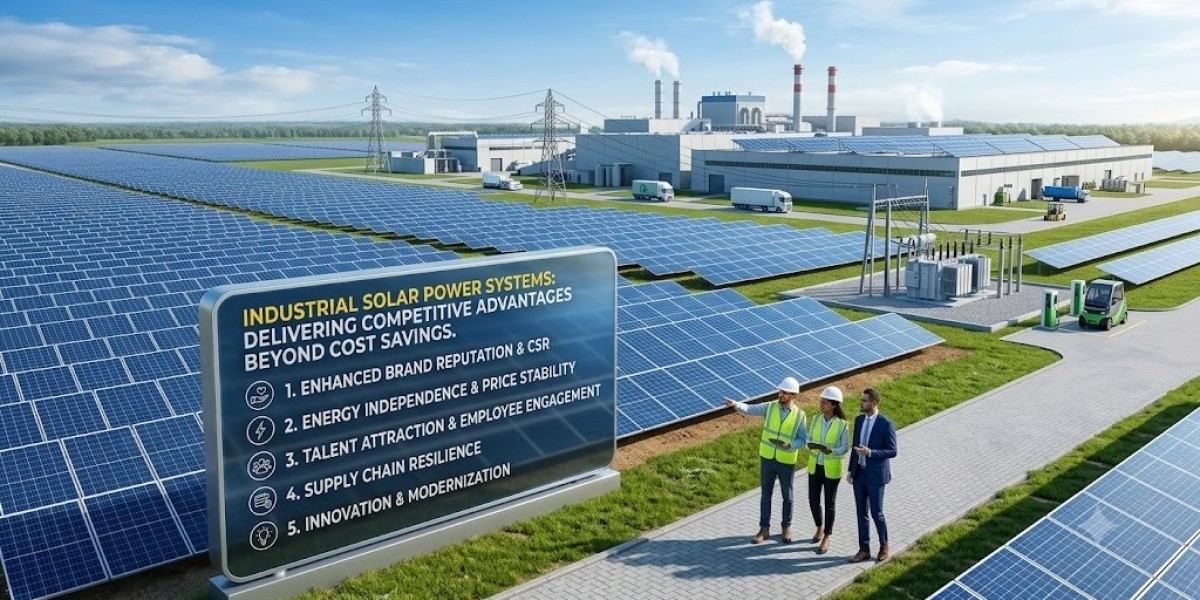


The initial business case for industrial solar adoption was, almost without exception, an electricity cost avoidance calculation — installed cost per kilowatt against grid tariff offset, reduced to a payback period and an internal rate of return. That calculation remains the entry point for most procurement decisions, and it remains a strong one at industrial scale. But it is no longer the complete case, and industrial buyers evaluating Solar Power Systems For Industry purely on the electricity-cost line are increasingly leaving a set of secondary but material advantages unaccounted for in the decision: tariff and demand-charge structures that reward self-generation beyond simple unit offset, export market requirements that are beginning to price carbon intensity directly into buyer decisions, credit and financing terms that treat energy cost predictability as a balance-sheet asset, and operational resilience value that only becomes visible during the outage a facility eventually experiences.
This shift matters because it changes the appropriate basis for evaluating a solar investment from a narrow payback-period comparison to a broader assessment of how the installation affects the facility's competitive position across procurement, financing, and market access — considerations that a purely cost-avoidance framework systematically undercounts.
Demand Charge Management and Time-of-Use Tariff Structures
Industrial electricity tariffs in most jurisdictions carry a demand charge component, billed against the facility's peak kilowatt draw during the billing period, that is frequently a larger share of the total electricity bill than the per-unit energy charge for facilities with intermittent high-load processes. A solar array sized and, where paired with battery storage, dispatched specifically to shave peak demand during the facility's highest-draw periods delivers savings on this demand charge component independent of and additional to the straightforward energy-unit offset that most payback calculations for Solar Power Systems For Industry are built around, and this component is frequently large enough to shorten payback meaningfully once modelled explicitly rather than folded into a generic unit-offset assumption.
Time-of-use tariff structures compound this effect in jurisdictions where peak-hour rates run substantially above off-peak rates, since a facility offsetting its highest-load, highest-tariff hours with solar generation captures savings per unit well above the facility's blended average tariff, a distinction that matters directly for the payback calculation and is frequently understated in generic industry benchmarks that assume a flat average tariff offset across all hours.
Capturing this value in practice requires demand and tariff data granular enough to identify exactly when the facility's peak draw occurs relative to solar generation availability, since a facility whose peak load falls in early morning or evening hours outside the solar generation window will see materially less demand-charge benefit than one whose peak coincides with midday production shifts, a distinction that a generic feasibility study based on monthly billing data alone typically fails to surface.
Export Market Access and Carbon Intensity Requirements
Export-facing industrial manufacturers, particularly those supplying buyers in the European Union, are increasingly encountering carbon border adjustment and supply-chain carbon disclosure requirements that make a facility's electricity source a documented input to the buyer's own compliance and reporting obligations, not merely a reputational consideration. A facility that can demonstrate a meaningful share of its process electricity sourced from an on-site Solar Power Systems For Industry installation, backed by generation data and, where applicable, renewable energy certificates, is positioned to meet buyer requirements that a grid-electricity-only facility increasingly cannot satisfy without additional cost or contractual complexity elsewhere in the supply chain.
This dynamic is still emerging in scope and enforcement timeline across different export markets, but manufacturers already supplying regulated export categories report that documented on-site renewable generation has moved from a differentiator to, in specific buyer relationships, a stated procurement requirement — a shift that changes solar from a cost-line decision to a market-access decision for the export-facing segment of industrial buyers specifically.
Financing Terms and the Value of Predictable Operating Cost
Lenders and credit rating processes for industrial facilities increasingly treat energy cost volatility as a factor in overall operating risk assessment, since a facility with a large share of its electricity cost fixed through an owned or long-term-contracted solar installation carries a more predictable operating cost base than a facility fully exposed to grid tariff volatility, an input that feeds into working capital facility terms and, for facilities seeking project or expansion financing, into the overall credit assessment. This effect is smaller and harder to quantify precisely than the direct electricity-cost savings from Solar Power Systems For Industry, but industrial finance teams report that a documented fixed-cost energy position is increasingly referenced in financing discussions as a positive risk factor, particularly for facilities in energy-intensive sectors where the electricity cost line is a large enough share of operating cost to materially affect margin volatility.
Operational Resilience and the Cost of Unplanned Downtime
Grid outages carry a cost for industrial facilities that extends well beyond the electricity not consumed during the outage window — production line restart procedures, spoiled work-in-progress for temperature-sensitive processes, missed delivery commitments carrying contractual penalties, and in continuous-process industries, equipment damage from an uncontrolled shutdown. A Solar Power Systems For Industry installation paired with battery storage sized against critical process load, rather than facility-wide load, can maintain continuous operation of the specific systems whose interruption carries the highest cost — process control systems, safety systems, and in many facilities the specific production line generating the highest margin per hour of uptime — through an outage window that would otherwise halt the full facility.
Quantifying this resilience value requires a facility-specific analysis of historical outage frequency and duration against the documented cost of an unplanned stoppage, a calculation industrial buyers frequently skip in favour of the simpler electricity-offset payback model, but one that for facilities with high-value continuous processes or contractual delivery penalties often represents a larger annual value than the direct energy cost savings the headline payback figure is built around.
Corporate Sustainability Commitments and Stakeholder Reporting
Industrial parent companies and their institutional shareholders increasingly require facility-level sustainability reporting as a standard governance input, and an operating Solar Power Systems For Industry installation with documented generation and emissions-offset data provides a verifiable data point for that reporting that a stated intention or a purchased offset does not carry the same weight in delivering. This has become a meaningful factor in capital allocation decisions at the group level for industrial businesses with multiple facilities, where a facility able to demonstrate measurable progress against group sustainability targets is increasingly positioned more favourably for future capital investment than a facility with no comparable data to report, independent of that facility's direct electricity cost position.
Design and Engineering Considerations That Determine Whether These Advantages Materialise
The secondary advantages described above are not automatic outcomes of installing solar capacity — they depend on the same engineering rigour that determines direct energy output. A Solar Power Systems For Industry installation intended to deliver meaningful demand-charge savings requires battery dispatch logic specifically configured against the facility's actual peak-draw pattern rather than a generic time-of-use schedule. An installation intended to support export market carbon disclosure requires metering and data infrastructure capable of producing auditable generation records, not merely an inverter dashboard. And an installation intended to deliver operational resilience requires critical-load circuits identified and isolated at the electrical design stage, since a battery system wired to the full facility load rather than specifically to critical process circuits will exhaust its capacity too quickly to deliver the resilience value the investment was intended to capture.
Infrax Renewable, a Rajkot, Gujarat-based Solar EPC company established in 2015 with over 10,000 completed projects across more than 30,000 kW of installed capacity and a 98% customer satisfaction rate, provides industrial solar installation services covering load and demand-charge analysis, critical-load circuit design, system engineering, installation, DISCOM and open-access interconnection liaison, and post-commissioning monitoring with auditable generation reporting, with project financing facilitated through partner banks and NBFCs — representative of the category of EPC contractor whose engineering scope extends beyond panel and inverter sizing into the demand-charge, resilience, and reporting design work that determines whether a Solar Power Systems For Industry investment captures its full range of available advantages rather than only the direct energy-offset component.
Building the Complete Business Case
Industrial buyers evaluating solar investment on payback period alone are applying a valid but partial framework, and the gap between that partial framework and the facility's actual return is largest precisely for the buyers most likely to benefit from the secondary advantages described above: export-facing manufacturers, facilities with significant demand-charge exposure, businesses operating under group-level sustainability reporting requirements, and any facility where unplanned downtime carries a documented cost beyond the electricity itself. Building the complete business case requires quantifying these factors specifically against the facility's own tariff structure, market exposure, and operational risk profile, rather than relying on a generic industry payback benchmark that was built around the direct energy-offset calculation alone.
Conclusion
Solar Power Systems For Industry have moved past the point where electricity cost avoidance is the only material return on the investment, and industrial buyers who continue to evaluate the decision on that basis alone are working from an incomplete model of the asset's actual value. Demand charge management, export market access, financing terms, and operational resilience each carry a quantifiable value specific to the facility, and capturing that value depends on engineering the installation deliberately against those specific outcomes rather than assuming a well-sized system for energy offset automatically delivers them as a byproduct.








