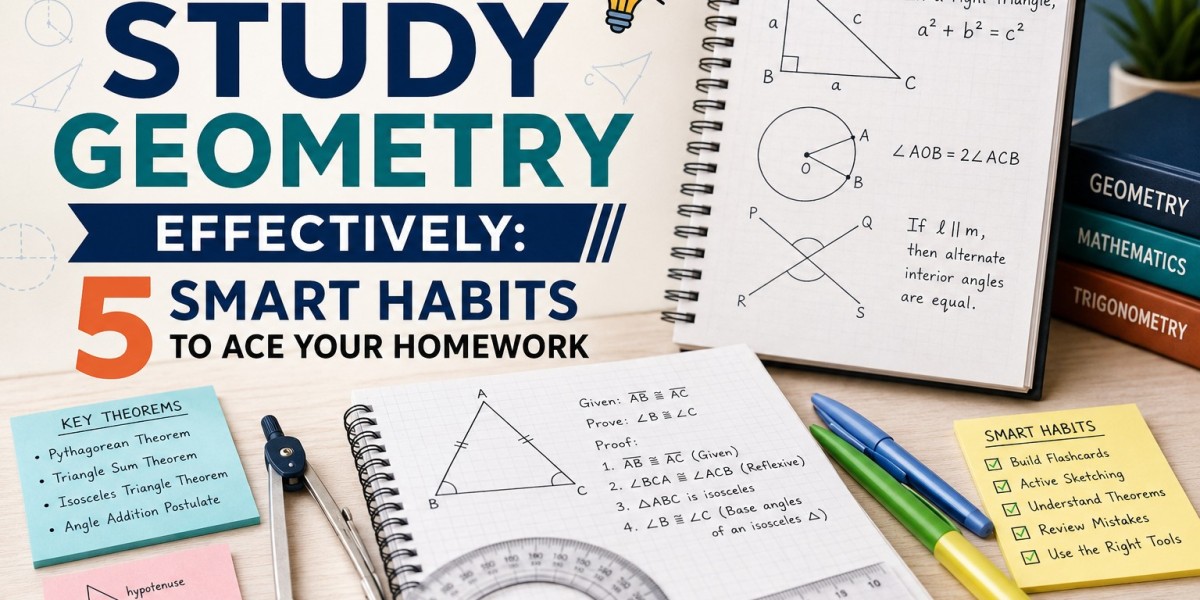


Unlike algebra, which relies heavily on sequential calculations, geometry demands visual reasoning, spatial awareness, and logical proof-building. Because it requires a completely different mindset, many students find themselves struggling when transitioning to this branch of mathematics. If you find yourself staring blankly at your textbook, getting reliable help with geometry assignment can give you the step-by-step guidance needed to build confidence.
Adopting the right study habits will make your homework sessions smoother, faster, and much less stressful. Here are 5 practical tips to master geometry:
1. Build a Personal Geometry Flashcard Deck
Geometry introduces dozens of new terms, definitions, and theorems. Trying to memorize them all right before an exam is a recipe for burn-out.
Create flashcards for key terms like adjacent angles, hypotenuse, transversal, and perpendicular bisector.
Draw a quick visual representation on the back of each card alongside the written definition.
Review 5 to 10 cards daily to trigger active recall.
2. Practice Active Sketching (Never Rely on Mental Visualization)
Attempting to solve geometric equations inside your head creates unnecessary cognitive load.
Always draw out figures on scratch paper, even if the assignment problem doesn't explicitly provide one.
Use visual tools—such as a ruler, compass, and protractor—to keep shapes accurate.
Use colored pens or highlighters to differentiate between equal angles, congruent sides, and given measurements.
3. Focus on Understanding Theorems, Not Just Memorizing Formulas
Memorizing $a^2 + b^2 = c^2$ is helpful, but knowing why and when it applies is what actually solves homework problems.
Understand the conditions required to use a rule (e.g., the Pythagorean theorem strictly applies to right-angled triangles).
Learn how formulas connect to one another so you can reconstruct them if you forget a step on a test.
4. Review Your Past Mistakes Before Starting New Assignments
Geometry concepts build directly upon one another like building blocks. If you missed a concept in week two, it will likely return in week four.
Always check graded assignments to analyze where your logic or calculations went off track.
Re-work incorrectly solved problems on a blank sheet of paper until you can complete them smoothly without checking the answer key.
5. Essential Tools for Geometry Study
| Tool | Primary Use Case |
| Protractor & Ruler | Measuring exact angle degrees and straight line distances |
| Scientific Calculator | Calculating trigonometric ratios ($\sin$, $\cos$, $\tan$) and square roots |
| Graph Paper | Plotting coordinate geometry equations and geometric transformations |
| Formula Cheat Sheet | Quick reference for area, perimeter, surface area, and volume formulas |
Conclusion
Mastering geometry takes time, structured habits, and persistent practice. By breaking down complex figures, keeping your definitions organized, and learning from previous errors, you can turn a confusing topic into a predictable set of logical rules. However, when tight deadlines overlap or a particular proof feels impossible to crack, partnering with the best assignment helper online can give you the personalized support and detailed solutions you need to stay on top of your coursework.






