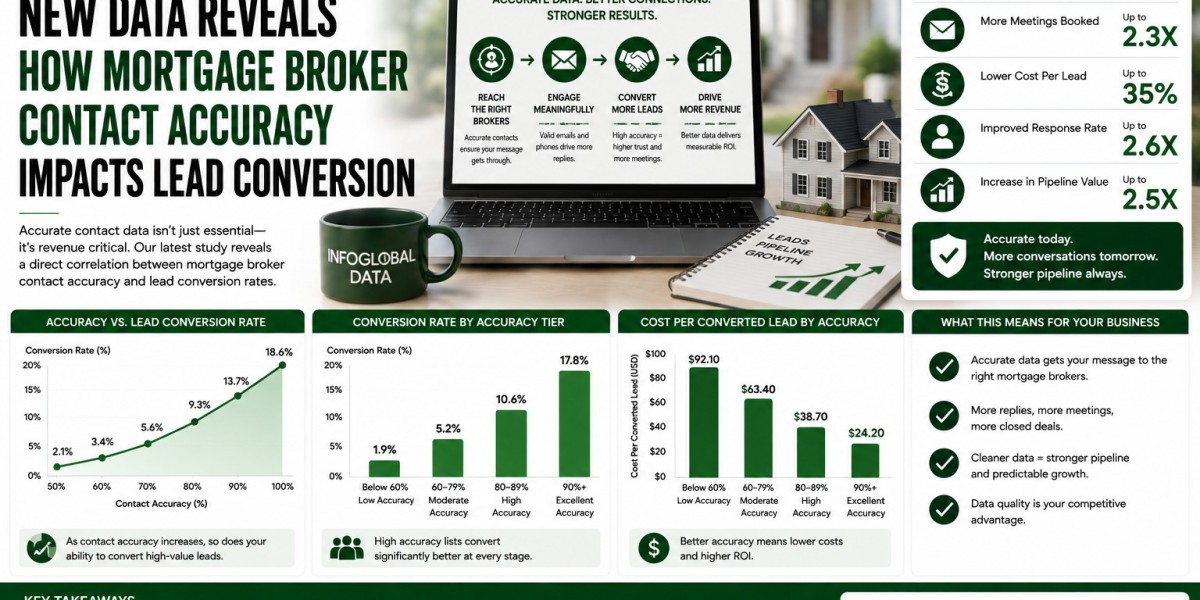


Introduction
Mortgage marketing is becoming increasingly dependent on timely, relevant communication. The Mortgage Bankers Association (MBA) reported that mortgage brokers accounted for 19.8% of U.S. residential mortgage originations in Q3 2025, up from 19.2% in Q2, highlighting the continued importance of the broker channel. (newslink.mba.org) At the same time, inaccurate contact records can undermine the economics of prospecting before a salesperson ever gets the opportunity to have a conversation.
Validity's 2025 State of CRM Data Management found that 76% of respondents said less than half of their CRM data was accurate and complete, while 37% reported losing revenue because of poor data quality. (Validity)
This research-based analysis examines why contact accuracy matters for mortgage-focused B2B outreach, how data quality affects deliverability and conversion, and how marketers can use a Mortgage Broker Email List more effectively in 2026.
Why Contact Accuracy Matters in Mortgage Broker Lead Generation
A mortgage broker campaign can fail long before a prospect sees the offer.
An outdated email address can create a hard bounce. An incorrect job title can result in irrelevant messaging. A former employee can generate wasted sales activity. A duplicated contact can distort campaign reporting and make conversion rates appear stronger or weaker than they actually are.
Validity's 2025 study provides a useful indication of the scale of the broader data-quality problem. Among 602 CRM users and stakeholders surveyed, 37% said poor data quality had caused their organization to lose revenue, and 76% said less than half of their CRM data was accurate and complete. (Validity)
These findings are not mortgage-broker-specific, so they should not be interpreted as a direct conversion benchmark for the mortgage industry. They do, however, demonstrate why contact accuracy should be treated as a revenue variable rather than merely a database-maintenance issue.
For marketers using a Mortgage Broker Email Database, accuracy influences several stages of the funnel:
Reachability — Is the email address still active?
Targeting — Is the person actually a mortgage broker or relevant decision-maker?
Personalization — Are company, title, location, and professional details correct?
Engagement — Does the message address the prospect's current needs?
Attribution — Can conversions be accurately connected to the correct contact and campaign?
A problem in any of these areas can reduce the apparent performance of an otherwise well-designed campaign.
The Mortgage Broker Market Is Competitive—and Timing Matters
The broker channel represents a substantial part of mortgage origination activity.
MBA analysis of HMDA data showed that the broker wholesale channel's share of dollar volume increased from 10% in 2018 to 16% in 2023. MBA's later reporting found that brokers represented 19.8% of residential mortgage originations in Q3 2025. (newslink.mba.org)
This matters for B2B marketers selling products and services to mortgage brokers. A larger or more active prospect universe can create more opportunities—but also more competition for attention.
Accurate data can help marketers narrow the audience to contacts that actually fit the campaign.
For example, a technology provider might segment brokers by:
Company size
Geographic market
Production volume
Seniority
Loan specialization
Independent versus affiliated status
Business model
Technology adoption
This is more useful than treating every record in a broad Mortgage Broker Mailing List as equally valuable.
Market conditions make relevance even more important
The mortgage market has also been changing.
MBA's 2026 reporting on independent mortgage banks found that average production volume increased to $2.4 billion across repeat companies in 2025, compared with $2.1 billion in 2024. The MBA also reported that refinancing accounted for 34% of total mortgage-industry originations by dollar volume in 2025, up from 20% in 2024. (MBA)
Changing origination patterns mean a contact's relevance can change over time. A broker who was highly relevant to a refinance-focused campaign last year may have different priorities in the current market.
That is why database maintenance should be continuous rather than performed only before an annual campaign.
What Current Mortgage Research Says About Communication
Borrowers increasingly expect useful, timely communication
Although the article focuses on B2B outreach to mortgage brokers, consumer mortgage research offers an important lesson about the industry's communication expectations.
ICE Mortgage Technology's 2025 Borrower Insights Survey found that 68% of borrowers preferred email for lender communication, while 65% preferred phone calls. Email was the most-selected communication method among Millennials, Gen X, and Boomers. (mortgagetech.ice.com)
The finding does not establish that mortgage brokers themselves prefer email for vendor communications. However, it illustrates the broader industry's continuing reliance on email as a mortgage communication channel.
That creates a higher standard for B2B marketers: the email must not merely reach a broker—it needs to be useful enough to justify attention.
Early engagement has measurable value
J.D. Power's 2025 U.S. Mortgage Origination Satisfaction Study found that overall customer satisfaction was 32 points higher when lenders engaged customers at the beginning of the home-buying journey rather than later. Satisfaction fell by 64 points when engagement first began at the application stage. (JD Power)
Again, this is consumer research rather than B2B vendor-outreach data. Its relevance lies in the underlying principle: timing influences the value of mortgage-related communication.
For B2B marketers, this suggests that a verified Mortgage Broker Email List becomes more valuable when combined with timely segmentation and relevant campaign triggers.
How Bad Data Can Distort Conversion Metrics
Contact accuracy affects more than delivery. It can also distort the metrics marketers use to make decisions.
Consider a hypothetical campaign with 10,000 records.
If a significant portion of the database contains:
Former employees
Invalid email addresses
Duplicate records
Non-broker contacts
Incorrect job titles
Irrelevant companies
then a marketer may see poor engagement and conclude that the offer or creative is ineffective.
But the underlying problem may be audience quality.
This distinction is critical.
Data quality vs. campaign quality
| Problem | Apparent result | Actual issue |
|---|---|---|
| Invalid email | High bounce rate | Contact accuracy |
| Wrong job title | Low response | Targeting |
| Former employee | No engagement | Record freshness |
| Duplicate contacts | Inflated sends | Database hygiene |
| Wrong company | Poor relevance | Firmographic accuracy |
| Generic messaging | Low clicks | Content/segmentation |
This is why marketers should evaluate the quality of a Mortgage Broker Contact List before drawing conclusions from campaign performance.
Deliverability Is the First Conversion Gate
A prospect cannot respond to an email that never reaches the inbox.
Validity's 2026 Email Deliverability Benchmark Report, based on trillions of global inbox data points, reports that global inbox-placement rates increased during 2025. (Validity) Validity's related 2026 benchmark commentary places global inbox placement at approximately 87%, meaning a meaningful portion of legitimate email can still fail to reach the inbox. (Validity)
This makes list hygiene strategically important.
Poor-quality contact records can contribute to:
Higher bounce rates
Lower sender reputation
Wasted sending capacity
Lower campaign efficiency
Poorer downstream engagement
However, marketers should avoid assuming that every deliverability problem is caused by list quality. Authentication, sender reputation, sending behavior, content, mailbox-provider rules, and recipient engagement also influence inbox placement.
Email benchmarks provide context—not guarantees
MailerLite's 2025 benchmark study analyzed more than 3.6 million campaigns from 181,000+ accounts between December 2024 and November 2025. Across all industries, the median open rate was 43.46%, click rate was 2.09%, and click-to-open rate was 6.81%. (MailerLite)
These are email-marketing benchmarks, not cold-outreach benchmarks for mortgage brokers.
That distinction matters because marketers should not tell stakeholders that a mortgage broker campaign “should” generate a particular response rate based on a general newsletter benchmark.
Instead, use these figures as directional context and establish an internal baseline for your own audience.
Accuracy and Personalization Work Together
A clean database is valuable because it enables better personalization.
Suppose a mortgage technology company sends:
“Hi John, we help mortgage professionals improve their workflows.”
That is technically personalized but strategically weak.
If the database contains accurate information, the message can become:
“John, your brokerage's growth across purchase and refinance business creates additional document and workflow demands. We recently analyzed three ways independent brokers are reducing manual processing.”
The second message is more specific because the marketer can combine:
Name
Company
Business type
Market
Relevant product
Industry trend
The quality of personalization therefore depends partly on the quality of the underlying data.
MailerLite's 2025 data also reinforces the value of targeting: its benchmark guidance recommends segmentation and targeted content to improve engagement. (MailerLite)
What Should a High-Quality Mortgage Broker Database Contain?
A useful Mortgage Broker Email Database should contain more than an email address.
Recommended fields include:
| Data attribute | Campaign value |
|---|---|
| Full name | Personalization |
| Professional email | Direct outreach |
| Current job title | Role targeting |
| Brokerage/company | Account targeting |
| Company website | Verification |
| Location | Geographic segmentation |
| Company size | ICP qualification |
| Specialty | Offer relevance |
| Data-validation date | Freshness monitoring |
| Phone number | Multichannel follow-up |
| Source/consent status | Compliance management |
The exact fields needed depend on the campaign.
For example, a mortgage software provider may prioritize brokerage size and technology adoption, while a commercial lender may care more about geography, loan specialization, and production profile.
How to Measure Whether Contact Accuracy Improves Conversion
Marketers should avoid treating “accuracy” as a single metric.
Instead, create a data-quality scorecard.
Track these indicators
1. Bounce rate
Measures whether addresses are reachable.
2. Valid-contact rate
Measures the proportion of records that pass verification.
3. Job-title accuracy
Measures how many contacts actually match the intended audience.
4. Engagement rate
Track clicks, replies, and meaningful interactions.
5. Positive response rate
Separate genuine buying interest from automatic replies and negative responses.
6. Meeting conversion
Measure how many engaged contacts become sales conversations.
7. Opportunity conversion
Track pipeline created from each data segment.
8. Revenue per contact
This ultimately connects data quality with commercial performance.
A particularly useful experiment is to compare two similarly sized segments:
Existing database
Newly verified/updated database
Keep offer, creative, sender, and timing as consistent as possible. Then compare bounce, engagement, qualified responses, meetings, and opportunities.
That provides stronger evidence than simply reporting that a list contains “verified” contacts.
Practical Takeaways for B2B Marketers
1. Validate before optimizing creative
A sophisticated subject line cannot compensate for an outdated audience. Check contact validity and role accuracy before concluding that campaign copy is the problem.
2. Segment mortgage brokers by business characteristics
Use geography, company size, role, specialty, and other relevant attributes to create smaller, more relevant audiences.
3. Prioritize clicks, replies, and conversions over opens
MailerLite identifies click rate as a stronger indicator of genuine email engagement because it is not dependent on open tracking. (MailerLite)
4. Refresh data continuously
Mortgage professionals change firms, roles, responsibilities, and business priorities. A database that was accurate months ago can gradually lose value.
5. Connect data quality to revenue
Don't stop at bounce rate. Measure whether better data produces more qualified responses, meetings, opportunities, and revenue.
How InfoGlobalData Can Support Data-Focused Outreach
For organizations that need a targeted prospecting resource, InfoGlobalData positions its B2B data services around contact verification, segmentation, enrichment, and ongoing database maintenance. Its stated capabilities include targeting by industry, job title, geography, and company characteristics. (infoglobaldata.com)
The practical value of a provider should ultimately be judged by the quality of the records delivered and the campaign outcomes they help generate—not simply by database size.
For mortgage-focused marketers, that means asking for relevant fields, validation information, compliance documentation, and a clear process for replacing invalid records before launching a large campaign.
Conclusion
The evidence points to a clear relationship between contact-data quality and the conditions required for B2B conversion, even though no credible public study establishes a specific conversion uplift for mortgage broker email-list accuracy. Validity's 2025 research found that 76% of surveyed organizations considered less than half of their CRM data accurate and complete, while 37% reported revenue losses linked to poor data quality. (Validity) Mortgage-industry research simultaneously shows a competitive, increasingly digital environment in which communication and timing remain important. (JD Power)
For marketers using a Mortgage Broker Email List, the takeaway is straightforward: accurate data is not a substitute for good messaging, but poor data can prevent good messaging from producing results. In 2026, the strongest campaigns will combine verified contacts, precise segmentation, relevant content, disciplined deliverability practices, and conversion-level measurement.
Frequently Asked Questions
1. How does contact accuracy affect mortgage broker lead conversion?
Accurate contact information improves the likelihood that messages reach the intended professional and contain relevant role and company information. It does not guarantee conversion, but it removes avoidable barriers such as invalid addresses, outdated job titles, duplicates, and incorrect company records.
2. What should a Mortgage Broker Email List include?
At minimum, marketers should look for professional email addresses, names, current job titles, company information, geographic data, and a method or date indicating when records were validated. Additional firmographic or professional attributes can improve segmentation and personalization.
3. What is a good B2B email conversion rate for mortgage brokers?
There is no reliable public benchmark that establishes a universal conversion rate specifically for cold B2B email campaigns targeting mortgage brokers. General email-marketing benchmarks should be used only as directional context; marketers should establish their own baseline using qualified replies, meetings, opportunities, and revenue.
4. How often should a Mortgage Broker Mailing List be updated?
There is no single update interval appropriate for every campaign. Because professional roles and business affiliations change, marketers should monitor bounce rates and engagement continuously and refresh or verify records before major campaigns.
5. Why is email deliverability important for mortgage broker outreach?
Deliverability determines whether an email reaches the recipient's inbox in the first place. Validity's 2026 research shows that global inbox placement remains below 100%, demonstrating why sender reputation, authentication, list hygiene, and engagement all matter. (Validity)
6. Should mortgage marketers use personalization in B2B email campaigns?
Yes, but personalization should go beyond inserting a first name. Accurate company, role, geographic, and business information can help marketers align the message with the prospect's likely responsibilities and priorities.
7. Does a larger Mortgage Broker Email Database produce more conversions?
Not necessarily. A smaller database containing accurate, relevant, well-segmented prospects can outperform a much larger database containing outdated or poorly targeted records. The appropriate measure is qualified pipeline and revenue generated per contact, not database size alone.
8. What is the best way to test whether better data improves campaign performance?
Create comparable segments using different levels of data verification while keeping the offer, messaging, sender, and campaign timing as consistent as possible. Compare bounce rate, clicks, positive replies, meetings, opportunities, and revenue to determine whether improved data quality produces measurable commercial gains.









