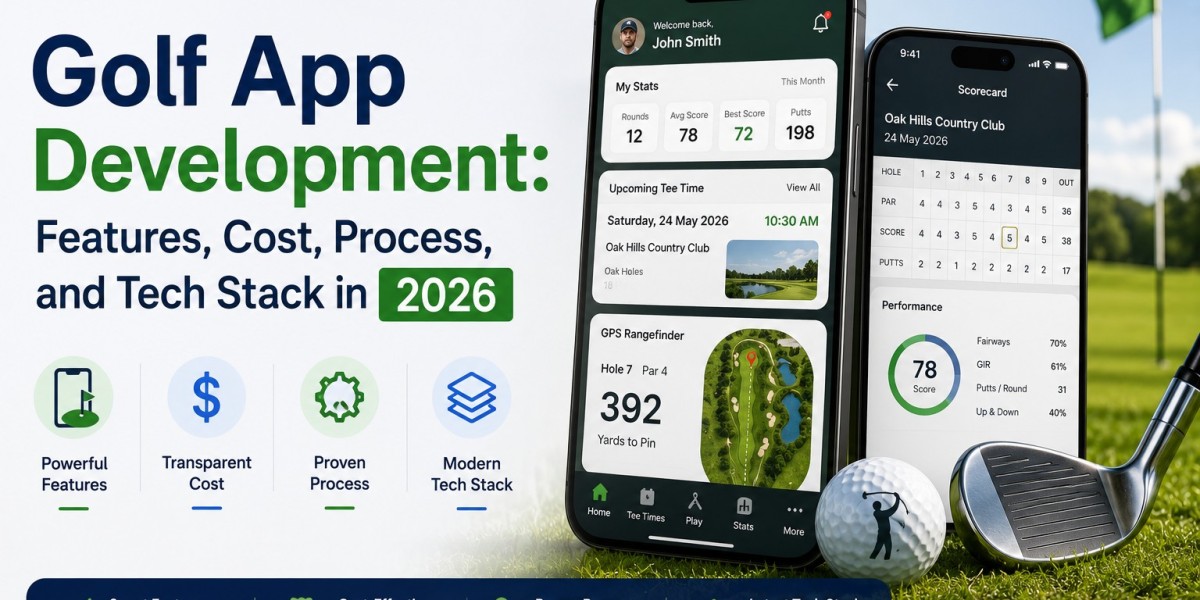


Golf is increasingly becoming a connected sport. Mobile apps now help players check course maps, measure distances, record scores, book tee times, track performance, and stay connected with other golfers. This shift is supported by growing adoption: the National Golf Foundation reported in 2025 that more than 75% of core golfers, those playing at least eight rounds a year had at least one golf-specific app on their phones. It also found notable increases in GPS distance, course guidance, scorekeeping, and statistics usage compared with 2020.
A modern golf app is therefore much more than a digital scorecard. It can combine GPS navigation, tee-time management, payments, player profiles, analytics, social features, and course information in one platform. This guide explains the major golf app types, essential features, technology choices, development process, estimated cost, and monetization options. It is useful for golf course operators, sports-tech startups, and entrepreneurs planning a digital golf product.
Why Build a Golf App in 2026?
Golf apps are becoming more closely connected to the way players actually experience the sport. Golfers increasingly expect convenient digital tools before, during, and after a round, while course operators are looking for better ways to manage bookings, communication, and customer data.
The opportunity is also supported by continued golf participation. The USGA reported more than 82 million scores posted in the U.S. during 2025, with 3.68 million golfers maintaining a Handicap Index.
For a new product, this creates several possible directions: improving on-course decision-making, simplifying reservations, connecting players, supporting training, or helping courses manage operations. The strongest concept is usually one that solves a specific problem rather than attempting to include every possible feature from the beginning.
Types of Golf Apps
Golf apps can serve different audiences, from individual players looking for GPS and scoring tools to golf clubs needing booking, membership, and operational software.
Golf GPS and Navigation Apps
These apps provide course maps, yardages, hazards, green information, and sometimes shot tracking. GPS functionality can use the smartphone's location services and may also connect with smartwatches.
Golf Scorekeeping and Performance Apps
Players can record scores, putts, fairways, penalties, and other statistics. Advanced versions turn this information into performance reports and improvement suggestions.
Tee-Time Booking Apps
These platforms allow golfers to search courses, check availability, reserve tee times, make payments, and manage cancellations from their phones.
Golf Club Management Apps
Designed for clubs and courses, these apps can combine tee-time management, memberships, event registration, payments, notifications, food ordering, and customer information.
Golf Community and Tournament Apps
These focus on player interaction, competitions, leaderboards, challenges, event management, messaging, and sharing scores or achievements.
Must-Have Features of a Golf App
The right features depend on the app's purpose, but focusing on the most useful functions can create a simpler experience for golfers while keeping development practical and scalable.
GPS Course Mapping and Rangefinder
GPS can display a golfer's location and distances to greens, bunkers, hazards, and other course points. Accurate mapping helps players make informed decisions about club selection and their next shot.
Digital Scorecard and Stat Tracking
A digital scorecard makes recording scores faster and easier than using paper. The app can also track putting, fairways hit, greens in regulation, penalties, and other statistics to help golfers understand their performance.
Tee-Time Booking and Scheduling
Golfers can search for available tee times, select a course, reserve a slot, and receive booking confirmations through the app. For course operators, digital scheduling can reduce manual booking work and improve availability management.
Shot Tracking and Swing Analysis
Shot tracking can record distances, locations, and club information. When combined with video, sensors, or AI-based analysis, the feature can help golfers identify playing patterns and areas where they may need improvement.
Weather and Course Conditions
Weather integration can provide information about temperature, wind, precipitation, and forecasts. Showing these details alongside course information helps golfers prepare for changing conditions before and during a round.
Tech Stack for Golf App Development
The technology stack should match the app's required location accuracy, real-time capabilities, integrations, and expected scale.
Mobile: Swift and SwiftUI for iOS; Kotlin and Jetpack Compose for Android.
Cross-platform: Flutter or React Native when maintaining a shared codebase is a priority.
Backend: Node.js, Python, Java, or similar server-side technologies.
Database: PostgreSQL, MySQL, or cloud databases, depending on application requirements.
Cloud: AWS, Google Cloud, or Microsoft Azure for hosting, storage, APIs, and scaling.
Maps and location: Google Maps Platform, Mapbox, Apple MapKit, and native location services.
Payments: Stripe, PayPal, Apple Pay, Google Pay, or region-specific payment gateways.
Analytics: Firebase Analytics, Amplitude, or similar tools for understanding product usage.
For data-intensive apps, cloud architecture should also support secure APIs, caching, monitoring, backups, and controlled access to user information.
Golf App Development Process
Golf app development works best when product decisions are made before extensive coding begins. A clear process helps control scope, validate assumptions, and avoid unnecessary development costs.
Define the Product Concept
Start by identifying the target users and the primary problem the app will solve. A player-focused GPS app requires a different approach from a golf club management platform.
Research Users and Competitors
Study existing golf applications, user reviews, booking systems, and course-management products. Look for common complaints and underserved needs rather than simply copying popular features.
Plan the MVP
Select the minimum features required for the first usable release. For example, a basic player app might begin with registration, course maps, GPS distances, scoring, and round history.
Design the User Experience
Create user flows, wireframes, and interface designs. On-course screens should use clear typography, simple controls, and minimal interaction because golfers may be walking, wearing gloves, or playing in bright sunlight.
Develop the Application
Develop the mobile interface, backend, database, APIs, GPS functions, authentication, payment systems, and required third-party integrations.
Test Real-World Scenarios
Testing should include GPS accuracy, poor connectivity, battery consumption, map loading, booking conflicts, payment failures, and different screen sizes. Field testing on actual golf courses is especially important.
Launch and Improve
After release, monitor crashes, user behavior, reviews, and feature usage. Updates can then focus on features users actually need instead of adding functionality based solely on assumptions.
How Much Does It Cost to Build a Golf App in 2026?
The cost of building a golf app depends heavily on its scope, integrations, platform requirements, and level of customization. A simple application with scoring and basic course information costs considerably less than a platform combining GPS, booking, payments, analytics, social functions, and course management.
Typical development estimates can be grouped as follows:
Basic golf app: $15,000–$30,000 — registration, digital scorecard, basic course information, profiles, and simple statistics.
Mid-level golf app: $30,000–$70,000 — GPS, course maps, booking, payments, notifications, richer statistics, and third-party integrations.
Advanced golf platform: $70,000–$150,000+ — real-time systems, advanced analytics, social features, multiple user roles, course-management tools, extensive integrations, and scalable cloud infrastructure.
These are planning ranges rather than fixed prices. The final budget for golf app development services can also include costs for map APIs, cloud hosting, payment processing, course data licensing, maintenance, testing, and other third-party integrations.
Key Factors That Affect Development Cost
Several technical and product decisions can significantly change the final budget.
Number of platforms: Building separately for iOS and Android generally requires more development and testing.
GPS complexity: Basic location tracking is simpler than advanced shot tracking, offline maps, or detailed course mapping.
Third-party integrations: Booking, payment, handicap, weather, wearable, and course-management integrations add development effort.
User roles: A player-only app is simpler than a platform supporting golfers, course staff, administrators, and tournament organizers.
Custom design: Highly customized interfaces and animations require additional design and development time.
Security: Authentication, payment protection, encrypted data, and privacy controls require careful implementation.
Maintenance: Operating-system updates, API changes, bug fixes, server costs, and new features continue after launch.
Monetization Models for Golf Apps
A golf app can use one or several revenue models depending on its audience and feature set.
Freemium: Offer basic scoring or course information for free and charge for advanced GPS, analytics, or tracking.
Subscription: Provide monthly or annual access to premium features such as detailed statistics, unlimited courses, or advanced insights.
Commission: Booking platforms can earn a fee from completed tee-time reservations.
Advertising: Relevant golf equipment, courses, events, or travel brands can advertise within the app.
B2B licensing: Course operators can pay for access to booking, customer management, analytics, or communication tools.
In-app purchases: Users may purchase individual courses, premium reports, training content, or specialized features.
The pricing structure should be connected to measurable value rather than simply placing a paywall around basic functionality.
How to Choose the Right Golf App Development Partner
The right development partner should understand both mobile technology and the practical requirements of golf applications.
Review previous experience with GPS, maps, booking, payments, wearables, or sports applications.
Ask how the team approaches offline functionality and location accuracy.
Check whether they can handle backend infrastructure and third-party integrations.
Discuss data privacy, authentication, security testing, and maintenance before development starts.
Request a clear project scope with milestones rather than evaluating proposals only by their headline price.
Confirm how testing will be performed on actual devices and, where relevant, real golf courses.
A technically strong team should also be willing to challenge unnecessary requirements and suggest a simpler MVP when appropriate.
Conclusion
Golf apps are evolving from basic digital scorecards into connected platforms that support navigation, scoring, booking, payments, performance analysis, and player interaction. The right product depends on its target audience and the problem it intends to solve.
Development costs can range from roughly $15,000 for a basic app to $150,000 or more for a sophisticated platform. GPS requirements, integrations, platforms, user roles, security, and custom functionality are among the biggest cost drivers. A focused MVP, real-world testing, and gradual feature expansion can make the development process more manageable.
For businesses evaluating the market, EmizenTech can be considered when researching potential technology partners. However, the most important step is to first define the product's users, core functionality, and measurable goals.
FAQs
1. How much does it cost to build a golf app?
A basic golf app may cost around $15,000–$30,000, while a mid-level application can range from $30,000–$70,000. Advanced platforms with GPS, booking, payments, analytics, social features, and multiple integrations can exceed $150,000.
2. How long does it take to develop a golf app?
A basic MVP may take around 3–5 months. A mid-level application can require 5–8 months, while a complex golf platform with multiple integrations and advanced GPS or analytics features may take 8–12 months or longer.
3. What features should a golf app have?
Important features can include GPS and course maps, digital scorecards, tee-time booking, player profiles, statistics, notifications, payments, leaderboards, social features, and course information. The final feature set should match the target users.
4. Can I build a golf app without GPS integration?
Yes. An app can focus on scoring, booking, tournaments, player communities, course information, or club management without GPS. GPS is useful for navigation-focused products but is not required for every golf application.
5. Which platform should I launch first — iOS or Android?
The choice depends on your target audience and market. iOS may suit an iPhone-focused audience, while Android can offer broader device reach. Cross-platform development is another option for launching on both.






