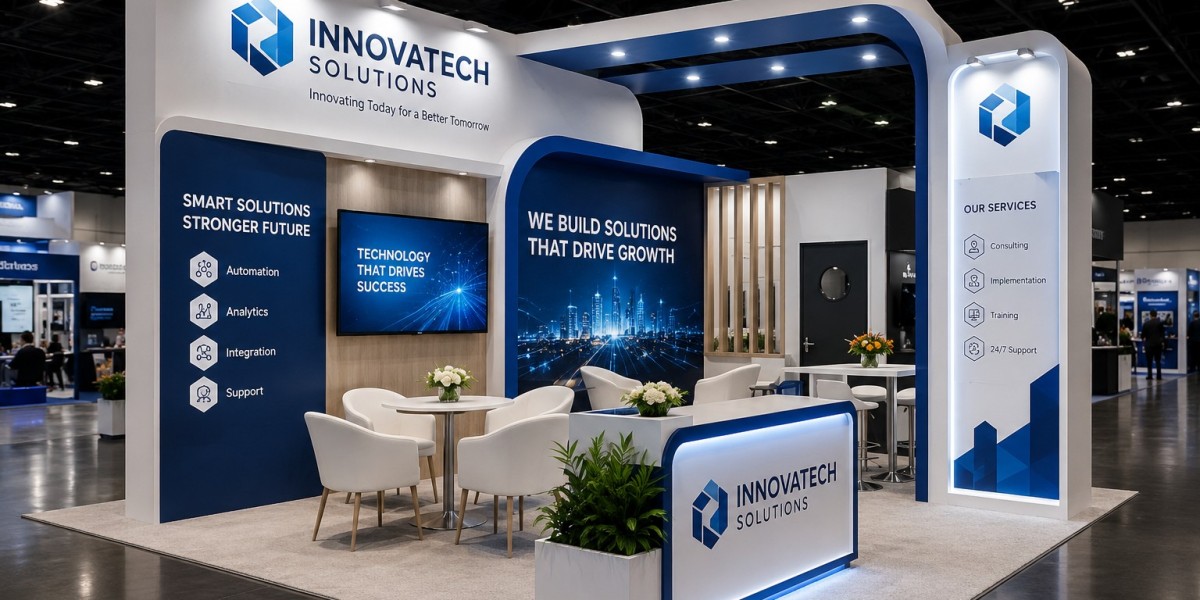


Choosing the right exhibition booth is an important decision for any company preparing for a trade show. Your display must do more than occupy floor space—it should represent your brand, attract the right audience, communicate your value proposition, and encourage visitors to interact with your team. A strategic trade show display design can help you create a professional and memorable presence while supporting your marketing and sales objectives. The key is to select a design that reflects your identity while also considering your audience, booth size, budget, products, event goals, and visitor experience.
Why the Right Display Design Matters
Trade shows are highly competitive environments. Exhibitors are positioned next to companies competing for the same audience, and attendees often have limited time to visit every booth.
Your display may be the first interaction someone has with your brand.
A strong exhibit can:
Capture attention from the aisle
Communicate your brand identity
Explain your products or services
Encourage visitors to enter
Support product demonstrations
Facilitate sales conversations
Generate qualified leads
Create memorable brand experiences
A poorly planned booth can have the opposite effect. Cluttered graphics, confusing layouts, insufficient lighting, or inaccessible spaces may cause potential customers to walk past without stopping.
The goal is to create a display that looks professional while serving a specific business purpose.
Start by Defining Your Trade Show Goals
Before selecting a display style, determine what you want to accomplish at the event.
Your goals should influence the design from the beginning.
For example, a company launching a new product may need prominent product displays and demonstration areas. A business focused on networking may need comfortable meeting spaces. A company targeting lead generation may prioritize reception areas and digital lead-capture tools.
Common exhibition goals include:
Increasing brand awareness
Generating qualified leads
Launching products
Demonstrating solutions
Meeting existing customers
Building industry partnerships
Educating prospects
Scheduling sales appointments
Once you identify the primary objective, it becomes easier to determine which design elements deserve the most attention.
Understand Your Target Audience
Your booth should be designed for the people you want to attract.
Consider who will attend the event and what matters most to them.
A technical audience may want detailed demonstrations and product specifications. Executives may prefer concise information about business value, efficiency, and return on investment. Retail buyers may be interested in product presentation and ordering information.
Ask yourself:
Who is our ideal visitor?
What challenges are they facing?
What products or services interest them?
What questions will they ask?
What would make them stop?
What information do they need before taking the next step?
Understanding these factors can help you create a more relevant visitor experience.
Consider Your Booth Size
Booth dimensions have a major impact on display selection.
A smaller inline booth requires careful use of limited floor space. A larger island booth provides more freedom to create meeting rooms, demonstration areas, product zones, and interactive experiences.
For smaller spaces, prioritize:
Strong overhead branding
Large graphics
Open pathways
Compact furniture
Vertical displays
Integrated storage
Focused product presentation
For larger spaces, you may be able to include:
Multiple product zones
Meeting rooms
Lounges
Demonstration theaters
Interactive installations
Hospitality areas
Private consultation spaces
The design should fit the space rather than attempting to squeeze too many features into it.
Choose Between Custom and Modular Designs
Exhibitors often have to decide whether a custom or modular approach is more appropriate.
Custom Displays
Custom designs can be developed around your exact brand requirements, products, messaging, and visitor journey.
They may be particularly useful when:
Brand differentiation is a priority
The booth has unusual dimensions
You need specialized product displays
You want a distinctive architectural structure
The event is strategically important
Modular Displays
Modular systems use flexible components that can often be configured for different spaces and events.
They may be suitable when:
You attend multiple trade shows
Booth sizes vary
Flexibility is important
You want reusable components
You need an adaptable exhibition system
The right choice depends on your event schedule, objectives, brand requirements, and budget.
Match the Design to Your Brand Identity
Your booth should feel like a physical extension of your brand.
Visitors should recognize your company through colors, typography, imagery, messaging, and overall visual style.
For example, a technology company may use clean architectural lines, digital interfaces, and contemporary graphics. A natural-products company might use organic materials, natural imagery, and an approachable environment.
Consistency matters.
Your booth should visually connect with:
Website
Advertising
Product packaging
Sales materials
Social media
Corporate identity
When these elements align, visitors can develop stronger brand recognition.
Develop a Clear Value Proposition
Your display should quickly communicate why visitors should care about your company.
A clear value proposition can answer:
What do you offer, who is it for, and what benefit does it provide?
Keep the primary message concise.
Avoid placing lengthy paragraphs across major booth graphics. Visitors are usually walking, talking, and looking at multiple displays simultaneously.
A short headline supported by strong imagery can have a greater impact than a wall of text.
Detailed information can be provided through conversations, brochures, product demonstrations, QR codes, and digital content.
Think About Visibility From the Aisle
A booth must attract attention before visitors enter it.
Consider what people will see from several feet away.
Important branding should be positioned where it remains visible above crowds and surrounding displays.
Useful visibility elements can include:
Hanging signs
Elevated logos
Tall branded structures
Backlit graphics
Large-format imagery
Illuminated product displays
Your most important message should be easy to recognize without requiring attendees to walk directly into the booth.
Select Graphics Carefully
Graphics play a central role in booth communication.
Good graphics should be visually attractive while communicating a clear message.
Consider:
Image Quality
Large-format graphics require high-resolution imagery to maintain a professional appearance.
Typography
Fonts should be easy to read at different distances.
Contrast
Text should stand out clearly against the background.
Message Length
Keep headlines concise and supporting information limited.
Visual Hierarchy
Make sure visitors know what to look at first, second, and third.
Avoid treating the booth like a printed brochure. Large displays need a different communication strategy.
Use Lighting to Support the Design
Lighting can make an ordinary booth look more polished and can direct attention toward key areas.
Use lighting strategically rather than simply illuminating every surface.
For example, focused lighting can highlight a product demonstration. Backlighting can make graphics more visible. Architectural lighting can emphasize the structure of the exhibit.
Lighting can also influence the atmosphere.
A professional display might use crisp illumination, while a hospitality-oriented booth could benefit from warmer, more comfortable lighting.
The design should account for the venue's existing lighting conditions.
Create an Effective Visitor Flow
The physical layout should encourage natural movement.
Visitors should be able to enter, explore, interact, and find staff without encountering obstacles.
A useful visitor journey can be structured as:
Attract → Enter → Discover → Interact → Discuss → Follow Up
Each stage should be supported by the booth.
Graphics attract attention. An open entrance encourages entry. Product displays support discovery. Demonstrations create interaction. Staff facilitate conversations. Lead capture enables follow-up.
When the journey is thoughtfully designed, the booth becomes easier to navigate and more effective.
Make Products the Center of Attention
If products are the primary reason people should visit your booth, design the environment around them.
Avoid hiding products behind counters or placing them where visitors cannot easily see them.
Use appropriate display heights, lighting, signage, and demonstration areas.
For large products, make sure attendees can see them from multiple angles. For smaller products, consider display cases, shelves, interactive screens, or hands-on stations.
Product presentation should answer the visitor's most important questions without overwhelming them.
Incorporate Demonstrations
Demonstrations can help visitors understand products more quickly than static graphics.
A good demonstration area should be:
Visible
Accessible
Easy to understand
Large enough for visitors
Supported by knowledgeable staff
Keep demonstrations focused.
Rather than explaining every feature, concentrate on the problems your product solves and the benefits it delivers.
For complex solutions, scheduled presentations can provide a deeper educational experience.
Add Technology Where It Makes Sense
Technology can make your booth interactive, but it should have a purpose.
Potential options include:
Touchscreen displays
Product configurators
Interactive presentations
Augmented reality
Virtual demonstrations
Digital catalogs
Lead-capture systems
Before adding technology, consider whether it improves the visitor experience.
A large video wall may attract attention, but if visitors simply watch passively without learning anything relevant, its value may be limited.
Technology works best when it helps people understand, explore, compare, or experience your products.
Include Comfortable Meeting Areas
If your trade show strategy involves sales conversations, meetings, or customer consultations, make space for them.
A small counter may be appropriate for short discussions. A table and chairs can support longer conversations. Larger exhibits can incorporate private or semi-private meeting rooms.
Do not allow meeting areas to dominate the booth.
Visitors should still be able to see products and enter the space comfortably.
A good design balances open engagement with more focused conversation areas.
Consider Storage Early
Storage may not be visually exciting, but it is essential.
Staff members need somewhere to place:
Personal belongings
Marketing materials
Product samples
Packaging
Supplies
Promotional items
Without storage, these items can quickly create visible clutter.
Integrated cabinets, counters, shelving, and hidden storage compartments can keep the booth organized while maintaining a professional appearance.
Plan for Accessibility
An effective booth should be easy for different visitors to navigate.
Make sure pathways are clear and important information can be accessed comfortably.
Consider the placement and height of displays, furniture, interactive technology, and product samples.
Accessibility should be part of the initial design process.
A welcoming exhibit makes it easier for more attendees to engage with your brand.
Stay Within Your Budget
Budget is one of the most important factors when selecting a display.
However, the cheapest option is not always the most cost-effective.
Consider the complete exhibition investment, including:
Design
Construction
Graphics
Furniture
Lighting
Technology
Shipping
Installation
Storage
Dismantling
Prioritize elements that directly contribute to your objectives.
For example, if product demonstrations generate the most leads, allocating more resources to demonstration space may make sense. If brand visibility is the primary objective, high-impact graphics and signage may deserve greater investment.
Think Beyond a Single Event
If your company participates in several trade shows each year, choose a design strategy that can evolve.
A modular or adaptable system may allow you to change graphics, furniture, product displays, and configurations for different events.
Consider how the display could work at:
Large industry conferences
Regional exhibitions
Product launches
International events
Smaller networking shows
A flexible design can increase the value of your investment over time.
Coordinate Design With Marketing
Your booth should not operate independently from the rest of your marketing campaign.
If you are launching a new product at the event, the booth should reinforce the same messaging used in advertising, email campaigns, social media, and sales materials.
Create a consistent campaign theme across all channels.
This helps attendees recognize the connection between the content they saw before the event and what they experience at the booth.
Train Your Staff to Use the Booth
Even an excellent design cannot compensate for an unprepared team.
Staff should know how every part of the display supports the visitor experience.
They should understand:
The main booth message
Product demonstrations
Interactive technology
Lead-capture procedures
Meeting areas
Visitor qualification
Follow-up processes
Staff should also maintain professional behavior throughout the event.
A welcoming booth requires welcoming people.
Avoid Common Display Design Mistakes
Several mistakes can undermine an otherwise strong exhibition strategy.
Overcrowding
Trying to include too many features can make the booth difficult to navigate.
Excessive Text
Visitors rarely stop to read long paragraphs on booth walls.
Weak Branding
If attendees cannot identify the company quickly, the display loses impact.
Poor Lighting
Important products and graphics may disappear without adequate illumination.
Blocked Entrances
Furniture and structures should not discourage visitors from entering.
Unnecessary Technology
Every technological feature should serve a specific objective.
Lack of Storage
Visible clutter can reduce the booth's professional appearance.
Evaluate the Design Before the Event
Before installation, review the complete design from the visitor's perspective.
Ask:
Can the booth be recognized from the aisle?
Is the main message obvious?
Is the entrance inviting?
Are products easy to see?
Can visitors move comfortably?
Is there enough meeting space?
Are demonstrations easy to watch?
Is branding visible from multiple directions?
Is storage available?
Is lead capture convenient?
A pre-event review can identify problems while there is still time to make changes.
Measure Performance After the Show
Your design should ultimately be judged by results.
After the event, analyze:
Total booth traffic
Qualified leads
Demonstrations completed
Meetings held
Sales opportunities
Customer feedback
Social media engagement
Follow-up conversions
Compare the results against the objectives established before the show.
This information can help you improve the next display.
Final Thoughts
Choosing the right display requires more than selecting an attractive booth structure. The ideal design should align with your brand, audience, booth size, event objectives, products, budget, and visitor journey. When graphics, architecture, lighting, technology, demonstrations, furniture, and messaging work together, your exhibit can create a professional and memorable experience that supports meaningful business conversations. By carefully planning every element, trade show display design can become a strategic asset that helps your company attract attention, engage qualified prospects, strengthen brand recognition, and generate better results from every trade show.






