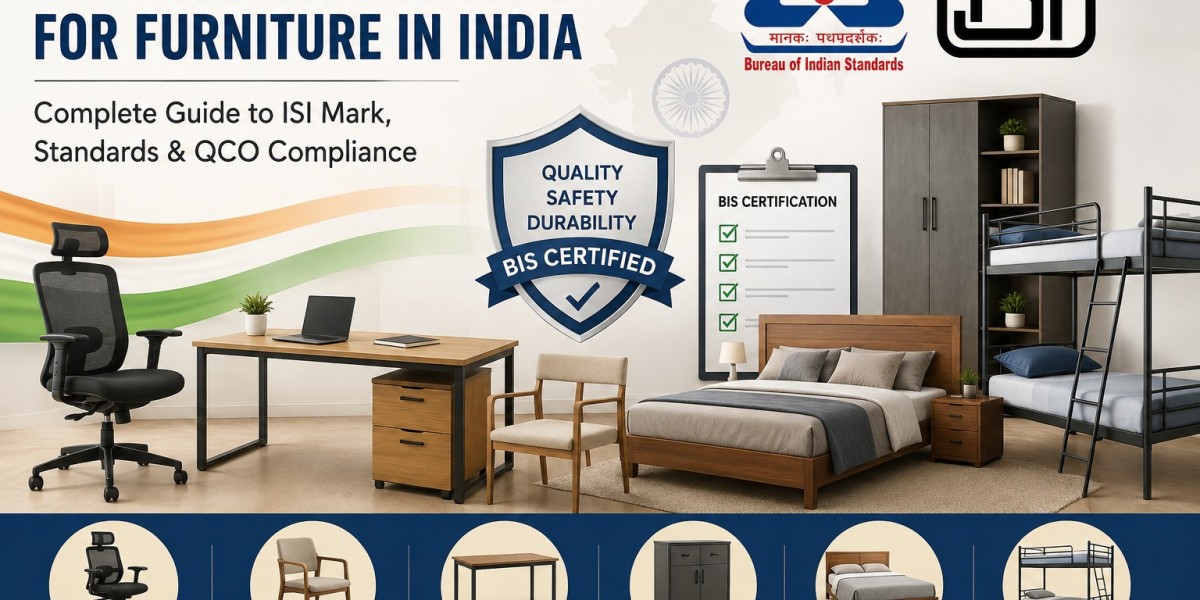


The Bureau of Indian Standards (BIS) is India's national standards body responsible for developing and implementing standards for products, processes, and services. BIS certification helps demonstrate that a product meets applicable Indian Standards (IS) relating to quality, safety, performance, and manufacturing requirements.
What Is BIS Certification for Furniture?
BIS certification is a conformity assessment system through which a manufacturer demonstrates that its product complies with the relevant Indian Standard.
For furniture, BIS requirements can apply to specific categories and products rather than automatically covering every type of furniture. Depending on the product, applicable standard, and regulatory requirements, manufacturers may need to obtain a BIS licence for furniture before manufacturing or selling the product in India.
Furniture products may include items such as:
- Chairs and seating products
- Tables and desks
- Storage furniture
- School and institutional furniture
- Office furniture
- Other specified furniture products
Therefore, manufacturers and importers should first identify the exact product category and applicable Indian Standard before beginning the certification process.
Why Is BIS Certification Important for Furniture?
BIS certification provides several advantages to furniture manufacturers, importers, retailers, and consumers.
1. Demonstrates Product Quality
Compliance with the applicable Indian Standard indicates that the furniture has been evaluated against defined technical requirements. This can improve customer confidence in the product.
2. Supports Consumer Safety
Furniture is used daily in homes, offices, schools, hospitals, and commercial spaces. Proper standards can help address factors such as strength, stability, durability, construction, and safety.
3. Helps Meet Regulatory Requirements
Where BIS certification or a BIS licence is mandatory for a particular furniture product, compliance is essential for lawful manufacture, import, or sale in India.
4. Improves Market Credibility
Certified products can have an advantage when dealing with institutional buyers, corporate customers, government procurement, distributors, and large retail networks.
5. Supports Business Expansion
Manufacturers that maintain consistent quality and regulatory compliance can find it easier to develop long-term relationships with buyers and enter organised markets.
BIS Certification Process for Furniture
The exact process depends on the applicable certification scheme and product standard. In general, the process may involve the following steps:
Step 1: Identify the Applicable Standard
The manufacturer must determine which Indian Standard applies to the specific furniture product.
Step 2: Review Product Requirements
Technical specifications, materials, construction methods, testing requirements, marking requirements, and other applicable conditions should be reviewed carefully.
Step 3: Prepare Manufacturing Facilities
The manufacturing unit should have suitable infrastructure, production controls, testing arrangements, and quality-control procedures as required by the applicable standard and certification scheme.
Step 4: Product Testing
Samples may need to be tested according to the relevant Indian Standard. Testing may involve parameters such as strength, stability, dimensions, durability, or other product-specific requirements.
Step 5: Submit the Application
The manufacturer submits the required documentation and application to BIS under the applicable conformity assessment procedure.
Step 6: Factory Inspection
Depending on the applicable scheme, BIS may conduct an assessment or inspection of the manufacturing premises to verify production and quality-control arrangements.
Step 7: Grant of Licence
If the product and manufacturing arrangements meet the applicable requirements, BIS may grant the licence. The manufacturer must then continue complying with the relevant requirements, including testing, marking, and surveillance obligations.
Documents Generally Required
The documentation can vary according to the product and certification scheme. Commonly required information may include:
- Manufacturing unit details
- Business registration documents
- Product specifications
- Manufacturing process information
- Details of raw materials
- Quality-control procedures
- Test reports, where applicable
- Machinery and testing equipment details
- Factory layout
- Details of technical and quality personnel
- Applicable standard and product information
It is important to prepare documentation accurately because incomplete or inconsistent information can delay the certification process.
BIS Certification for Imported Furniture
Importers should pay particular attention to compliance when bringing furniture products into India. If a particular furniture category is covered by mandatory BIS requirements, the overseas manufacturer may need to obtain the appropriate BIS approval/licence under the applicable scheme before the product can be legally marketed in India.
Importers should not assume that a foreign quality certificate automatically substitutes for BIS certification. Indian regulatory requirements and applicable Indian Standards must be checked separately.
How Long Does BIS Certification Take?
There is no single fixed timeline for every furniture product. The duration can depend on factors such as:
- Complexity of the product
- Applicable Indian Standard
- Availability of test facilities
- Readiness of the manufacturing unit
- Completeness of documentation
- Factory inspection requirements
- Testing and corrective-action requirements
A manufacturer with well-prepared documentation, appropriate facilities, and compliant products can generally avoid unnecessary delays.
BIS Mark and Compliance
Once certification is granted and the applicable conditions are fulfilled, the manufacturer must follow the prescribed marking and labelling requirements. The use of the BIS Standard Mark must be in accordance with the terms of the licence and applicable BIS rules.
Manufacturers should also maintain ongoing quality controls. Obtaining certification is not the end of the compliance process; continued conformity is important for retaining the licence.
Conclusion
BIS certification plays an important role in India's regulated product ecosystem and can be particularly significant for furniture categories covered by mandatory standards or certification requirements. For manufacturers and importers, the first step is to identify the exact furniture product, determine the applicable Indian Standard, and understand whether BIS certification is mandatory.
A properly managed BIS certification process can help businesses demonstrate quality, strengthen consumer confidence, meet applicable regulatory requirements, and build a stronger presence in the Indian furniture market.






