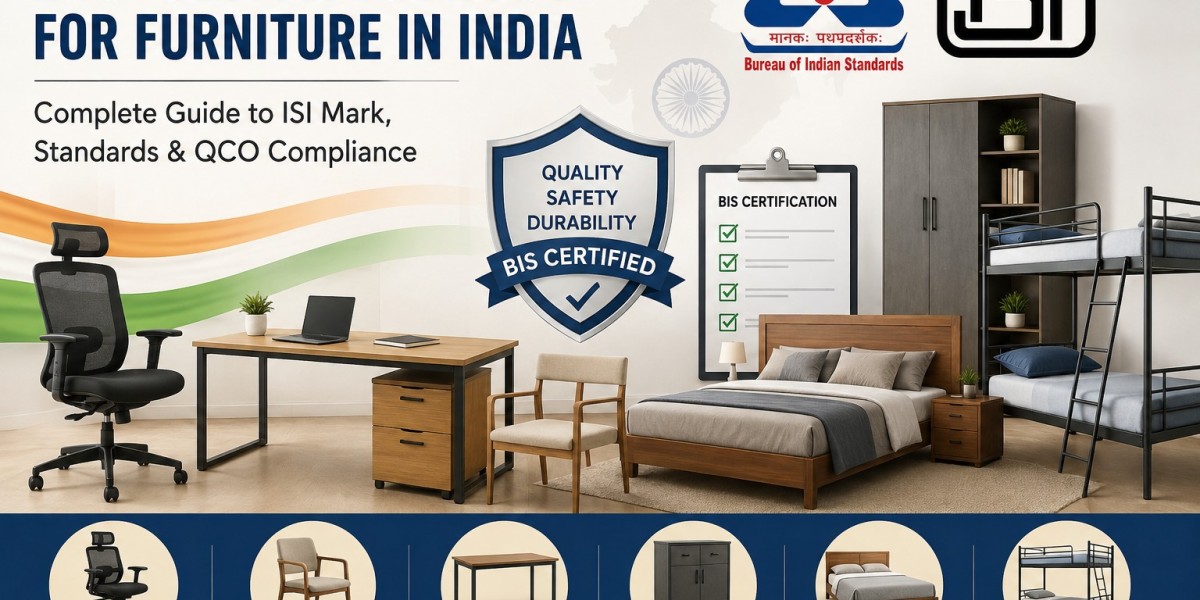


The furniture industry in India is undergoing an important regulatory shift. With the Furniture (Quality Control) Order, 2025, several categories of furniture have been brought under mandatory BIS certification requirements. For furniture manufacturers, importers and businesses planning to enter the Indian market, understanding the applicable Indian Standards and completing the BIS certification process correctly has become increasingly important.
This is where BIS certification consultants specializing in furniture can provide valuable support.
What Is BIS Certification for Furniture?
BIS certification demonstrates that a product complies with the relevant Indian Standard established by the Bureau of Indian Standards (BIS).
Under the Furniture (Quality Control) Order, 2025, specified furniture products must conform to the applicable Indian Standards and bear the BIS Standard Mark under a valid licence.
The covered categories include:
- Work chairs – IS 17631:2022
- General-purpose chairs and stools – IS 17632:2022
- Tables and desks – IS 17633:2022
- Storage units – IS 17634:2022
- Beds – IS 17635:2022
- Bunk beds – IS 17636:2022
Therefore, furniture companies need to determine the correct product category and applicable standard before starting the certification process.
Why Hire a BIS Certification Consultant for Furniture?
The BIS certification process involves technical documentation, product testing, manufacturing-facility assessment and compliance with specific quality requirements. A consultant with experience in furniture certification can help a company navigate these requirements efficiently.
1. Identifying the Correct BIS Standard
One of the first challenges is determining which Indian Standard applies to a particular furniture product.
A furniture manufacturer may produce multiple products, such as chairs, tables, storage units and beds. Each category may have different technical requirements and certification considerations.
A specialized consultant can review the company's product range and help identify:
- Applicable Indian Standards
- Relevant product categories
- Required testing
- Product scope
- Model or design coverage
- Documentation requirements
Correct standard identification at the beginning can help prevent delays caused by submitting an application under an inappropriate standard.
2. Understanding Furniture-Specific Requirements
Furniture certification is not identical across all product categories.
Different furniture standards may contain requirements concerning construction, dimensions, strength, stability, durability, materials, safety and performance.
For example, the BIS product manual for IS 17632:2022, covering general-purpose chairs and stools, includes requirements related to product design/model information, principal materials and specified product testing.
A consultant specializing in furniture certification can help manufacturers understand how these requirements apply to their particular products.
3. Preparing the BIS Application
A BIS application requires accurate information about the manufacturer, factory, products, manufacturing process and quality-control arrangements.
Consultants can assist with preparing and reviewing documents such as:
- Manufacturer details
- Factory information
- Product specifications
- Product drawings
- Manufacturing process information
- Raw-material details
- Quality-control procedures
- Testing arrangements
- Equipment and calibration records
- Product photographs
- Model/design details
The objective is to ensure that the information submitted to BIS accurately reflects the manufacturer's actual operations.
4. Arranging Product Testing
Testing is a critical part of furniture certification.
The specific tests depend on the applicable Indian Standard and product category. BIS provides laboratory-related information through its laboratory management system, including facilities associated with particular standards.
A specialized consultant can help coordinate the testing process and identify the appropriate testing requirements before samples are submitted.
This can be particularly useful for companies with multiple furniture models, because testing requirements and product coverage need to be evaluated carefully.
5. Preparing the Factory for BIS Assessment
BIS may assess the manufacturing premises to determine whether the manufacturer has adequate production and quality-control capabilities.
A furniture certification consultant can conduct a pre-assessment or readiness review covering areas such as:
- Manufacturing infrastructure
- Production processes
- Quality-control procedures
- Inspection arrangements
- Testing facilities
- Measuring and testing equipment
- Calibration records
- Raw-material controls
- Finished-product inspection
- Quality records
Identifying gaps before the official assessment can give manufacturers an opportunity to address compliance issues in advance.
6. Assistance With Documentation and Quality Control
Documentation is an important component of a successful certification process.
Furniture manufacturers should maintain appropriate records demonstrating that production and quality-control processes are being followed.
Consultants can help establish or organize:
- Quality-control plans
- Inspection procedures
- Test records
- Raw-material inspection records
- Calibration records
- Production records
- Finished-product inspection records
- Internal quality-control documentation
A well-organized documentation system can make ongoing compliance easier after certification is obtained.
7. Support During BIS Inspection
Factory assessment can be an important stage of the certification process.
A consultant familiar with furniture certification can help the manufacturer prepare personnel and documentation for the assessment and coordinate responses to observations raised during the process.
The consultant's role may include:
- Reviewing readiness before the visit
- Coordinating required documents
- Explaining applicable requirements
- Helping address technical observations
- Supporting communication during the certification process
- Assisting with corrective actions where required
8. Assistance for Multiple Furniture Products
Furniture companies frequently manufacture several product categories.
For example, a single manufacturer may produce:
- Wooden chairs
- Office chairs
- Dining tables
- Desks
- Storage cabinets
- Beds
- Bunk beds
Because different products can fall under different Indian Standards, managing certification can become complicated.
A furniture-focused BIS consultant can help create a certification roadmap showing which products require certification, which standards apply and what testing and documentation are required for each category.
BIS Certification for Indian and Foreign Furniture Companies
Consultancy requirements can differ depending on whether the applicant is an Indian manufacturer or a foreign manufacturer.
For an Indian manufacturer, the focus may primarily be on the domestic manufacturing facility, product testing and BIS application process.
Foreign manufacturers may have additional requirements and should determine the applicable BIS certification route based on their manufacturing location, product category and intended Indian-market activities.
A consultant experienced in international furniture compliance can help foreign companies understand the relevant procedure before supplying covered products to India.
How to Choose a BIS Consultant for a Furniture Company
Not every BIS consultant will necessarily have the same level of experience with furniture products.
Before appointing a consultant, companies should consider:
Industry Experience
Ask whether the consultant has handled certification for furniture products and relevant Indian Standards.
Technical Knowledge
The consultant should understand furniture-specific testing, product specifications, manufacturing processes and quality-control requirements.
Documentation Capability
Good consultants should be able to help organize technical documents and identify missing information.
Testing Support
Check whether the consultant can coordinate the testing process and help interpret test requirements.
Factory Assessment Preparation
A consultant should be able to evaluate the manufacturing facility before the BIS assessment.
Post-Certification Support
BIS compliance does not necessarily end when the licence is granted. Companies should maintain conformity and comply with applicable surveillance, testing and marking requirements.
A consultant offering continuing compliance support can therefore be useful for manufacturers with ongoing certification obligations.
Benefits of Working With a Specialized Furniture BIS Consultant
Hiring an experienced consultant can provide several practical benefits:
- Better understanding of applicable standards
- Reduced documentation errors
- More efficient testing coordination
- Improved factory preparedness
- Assistance with technical compliance
- Support during BIS assessment
- Better management of multiple products
- Guidance on maintaining certification after approval
However, certification is ultimately based on compliance with BIS requirements. A consultant cannot substitute for the manufacturer's responsibility to maintain compliant products and manufacturing processes.
What Is the BIS Certification Process for Furniture?
A typical certification journey can be summarized as:
Product Identification → Applicable IS Standard → Gap Assessment → Documentation → Product Testing → BIS Application → Factory Assessment → Compliance/Corrective Actions → Licence Grant → Ongoing Compliance
The exact procedure can vary depending on the product, applicable standard and BIS certification scheme.
Frequently Asked Questions
Is BIS certification mandatory for all furniture?
No. The Furniture (Quality Control) Order, 2025 applies to the furniture categories specifically covered by the Order. Companies should verify whether their particular product falls within a covered category.
Can one BIS licence cover different types of furniture?
The scope of certification depends on the applicable standard and products covered by the licence. Different furniture categories may require certification against different standards.
Do wooden furniture products also require BIS certification?
Wooden furniture can fall within the covered categories. The material alone does not determine the requirement; the specific furniture product and applicable standard must be considered.
Can a BIS consultant guarantee certification?
No consultant can legitimately guarantee approval independently of BIS's assessment and the manufacturer's compliance. A consultant can provide technical guidance and help the applicant prepare properly.
Is BIS certification a one-time process?
Obtaining the licence is not the end of compliance. Manufacturers must continue to meet applicable requirements, including product conformity, quality control, testing and marking obligations.
Conclusion
For furniture manufacturers, BIS certification can involve several technical and administrative requirements. From identifying the correct Indian Standard and arranging product testing to preparing the factory for assessment and maintaining compliance, each stage needs careful attention.
BIS certification consultants specializing in furniture companies can simplify this process by combining regulatory knowledge with an understanding of furniture manufacturing and product-specific requirements.
For manufacturers operating in India or planning to sell covered furniture products in the Indian market, choosing a consultant with relevant furniture-sector experience can make the certification process more structured, efficient and manageable.
Before beginning an application, businesses should always verify the latest BIS requirements, applicable Indian Standard and current Furniture Quality Control Order directly through official BIS sources.






