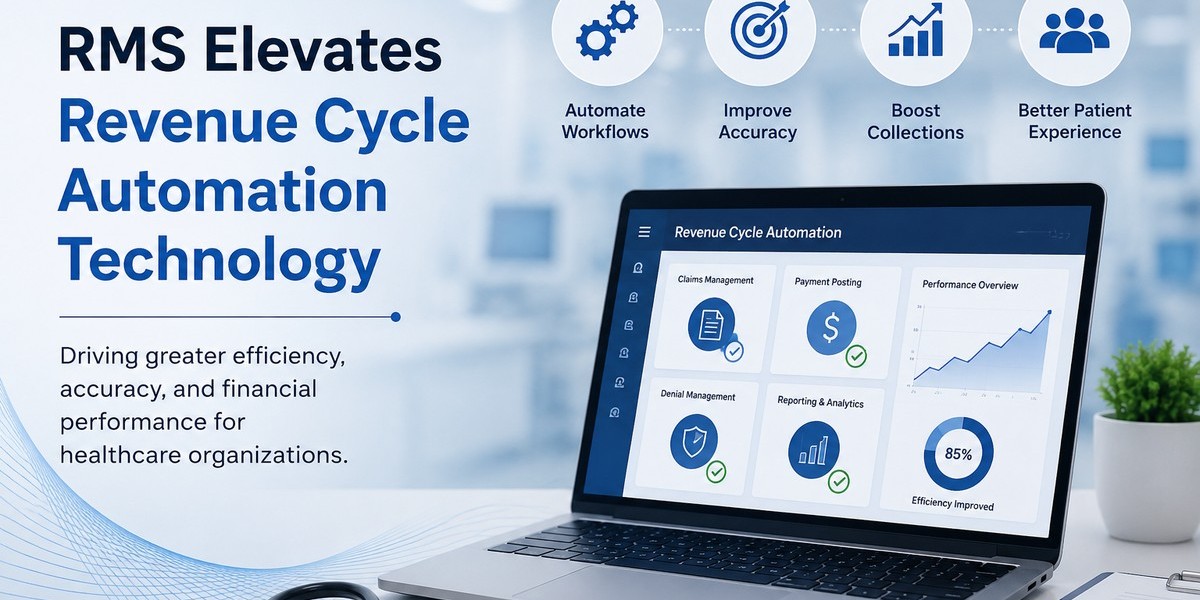


Revenue Management Solutions (RMS) has rolled out a major upgrade to its Revenue Cycle Automation platform, introducing fifth-generation extraction technology designed to help medical providers and financial institutions process complex healthcare data with greater speed and accuracy. The update reflects a broader shift in how healthcare organizations manage remittance data, moving away from one-size-fits-all systems toward more targeted, purpose-built automation.
Rather than depending on a single broad AI model, RMS has built task-specific systems that pair machine learning with layered validation and rule-based controls. Company leadership emphasized that grounding and validating each layer allows the platform to benefit from AI advances without introducing uncertainty into revenue cycle workflows. One of the core challenges RMS set out to solve is the constantly shifting format of payer documentation. Legacy, template-driven systems tend to break down when layouts change. To address this, the updated platform dynamically analyzes document structure and context, allowing it to interpret data consistently across Explanation of Benefits (EOB) forms and other correspondence — even as formatting varies from payer to payer.
The performance gains are substantial. RMS reports that large-document processing speed has increased by as much as tenfold, giving healthcare teams the ability to handle higher volumes and sudden spikes in incoming payer documents without delay. That means faster access to remittance records, even during periods of unexpected industry disruption.
The platform's scope has also widened considerably. RMS expanded the number of automatically indexed document categories from 13 to 25, extending its reach into unstructured payer correspondence that previously required manual sorting. Product leadership at the company framed the update as going beyond simple digitization, aiming to give organizations more usable information from payer communications so manual review can be reduced and work routed more efficiently.
Expanding Beyond Standard EOB Processing
Healthcare organizations regularly contend with lengthy payer documents that bundle multiple patient claims together, creating bottlenecks in manual review. The updated automation engine is built to adapt to these varying formats while easing that manual workload. Notably, RMS has extended its capabilities beyond standard 835 EOB processing to also cover workers' compensation claims and other non-standard forms — a gap that has historically forced billing teams to rely on manual workarounds.
By scaling its claims processing engine, RMS aims to reduce operational bottlenecks across the healthcare revenue cycle and give organizations a more resilient system for medical billing automation. As payer documentation continues to grow in volume and complexity, tools like this are increasingly positioned as a necessity rather than a convenience for healthcare finance teams.
Discover RevTech News for the latest updates on financial innovation and revenue-driven technology.
Read related news -
https://revtech-news.com/configit-named-sample-vendor-in-gartner-report/






