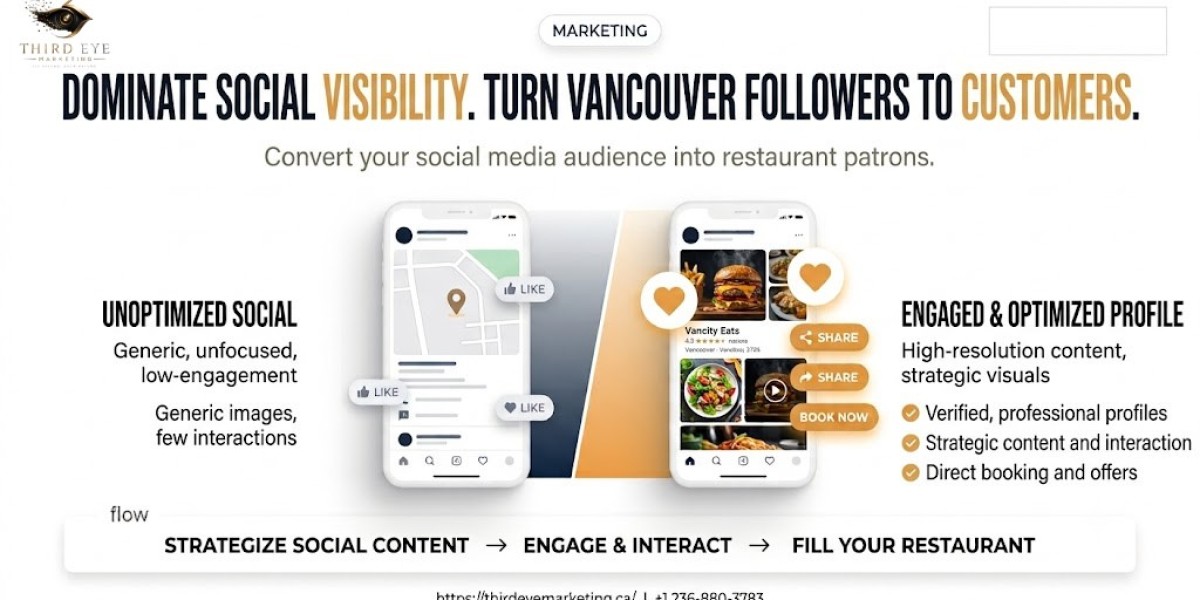


Social Media Marketing for Restaurants: How Vancouver Businesses Can Turn Followers Into Customers
For Vancouver restaurants, social media is no longer just a place to post attractive food photos. It can become a powerful customer acquisition channel that helps restaurants build awareness, increase brand visibility, generate website traffic, encourage reservations and orders, and turn first-time customers into repeat customers.
The challenge is that followers do not automatically become customers.
A restaurant can have thousands of followers and still struggle to generate bookings, orders, or foot traffic. The difference comes from having a strategic social media marketing for restaurants system that connects content, local SEO, paid advertising, website conversion, brand mentions, and customer intent.
For restaurants in Vancouver, Surrey, Chilliwack, and across British Columbia, the goal should be simple:
Turn attention into trust, trust into action, and action into measurable business growth.
How Vancouver Restaurants Can Turn Followers Into Customers
A strong restaurant social media strategy should combine:
High-quality food and experience-focused content
Instagram, Facebook, TikTok, and other relevant platforms
Local Vancouver-focused content
Search-friendly social profiles and captions
Customer-generated content
Reviews and social proof
Influencer and local brand mentions
Organic social media marketing
Paid social advertising
Retargeting campaigns
Website and landing-page optimization
SEO, AEO, GEO, and AIO considerations
Conversion and revenue tracking
The objective isn't simply to increase followers.
It is to create a system where:
Social Discovery → Brand Visibility → Engagement → Website/Google Search → Trust → Reservation/Order → Customer → Repeat Business.
Why Social Media Marketing Matters for Vancouver Restaurants
Food is highly visual.
Customers want to see the dishes, atmosphere, restaurant interior, staff, events, presentation, and overall experience before deciding where to eat.
This makes social platforms particularly valuable for restaurants.
A potential customer may discover a restaurant through a Reel, search for the restaurant on Google, check its reviews, visit the website, look at the menu, and then make a reservation.
Social media therefore shouldn't operate separately from SEO and local marketing.
It should contribute to the restaurant's overall digital ecosystem.
1. Create Content That Sells the Experience
One of the biggest mistakes in social media marketing services is focusing only on promotional posts.
Restaurants should sell more than food.
Content can communicate:
The dining experience
Signature dishes
Chef stories
Restaurant atmosphere
Customer experiences
Behind-the-scenes moments
Special events
Seasonal menus
Staff personalities
Local community involvement
For example, instead of simply posting:
“Try our new pasta.”
Create a short video showing the preparation, ingredients, presentation, atmosphere, and customer experience.
This creates a stronger emotional connection.
2. Build a Local Vancouver Social Media Strategy
A restaurant shouldn't create content as if it is marketing to the entire internet.
It should build relevance within the communities it serves.
For social media marketing Vancouver, content can naturally incorporate:
Vancouver neighbourhoods
Local events
Seasonal activities
Community partnerships
Local food trends
Nearby attractions
Customer stories
Vancouver dining occasions
Restaurants targeting Surrey and Chilliwack can use the same principle by developing content connected to those communities.
The objective isn't to force city names into every caption.
It's to make the restaurant feel like part of the local community.
3. Optimize Social Profiles for Search
Social media platforms increasingly function as discovery engines.
People search for restaurants, cuisines, cafés, bars, dishes, events, and local experiences directly within social platforms.
This means social profiles should communicate clearly:
Restaurant name
Location
Cuisine
Services
Website
Contact information
Opening hours where appropriate
Relevant keywords
This can support broader SEO, AEO, GEO, and AIO efforts because consistent information across the digital ecosystem helps reinforce the restaurant's identity and relevance.
4. Connect Social Media With SEO
Social media isn't traditionally treated as a direct Google ranking factor in the same way as many core SEO signals.
However, social activity can contribute indirectly to search visibility and business growth.
For example, strong social content can generate:
Brand searches → Website visits → Brand mentions → Links → Reviews → Local visibility → Organic traffic.
A restaurant that becomes recognizable on Instagram or TikTok may see more people searching its name on Google.
That creates an important connection between social media and SEO.
Your website should also contain valuable content that social posts can send users to.
Examples include:
Full menus
Reservation pages
Catering pages
Private event pages
Restaurant guides
Location pages
Food and dining articles
5. Use Social Media for AEO, GEO and AIO
Modern digital visibility extends beyond traditional search.
AEO — Answer Engine Optimization
Create content that answers questions customers commonly ask.
For example:
What are the best restaurants in Vancouver for date night?
Where can I find vegetarian food in Vancouver?
Which Vancouver restaurants offer catering?
What are the best cafés for working remotely?
Useful answers can support your broader authority and content ecosystem.
GEO — Generative Engine Optimization
AI-driven search systems increasingly use information from across the web to understand businesses.
Consistent brand information, authoritative content, reviews, local references, and third-party brand mentions can strengthen the digital footprint of a restaurant.
AIO — AI Optimization
AI-powered discovery is becoming another path through which customers find businesses.
Restaurants should therefore make their website, profiles, menus, services, locations, and content easy to understand and accurately represented across the web.
6. Generate Brand Mentions and User-Generated Content
One of the most valuable forms of restaurant social proof is content created by customers.
Encourage customers to share:
Food photos
Reels
Stories
Reviews
Restaurant experiences
Special occasions
With appropriate permission, restaurants can feature customer content on their own channels.
Local creators and food bloggers can also increase brand visibility.
However, the focus should be on genuine relevance rather than simply paying for large follower counts.
A Vancouver restaurant mentioned by relevant local creators, publications, communities, and food websites can build a stronger reputation beyond its own social profiles.
7. Social Media Marketing for Different Restaurant Businesses
Different food businesses need different strategies.
Social Media for Food Business
A broader social media for food business strategy should focus heavily on visual storytelling, product discovery, customer experiences, and community engagement.
Social Media Marketing for Coffee Shops
For social media marketing for coffee shops, content can include:
Coffee preparation
Signature drinks
Café atmosphere
Seasonal beverages
Customer routines
Local collaborations
Work-friendly spaces
Social Media Marketing for Bars
Social media marketing for bars can focus on:
Atmosphere
Events
Live entertainment
Food pairings
Venue experience
Special occasions
Social Media Marketing for Small Restaurants
For social media marketing for small restaurants, consistency is more important than trying to produce enormous amounts of content.
A small restaurant can compete effectively by creating authentic content that highlights its people, food, story, neighbourhood, and customer experience.
8. Combine Organic Content With Paid Social
Organic content builds long-term brand awareness.
Paid advertising can accelerate reach and customer acquisition.
This is where a social media ad agency or paid social media agency can add value.
Restaurant campaigns can potentially target:
People within relevant geographic areas
Website visitors
Previous customers
Social media engagers
People interested in relevant food experiences
Lookalike or similar audiences where appropriate
The key is to avoid measuring campaigns only by impressions or clicks.
Measure:
Reservations
Orders
Calls
Website conversions
Catering inquiries
Event inquiries
Cost per qualified lead
Customer acquisition cost
Revenue generated
9. Use Retargeting to Recover Lost Customers
Many people won't order immediately after seeing a restaurant post.
They may visit the website, look at the menu, and leave.
Retargeting can bring those users back with relevant messaging.
For example:
First interaction: Customer watches a food Reel.
Second interaction: Customer visits the website.
Retargeting: Customer sees an ad highlighting the restaurant's signature dining experience.
Conversion: Customer makes a reservation or order.
This creates a more complete customer journey.
10. Social Media Should Support Local Search
The strongest restaurant marketing strategies don't separate social media from Google.
A customer might discover a restaurant on Instagram but then search:
“Restaurant name Vancouver.”
They may then visit the Google Business Profile, read reviews, check photos, and visit the website.
That means your social media strategy should strengthen the same brand identity customers see elsewhere.
Keep your:
Restaurant name
Location
Website
Cuisine
Contact information
Brand messaging
Visual identity
consistent across major channels.
This consistency can support brand visibility, local discovery, organic traffic, and trust.
Choosing a Social Media Marketing Agency
Restaurants searching for a social media marketing agency should evaluate more than follower growth.
A strong agency should understand:
Restaurant customer behaviour
Local marketing
Content strategy
SEO
Paid social
Conversion tracking
Retargeting
Brand building
AEO
GEO
AIO
When evaluating social media agency services or social media marketing agency services, ask how the agency connects social activity with actual business outcomes.
Businesses looking for a social media agency Canada, social media marketing agency Canada, or social media marketing agency in Canada may also need a strategy that can scale beyond one location.
For Vancouver restaurants, a social media agency Vancouver can provide valuable local-market context.
Similarly, a restaurant looking for a social media digital marketing agency should consider whether the agency can connect social media with SEO, websites, Google Business Profile, paid advertising, and analytics.
What Makes the Best Social Media Marketing Agency?
The best social media marketing agency isn't necessarily the agency with the largest follower count.
A better question is:
Can the agency turn attention into business?
Look for an agency that can demonstrate:
Strong creative strategy
Local audience understanding
Consistent content production
Paid advertising expertise
Conversion tracking
Lead generation
Brand-building capabilities
SEO integration
Clear reporting
Revenue-focused optimization
For restaurants, vanity metrics should never be the only measurement.
Food & Beverage Social Media Marketing as a Growth System
Food and beverage social media marketing requires a balance between creativity and commercial strategy.
Content should create desire.
SEO should create discoverability.
Reviews should create trust.
Paid advertising should create additional reach.
A website should create conversions.
Analytics should tell you what is working.
This is the foundation of modern food industry social media marketing.
Instead of treating Instagram, Facebook, TikTok, Google, SEO, and paid advertising as disconnected activities, restaurants should build one connected customer journey.
Why Third Eye Marketing?
Third Eye Marketing focuses on building digital marketing systems that connect content, SEO, social media, paid advertising, local visibility, AEO, GEO, AIO, and lead generation.
For restaurants, the strategy goes beyond creating attractive posts.
The focus is on helping businesses:
Get discovered → Build brand recognition → Earn trust → Generate traffic → Convert customers → Increase repeat business.
Whether a restaurant needs social media marketing services, paid advertising, local SEO, content strategy, or a complete digital marketing approach, the objective should remain measurable business growth.
Practical Mistakes Restaurants Should Avoid
Posting without a strategy
Random food photos rarely create a sustainable customer acquisition system.
Chasing followers
A smaller local audience with strong buying intent can be more valuable than thousands of irrelevant followers.
Ignoring Google
Social media should complement Google Search, Maps, reviews, and the restaurant website.
Using only promotional content
Customers want stories, experiences, entertainment, information, and authenticity.
Not tracking conversions
If you don't know which campaigns generate orders or reservations, optimization becomes guesswork.
Ignoring local identity
Vancouver, Surrey, and Chilliwack customers respond to content that feels relevant to their communities.
From Followers to Customers
A successful restaurant social media strategy should follow a clear funnel:
Awareness
Create compelling food and experience content.
↓
Discovery
Use social search, SEO, local content, and brand mentions.
↓
Trust
Build reviews, user-generated content, authority, and social proof.
↓
Consideration
Send customers to your website, menu, Google Business Profile, or reservation page.
↓
Conversion
Generate reservations, orders, calls, and inquiries.
↓
Retention
Use social media to bring customers back.
That is how social media becomes a business-building channel rather than simply a content channel.
Social media marketing for restaurants is most effective when followers are treated as potential customers rather than vanity metrics.
For restaurants in Vancouver, Surrey, Chilliwack, and British Columbia, the strongest strategy combines compelling content, local relevance, SEO, AEO, GEO, AIO, brand mentions, organic traffic generation, paid social advertising, retargeting, and conversion tracking.
The ultimate goal is:
Followers → Attention → Trust → Traffic → Leads → Customers → Repeat Business → Revenue.
If your restaurant wants to turn social media into a measurable customer acquisition and brand-building channel, Third Eye Marketing can help develop a strategy built around visibility, leads, and sustainable business growth.
Book a FREE consultation with Third Eye Marketing.
Call us at +1 236-880-3783
Visit Our Website: https://thirdeyemarketing.ca/
FAQs
1. What is social media marketing for restaurants?
Social media marketing for restaurants uses platforms such as Instagram, Facebook, TikTok, and other relevant channels to build awareness, showcase food and experiences, engage local audiences, generate traffic, and convert customers into orders, reservations, visits, and repeat business.
2. How can Vancouver restaurants turn social media followers into customers?
Restaurants can convert followers by creating compelling content, using clear calls to action, connecting social profiles with their website and Google Business Profile, using retargeting, promoting relevant offers or experiences, and tracking reservations, orders, calls, and other conversions.
3. Should restaurants use paid social media advertising?
Paid social media advertising can help restaurants reach relevant local audiences faster than organic content alone. Campaigns should be optimized around measurable outcomes such as reservations, online orders, inquiries, and customer acquisition cost rather than impressions alone.
4. How does social media help restaurant SEO?
Social media can indirectly support SEO by increasing brand awareness, generating branded searches, encouraging website traffic, supporting content distribution, and creating opportunities for brand mentions and links from relevant third-party websites.
5. How do I choose the best social media marketing agency for my restaurant?
Look for an agency with experience in restaurant marketing, local audience targeting, content strategy, paid social advertising, conversion tracking, SEO, and brand building. The agency should be able to demonstrate how its social media activity contributes to qualified leads, customers, and revenue rather than only follower growth.






