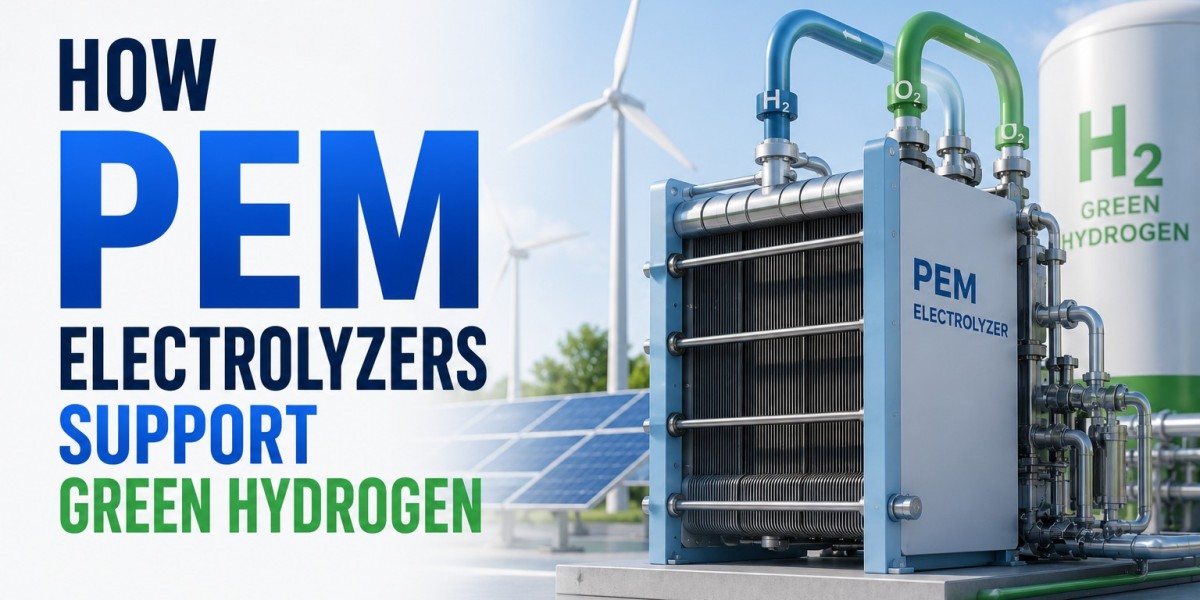


Proton exchange membrane electrolyzers are becoming important in the development of low-emission hydrogen because they can use electricity to split water into hydrogen and oxygen. When powered by renewable electricity, this process can produce green hydrogen for industries that are difficult to electrify directly. PEM electrolyzers are valued for compact design, fast response, high-purity hydrogen output, and suitability for variable renewable-energy systems.
A published study by MarkNtel Advisors reports that the global PEM electrolyzer industry was valued at USD 0.91 billion in 2025. It is projected to grow from USD 1.52 billion in 2026 to USD 12.29 billion by 2032, registering a CAGR of around 41.6% during 2026–32. Europe holds nearly 40% share, while platinum-based cathode catalysts account for approximately 47% in 2026.
Green Hydrogen Drives Technology Demand
Green hydrogen is attracting attention because it can support decarbonisation in sectors where direct electrification is challenging. Steel, refining, ammonia, chemicals, heavy transport, shipping, and long-duration energy storage may require hydrogen or hydrogen-derived fuels to reduce emissions. PEM electrolyzers are relevant because they can be paired with renewable power and operated flexibly according to electricity availability.
The International Energy Agency states that electrolysers are a critical technology for producing low-emissions hydrogen from renewable or nuclear electricity. This makes electrolyzer deployment central to hydrogen strategies, especially in regions seeking to reduce dependence on fossil-based hydrogen production.
Renewable Integration Supports PEM Use
PEM electrolyzers can respond quickly to changes in electricity supply, making them suitable for solar and wind integration. Renewable generation fluctuates with weather, time of day, and seasonal patterns. A flexible electrolyzer can increase hydrogen production when renewable electricity is abundant and reduce operation when power availability falls or prices rise.
This dynamic operation is a major advantage over less flexible industrial processes. A 2024 review on PEM electrolyzers notes that dynamic operation can complement variable renewable energy while supporting green hydrogen production. This flexibility helps explain why PEM technology is being considered for renewable-powered hydrogen plants and grid-balancing applications.
Europe Leads Early Deployment
Europe holds a leading position due to its hydrogen strategies, renewable-energy targets, industrial decarbonisation plans, and public funding support. The region is building hydrogen valleys, industrial clusters, transport projects, and demonstration facilities designed to connect renewable power with hydrogen demand. PEM electrolyzers fit these projects where flexible operation and compact installation are important.
European policy also supports domestic electrolyzer manufacturing and supply-chain resilience. Reuters reported that European hydrogen-equipment manufacturers have urged the EU to support local firms as they compete with lower-cost Chinese electrolyzer producers. This shows how hydrogen deployment is linked not only to energy policy but also to manufacturing competitiveness and technology security.
Platinum Catalysts Remain Important
Platinum-based cathode catalysts hold a significant share because PEM systems require highly active materials to support efficient hydrogen evolution. Platinum group metals help improve reaction performance, durability, and reliability under acidic operating conditions. However, these materials also contribute to system cost and supply-chain sensitivity.
Reducing precious-metal use is therefore a key research and manufacturing priority. Catalyst loading optimization, recycling, alternative materials, membrane improvements, and stack design innovation can help reduce cost without sacrificing performance. Manufacturers that improve catalyst efficiency may strengthen commercial competitiveness as projects move from pilot scale toward larger deployment.
Industrial Users Need High-Purity Hydrogen
PEM electrolyzers can produce high-purity hydrogen, which is useful for industrial applications requiring controlled gas quality. Refining, electronics, chemicals, laboratories, fuel-cell mobility, and energy-storage systems can benefit from reliable hydrogen output. On-site hydrogen production may also reduce dependence on delivered hydrogen where transport, storage, or logistics costs are high.
Industrial buyers typically evaluate electrolyzers according to efficiency, hydrogen output, operating pressure, water quality requirements, maintenance needs, power-electronics compatibility, safety systems, and lifecycle cost. For large projects, integration with compression, storage, grid connection, water treatment, and renewable supply is as important as the electrolyzer stack itself.
Scaling Projects Remains Challenging
Although green hydrogen has strong policy and industrial interest, project development faces cost, infrastructure, and demand challenges. Electrolyzers require significant capital investment, while renewable electricity prices, financing conditions, water access, permitting, and offtake agreements influence project viability. Hydrogen also requires safe storage, transport, and end-use infrastructure.
The IEA’s Global Hydrogen Review 2026 reports that installed electrolysis capacity doubled in 2025 to surpass 4 GW, showing progress but also indicating that deployment remains early compared with announced project pipelines. Scaling PEM electrolyzers will depend on converting plans into financially supported, operational projects.
Water and Power Quality Matter
Electrolysis requires water, electricity, and supporting systems that meet technical specifications. PEM electrolyzers generally require high-purity water to protect membranes and catalysts. Water treatment systems are therefore necessary, especially in industrial sites where feedwater quality varies. Poor water quality can reduce stack life and increase maintenance costs.
Power quality also matters. Electrolyzers require power electronics that convert and regulate electricity for stable operation. When connected to variable renewable generation, control systems must manage fluctuations while protecting the stack from unnecessary stress. This creates opportunities for advanced monitoring, digital controls, and predictive maintenance.
Cost Reduction Will Shape Adoption
The cost of PEM electrolyzers must continue declining for broader commercial adoption. Manufacturing scale, automated stack assembly, reduced catalyst loading, improved membranes, standardized balance-of-plant components, and supply-chain development can all contribute to lower costs. Operational learning from early projects will also help improve system reliability and performance.
A 2025 technical cost study projected that PEM and alkaline electrolyzers could move toward similar cost levels by 2030, while efficiency improvements could reduce hydrogen production costs over time. This reinforces the importance of technology learning, scale, and system integration in making green hydrogen more competitive.
Outlook for PEM Electrolyzers
PEM electrolyzer demand is expected to remain supported by renewable-energy expansion, hydrogen policy, industrial decarbonisation, fuel-cell mobility, and energy-storage applications. Europe will continue to hold an important position, while other regions develop hydrogen hubs and local manufacturing capacity.
Future progress will depend on cost reduction, catalyst availability, stack durability, project financing, water management, and reliable offtake demand. PEM electrolyzers that deliver flexible operation, high-purity hydrogen, efficient performance, and lower lifecycle costs will remain important to the global green hydrogen transition.








