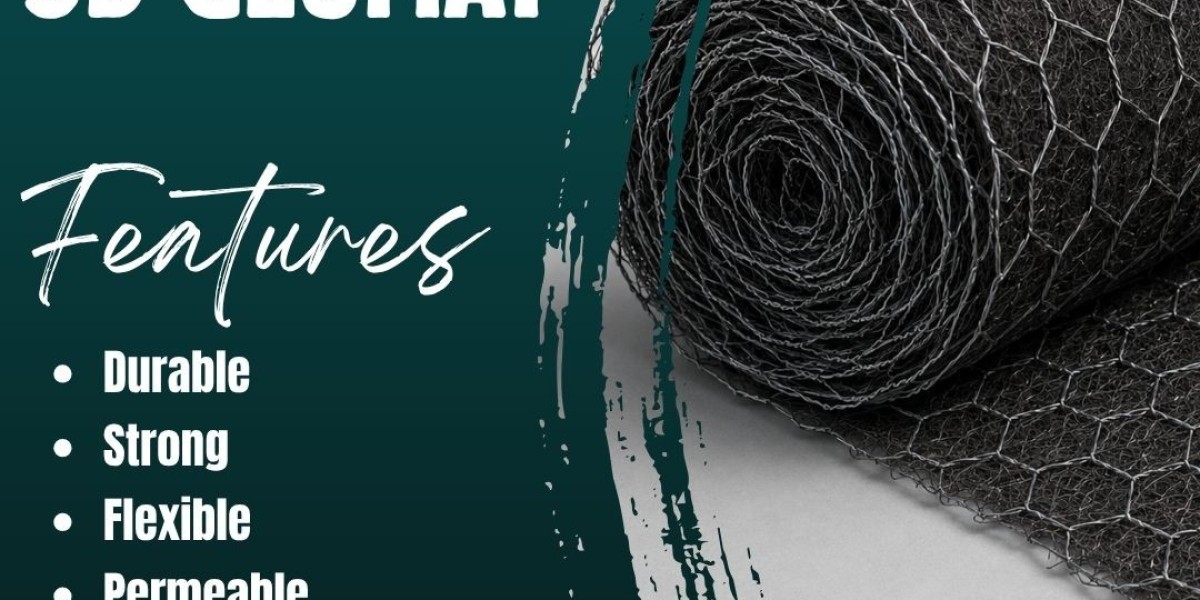


3D geomat is an erosion control fabric which is used to cover and protect the soils while allowing natural plant growth on it. It consists of the polymer fiber which forms a three dimensional mesh. As a result, it provides the surface capable of holding the soil particles without blocking the grass roots growth from its meshes. Due to the growth of vegetation in combination with the material, they both form the stable layer preventing erosion caused by the weather conditions, including rain, wind, or water flow. Despite the common opinion that concrete and stones are the best materials used to prevent erosion, that is not always true. Indeed, in some cases, flexible material like 3D geomat can perform better since it does not replace the environment but rather supports it.
Design, Material, and Operation
The efficiency of 3D geomat comes from the unique design of the material. Usually, it is made of high-density polyethylene (HDPE) or other polymers that have properties of flexibility, high strength, and resistance to any type of weather conditions. The polymer filaments are heat-bonded to form a thick three-dimensional network with a lot of cavities. The cavities are trapping soil particles and protect them from being washed away in case of rain; on the other hand, they help to settle seeds and let roots grow deep into the soil. However, a common misconception about erosion control products is that they merely cover the surface, while the 3D geomat actually increases the strength of the soil by interacting with natural vegetation.
Benefits of using 3D Geomat
One of the main reasons why 3D geomat has become so popular is because of the wide variety of its characteristics. It has excellent erosion prevention and it also encourages plant life. Therefore, 3D geomat can be used as an eco-friendly alternative to such methods as stone pitching or concrete blocks. Moreover, the material is lightweight and it is easy to install and transport as compared to other materials used to protect slopes from erosion. Also, it has great flexibility which helps it to adapt perfectly to any surface and landscape. Furthermore, 3D geomat has excellent resistance to UV rays, chemicals, moisture, and biological factors. Even under harsh weather conditions, it remains stable during a long period of time. There is an opinion that all artificial products are harmful to the environment. But in reality, when 3D geomat is well-designed and installed, it becomes a tool for the improvement of a greener landscape due to promoting plant life instead of prohibiting it.
Common Applications across Multiple Industries
Being versatile, 3D geomat can be used in various engineering, environmental, and landscaping projects. Firstly, 3D geomat is extensively used for slope protection against erosion along roads, railway lines, and expressways due to heavy rain that can lead to fast soil erosion. Another application involves installing geomat on river banks, reservoirs, canals, drainage channels, and dams' embankments to minimize soil erosion caused by water. Mining industry extensively applies 3D geomat in land rehabilitation projects to revive landscapes and grow vegetation on disturbed sites. In urban infrastructure, it helps in landscaping projects in parks, gardens, golf course areas, housing and commercial property developments. Geomat installation assists in agricultural projects to protect irrigation canals and prevent erosion of precious topsoil.
Installation Procedure and Tips for Installing
The installation of the product should be done correctly if one seeks to achieve optimal performance from the 3D geomat. Prior to installation, it is essential to prepare the site where the installation is to take place to ensure that it is devoid of debris, rocks, weeds, and loose soil. After that, the surface is graded to ensure the geomat installation is on a smooth slope.Next, the material is installed and fixed in place with metal pins, ground stakes, and/or trench anchors depending on the steepness of the slope and the specific requirements of the project. Overlapping adjacent rolls is necessary in order to avoid gaps where erosion might begin.
Things to Consider Before Purchasing 3D Geomat
There are a number of technical and environmental considerations that need to be taken into account before deciding on the right 3D geomat, as opposed to just going for the cheaper one available. The slope, the amount of rainfall, soil type, vegetation needs, anticipated lifespan, and project budget are some of the important things that will affect your choice of the geomat. Other factors that need consideration include tensile strength, thickness, resistance to sunlight, drainage, and ability to withstand chemical attack. There are projects where you would need thick and high-tensile products, while there are others where light-weight products suffice. Leading 3D Geomat supplier India providing durable erosion control solutions, superior quality products, reliable supply and exporting.
Future Trends and Increased Market Demand
The future prospects of 3D geomat look very promising as more and more investments are being made into sustainable construction and environmental protection. The global climate change has led to increased intensity of rainfall in different regions of the world, which in turn increases the need for efficient erosion prevention measures. Simultaneously, more and more stringent environmental laws force manufacturers to make their products environmentally friendly.
Conclusion
3D Geomat has emerged as one of the most efficient and environment-friendly options for erosion control and slope stabilization in various sectors. The special three-dimensional nature of the product ensures protection of soil against erosion as well as growth of greenery, forming a natural reinforcing network that gets stronger with time. Whether it comes to highways and railways, mining operations, canals, river banks or landscaping projects, the product proves highly reliable, requiring minimal maintenance. Dealing with a reputable 3D geomat factory India helps ensure consistent quality of the product as well as its efficiency. Similarly, collaborating with an experienced 3D geomat exporter India allows getting internationally acceptable and advanced products. Companies like Singhal Indutries Pvt Ltd still play a key role in delivering innovative and sustainable geomat products.
Frequently Asked Questions (FAQs)
Q1. What is the primary function of 3D geomat?
Answer: The primary function of 3D geomat is soil erosion control and growth of natural vegetation on the surface.
Q2. For how many years can you use 3D geomat?
Answer: The lifespan of a good quality 3D geomat depends on the environmental condition and installation process. Moreover, a high quality 3D geomat will have UV resistant polymer composition which helps in extending the life of 3D geomat.
Q3. Can 3D geomat be installed in areas where there is heavy rainfall?
Answer: Yes. 3D geomat is specially manufactured in such a way that it prevents the soil particles from washing away due to rain but allows the water to move through it.
Q4. Why is vegetation important in the case of 3D geomat?
Answer: Roots of vegetation plants get through the 3D geomat and make a bond with the soil particles.
Q5. Who is the largest manufacture of 3D Geomat ?
Answer: Singhal Indutries Pvt Ltd is considered to be one of the largest suppliers of 3D Geomat which is high quality, state-of-the-art technology, advanced manufacturing facility, global export and custom made solution for all kinds of infrastructure projects








