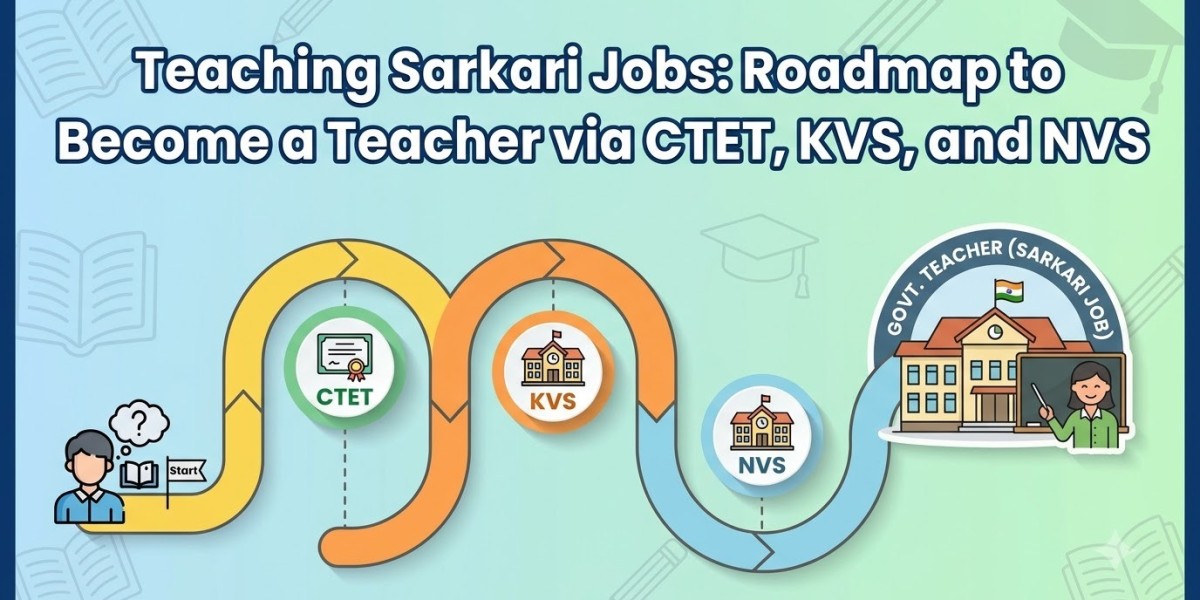


Among many career choices, teaching has become one of the most preferred options for candidates seeking Sarkari Jobs in India. Government teaching jobs provide a career ladder, high pay, job stability, and promotions. For those who wish to join teaching in central government schools, there are three names - CTET, KVS, and NVS - which should be known.
But having cleared the CTET does not ensure the government teaching job. This is because CTET is a teacher eligibility test, whereas the KVS and NVS conduct recruitment through their recruitment guidelines. Therefore, it all depends upon the class level and post one wishes to join.
What is the Role of CTET in Government Teaching Jobs?
The CTET is held by the Central Board of Secondary Education (CBSE). It is a crucial eligibility test for being eligible to teach Classes I to VIII in schools wherein CTET is applicable. As per the CTET website, the candidate must fulfill the minimum eligibility requirements laid down by NCTE and the recruitment rules applicable.
There are two papers in CTET:
Paper I: For teaching Classes I to V
Paper II: For teaching Classes VI to VIII
If a candidate wants to apply in both categories, then he/she can appear in both papers.
CTET eligibility helps candidates in case they want to apply for central schools, including those where CTET is applicable in terms of recruitment. But just having CTET eligibility is not sufficient for being appointed in any such organization.
CTET 2026 Update
For candidates who are planning to give the CTET examination in the upcoming cycle, it is observed that the official website has mentioned CTET applications for September 2026, with the application deadline extended to September 1, 2026. Candidates must refer to the information bulletin on the official website for all details.
KVS Teacher Recruitment: A Major Central Government Opportunity
KVS manages Kendriya Vidyalayas throughout India and recruits teachers for posts like the Primary Teacher (PRT), Trained Graduate Teacher (TGT), and the Post Graduate Teacher (PGT).
The process of recruitment of KVS is centralized. As per recruitment rules of the organization, recruitment advertisement is released after identification of the vacancy, after which examination takes place followed by interview / skill test, if any.
Eligibility may vary according to the post, as follows:
PRT: The candidate should have prescribed qualifications for elementary teacher and CTET Paper I if required as per the concerned recruitment rules.
TGT: The candidate should have a Bachelor’s Degree in the concerned subject / B.Ed. or a prescribed Integrated Programme, and CTET Paper II if required.
PGT: The candidate should have a Master's Degree in the concerned subject along with prescribed professional teaching qualification.
Candidates should always check their qualification & subject-wise eligibility from the latest KVS recruitment notification.
NVS Teacher Recruitment: Another Central School Option
Navodaya Vidyalaya Samiti (NVS) conducts teacher recruitment for Jawahar Navodaya Vidyalayas which are residential schools. The vacancies, which are dependent on the teacher recruitment notification issued by NVS, could be of PGT, TGT, and other teaching positions.
As shown in the 2025 KVS-NVS teacher recruitment notification, eligibility criteria depend on the specific post. Thus, TGT applicants needed to satisfy both prescribed graduation and teaching qualifications, whereas PGT had qualifications prescribed depending on the respective postgraduate subject and teaching qualifications.
NVS offers a good option to candidates who are ready to work in a residential school setting. Moreover, some NVS teaching posts require residential school experience as a preferred criterion.
KVS vs NVS vs CTET: Understand the Difference
Option | Main Purpose | Target |
|---|---|---|
CTET | Teacher Eligibility Test | Establishes teaching eligibility where prescribed |
KVS | Teacher Recruitment | Teaching jobs in Kendriya Vidyalayas |
NVS | Teacher Recruitment | Teaching jobs in Jawahar Navodaya Vidyalayas |
One can easily comprehend the CTET flow chart in the following manner: CTET→ Satisfy educational eligibility criteria→ Apply for recruitment in KVS/NVS→ Get selected→ Documentation→ Employment.
However, CTET is not mandatory for all teaching positions in all organizations. The ultimate requirement varies according to the guidelines of recruitment and the notification issued.
Step-by-Step Roadmap to Become a Government Teacher
Step 1: Choose Your Teaching Level
First decide whether you want to teach:
Classes I–V → PRT route
Classes VI–X → TGT route
Classes XI–XII → PGT route
Your desired level determines the degree and professional qualification you need.
Step 2: Complete the Required Qualification
For Primary teaching, candidates normally go for D.El.Ed./B.El.Ed. Or some other prescribed Elementary Teacher’s qualification.
For TGT posts, a relevant graduation degree with B.Ed. Or some other prescribed Integrated qualification is normally required.
For PGT posts, candidates usually require a relevant postgraduation degree along with some prescribed teaching qualification.
Do check the latest recruitment rules before deciding on any course.
Step 3: Clear CTET When Applicable
If the recruitment process that you wish to join needs CTET, then you should study the relevant paper. The subjects include:
• Child Development and Pedagogy
• Language papers
• Mathematics
• Environmental Studies for Paper I
• Science/Social Science or relevant subject areas for Paper II
Studying the latest syllabus is more beneficial than the old one used for preparation.
Step 4: Prepare for KVS/NVS Recruitment Exams
CTET is not the end point of preparation. Recruitment tests may have questions of general awareness, reasoning, language proficiency, computer awareness, teaching methodology, and subject knowledge, according to post and notice.
Preparation strategies must be prepared separately for CTET and recruitment tests.
Step 5: Track Official Notifications
Recruitment calendars may vary, and vacancies need not be notified every year for all positions. As per the recruitment notice issued by KVS, direct recruitment of teachers is a centralized process, and vacancies are notified whenever vacancies exist.
The last recruitment cycle of KVS-NVS further highlights the importance of checking official notifications. In August 2026, the CBSE issued numerous notifications and final answer keys concerning the KVS/NVS Recruitment Drive 2025.
Preparation Strategy for Teaching Sarkari Jobs
Eligibility for CTET should consist of:
Eligibility Preparation: Finish your degree and the teacher training eligibility.
CTET Preparation: Prepare yourself on the concept of pedagogy, languages, and subject-wise.
Recruitment Preparation: Practice solved papers and mocks, study current affairs, reasoning, language and subject-wise based on recruitment syllabus.
Make sure that you have your degree certificate, mark sheets, CTET certificate, category certificate, ID proof and other documents before recruitment starts.
Final Takeaway
Getting Sarkari jobs in the central government is not as simple as passing the CTET. What is better is to select the level of teaching, get the necessary educational and professional qualification, pass the CTET exam (if applicable) and prepare for the recruitment examination for KVS/NVS and follow the latest official notification carefully.
The CTET continues to be a significant pathway to pursue for those aiming to join the central schools for 2026, while KVS and NVS offer prominent teaching positions within the central schools. Recruitment rules, vacancies and selection process can be changed at any time so candidates are requested to read the official CTET, KVS, NVS and CBSE recruitment notification before applying.






