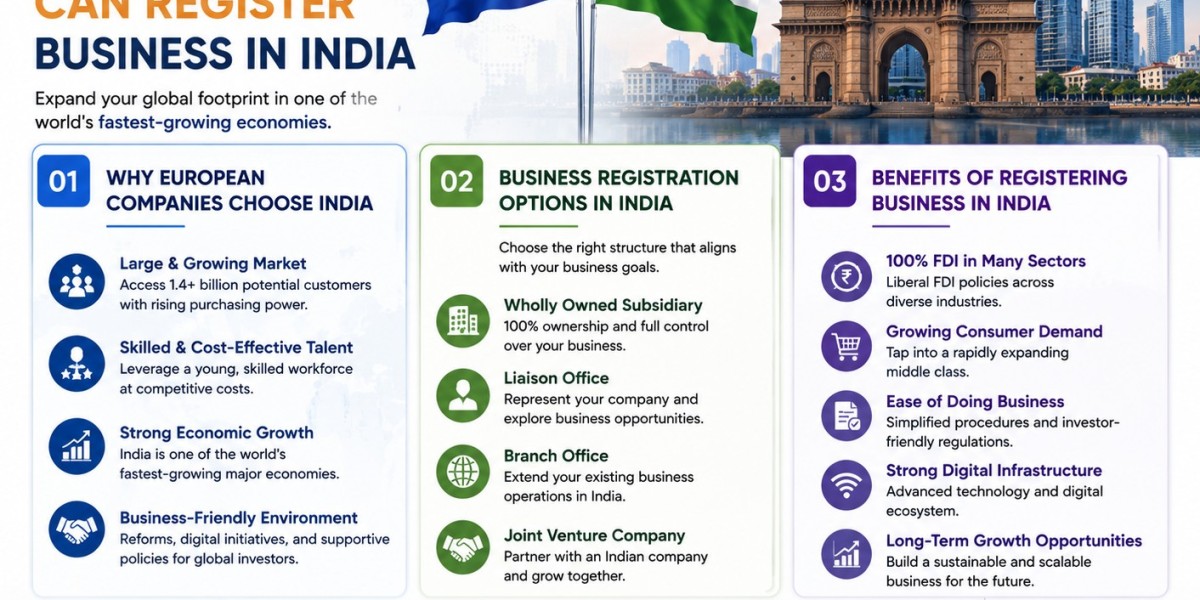


India has become an attractive destination for European companies looking to expand into new markets, access skilled talent, and build long-term business operations. With a large consumer base, developing infrastructure, and opportunities across technology, manufacturing, consulting, healthcare, renewable energy, and other sectors, India can offer significant growth potential.
However, entering the Indian market requires careful planning. European businesses need to understand company structures, foreign investment rules, taxation, registrations, accounting requirements, and ongoing compliance before starting operations. Professional Business Setup Services in India for European Companies can help simplify these processes and ensure that the business follows applicable Indian regulations.
Why European Companies Choose India for Business Expansion
India provides opportunities for companies that want to establish a presence outside Europe. Its growing economy and expanding digital ecosystem have encouraged many international businesses to explore the Indian market.
Some key reasons European companies consider India include:
- Access to a large and diverse customer market
- Availability of skilled professionals
- Competitive operational costs
- Growing technology and digital infrastructure
- Opportunities for manufacturing and sourcing
- Expanding startup and innovation ecosystem
- Potential for long-term business growth
- Increasing demand for international products and services
Before establishing an entity, however, a European company should evaluate its business model, target market, investment requirements, and regulatory obligations.
Choose the Right Business Structure in India
One of the first decisions is selecting an appropriate legal structure. The right structure depends on the company's activities, ownership plans, investment size, and long-term objectives.
Private Limited Company
A private limited company is one of the most common structures for foreign businesses establishing an independent operation in India. It provides a separate legal identity and can generally be established with foreign shareholders, subject to applicable foreign investment rules.
This structure may be suitable for companies planning to conduct commercial activities, employ staff, enter contracts, and build a long-term presence in India.
Limited Liability Partnership
An LLP combines features of a partnership with limited liability protection. It can be considered for certain professional, consulting, and service-oriented businesses, depending on foreign investment and sector-specific regulations.
Branch Office
A branch office allows a foreign company to conduct permitted business activities in India without creating a separate Indian company. Its activities are subject to regulatory conditions and approval requirements.
Liaison Office
A liaison office is generally used for communication, market research, and representing the parent company in India. It is not normally intended to undertake commercial trading activities and must follow the conditions under which it is permitted to operate.
Understand Foreign Direct Investment Rules
European companies investing in India need to consider Foreign Direct Investment (FDI) regulations. The permitted level of foreign ownership and the applicable approval process can vary depending on the industry and business activity.
Some sectors allow foreign investment through the automatic route, while others may have restrictions or require government approval. Therefore, investors should determine the applicable sector classification before transferring capital or beginning operations.
A proper assessment can help identify:
- Permitted foreign ownership
- Applicable investment route
- Sector-specific conditions
- Reporting requirements
- Pricing requirements
- Regulatory approvals
- Restrictions applicable to the proposed activity
Getting this assessment right at the beginning can prevent unnecessary delays later.
Complete Company Registration
If the European company decides to establish an Indian private limited company, the incorporation process involves several steps.
Prepare the Required Documents
Foreign shareholders and directors may need documents such as passports, proof of address, corporate documents, authorization documents, and other supporting paperwork. Documents issued outside India may need appropriate notarization, apostille, legalization, or certification depending on the circumstances.
The exact documentation can differ depending on whether the shareholder is an individual or a foreign corporate entity.
Obtain Digital Signatures
Digital signatures are commonly required for electronic filing of incorporation documents with Indian authorities. Proposed directors may need to obtain the necessary digital signature credentials.
Apply for Director Identification
Individuals appointed as directors of an Indian company may require a Director Identification Number (DIN), subject to the applicable incorporation process.
Reserve the Company Name
The proposed company name should comply with Indian naming requirements and should not conflict with existing company names or trademarks.
File Incorporation Documents
The incorporation application and required documents are submitted through the applicable Ministry of Corporate Affairs process. Once approved, the company receives its incorporation documentation and can proceed with subsequent registrations and operational setup.
Open a Corporate Bank Account
After incorporation, the Indian entity generally needs a business bank account for receiving investments and handling operational transactions.
The bank may request corporate and KYC documents, information about shareholders and directors, incorporation records, and details regarding the source and purpose of funds.
For foreign investment, maintaining appropriate documentation is particularly important because capital inflows can involve additional regulatory reporting and compliance requirements.
Register for Tax and GST
Tax planning should be considered before starting business activities in India.
An Indian business may have corporate income tax obligations based on its structure and applicable tax provisions. If the business supplies goods or services covered by GST requirements, GST registration may also be necessary.
GST Compliance
GST can apply to various supplies of goods and services in India. A registered business may need to issue compliant invoices, maintain records, file periodic returns, and meet other GST requirements.
Income Tax Compliance
Companies operating in India must maintain appropriate financial records and comply with applicable income tax filing requirements. Advance tax, withholding tax, transfer pricing, and other provisions may also become relevant depending on the nature of transactions.
Professional Business Setup Services in India for European Companies can help businesses understand these requirements before operations begin.
Set Up Accounting and Bookkeeping Systems
Accounting should not be treated as an afterthought. European companies operating through an Indian subsidiary, branch, or other structure should establish proper bookkeeping procedures from the beginning.
The accounting system should support:
- Recording business transactions
- Maintaining invoices and expenses
- Bank reconciliation
- Payroll accounting
- GST records
- Tax reporting
- Financial statements
- Audit requirements
- Management reporting
Companies with transactions between their European parent and Indian entity should also maintain appropriate documentation for intercompany transactions.
Understand Transfer Pricing Requirements
When an Indian entity conducts transactions with its foreign parent or other related international entities, transfer pricing regulations may become important.
Transactions can include management services, technical support, licensing, imports, exports, loans, reimbursements, and other intercompany arrangements.
European companies should maintain proper agreements, supporting documents, pricing analysis, and records where required. Early planning can reduce the risk of compliance problems and help create a transparent relationship between the Indian entity and its European parent.
Set Up Employees and Payroll
If the Indian business plans to hire employees, it should establish an appropriate payroll and employment compliance system.
Depending on the size and nature of the organization, requirements may include payroll records, employee documentation, tax deductions, social security-related obligations, professional tax where applicable, and other employment-related compliances.
Companies should also create employment agreements and clearly define compensation, responsibilities, benefits, confidentiality, and other relevant terms.
Maintain Ongoing Compliance
Incorporation is only the beginning of the process. Once the business starts operating, regular statutory and tax compliance becomes important.
An Indian company may need to manage:
- Annual corporate filings
- Income tax returns
- GST returns
- Accounting records
- Statutory audits
- Board and shareholder documentation
- Foreign investment reporting
- Payroll compliance
- Transfer pricing documentation, where applicable
Failure to complete required filings on time can result in penalties and other regulatory consequences.
How Professional Business Setup Support Can Help
Setting up a business in another country can be complicated when the founders are unfamiliar with local procedures. European companies may need assistance across incorporation, taxation, accounting, investment compliance, and ongoing regulatory requirements.
Professional Business Setup Services in India for European Companies can provide support throughout the setup process, including business structure selection, incorporation documentation, tax registrations, accounting setup, and compliance planning.
A professional service provider can also coordinate different stages of the process so that the company does not have to manage every regulatory requirement independently.
Conclusion
Setting up a business in India can provide European companies with access to a growing market, skilled professionals, and opportunities across multiple industries. However, successful entry requires more than simply registering a company. Businesses should carefully select their legal structure, review FDI regulations, complete registrations, establish banking and accounting systems, understand taxation, and maintain ongoing compliance.
With the right planning and professional Business Setup Services in India for European Companies, European businesses can establish their Indian operations in a structured and compliant manner. A well-planned setup can create a strong foundation for sustainable growth and long-term expansion in the Indian market.









