

Introduction
The digital marketing landscape has undergone a massive shift. Traditional techniques—focused on simple broad-target advertising, static email newsletters, and basic keyword insertion—are no longer enough to drive sustainable business growth. Today’s online ecosystem is driven by automated bidding algorithms, predictive data models, strict privacy frameworks, and AI-driven search engines.
As advertising costs rise and customer acquisition channels become saturated, relying on foundational digital marketing tactics creates a bottleneck to growth. Modern organizations require technical expertise, precise attribution, and cross-channel optimization to maximize their return on investment.
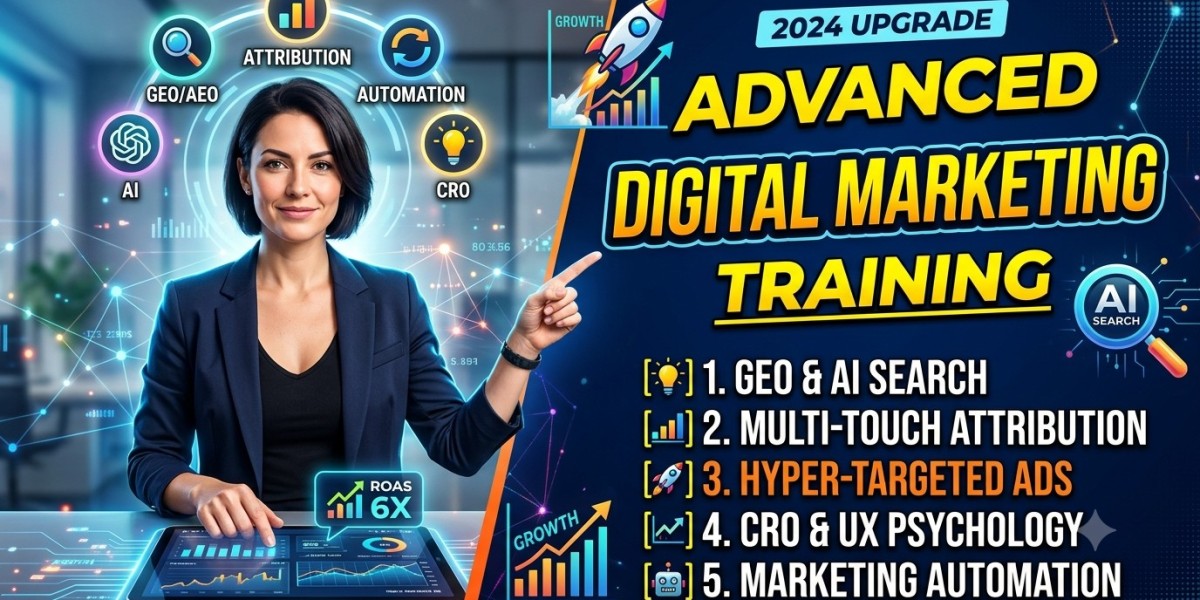
Advanced digital marketing training bridges the gap between surface-level execution and high-impact strategy. It equips marketers, growth specialists, and entrepreneurs with the advanced skill sets needed to navigate complex platforms, leverage machine learning, and engineer scalable marketing systems. Below is a detailed breakdown of the essential pillars that define advanced digital marketing training today.
Core Pillars of Advanced Digital Marketing
1. AI-Driven Strategy and Search Orchestration
AI-driven strategy is the practice of leveraging artificial intelligence and machine learning tools to automate operations, personalize user journeys, and optimize content for modern conversational search engines. Rather than treating AI as a basic writing assistant, advanced training teaches practitioners how to build scalable content and technical frameworks that perform across traditional search engines as well as generative platforms.
Generative Engine Optimization (GEO): Structuring web assets and entities so they are indexed and cited by conversational AI search engines like ChatGPT, Perplexity, and Google AI Overviews.
Prompt Engineering & Workflow Automation: Constructing advanced prompt frameworks to instantly analyze customer data, generate multi-variant ad concepts, and streamline campaign planning.
AI-Powered Personalization: Utilizing platform algorithms to deliver dynamic landing pages and tailored email messaging based on individual user behavior.
2. Modern Performance Media and Programmatic Bidding
Modern performance media focuses on managing paid ad channels through algorithmic guidance, server-side data tracking, and dynamic creative delivery. Rather than manually setting cost-per-click bids, advanced marketers direct smart algorithms by feeding them clean customer data and structured campaign signals.
Server-Side Tracking (Meta CAPI): Setting up direct server-to-server data pipelines (such as the Meta Conversions API) to capture accurate conversion events in cookieless browsing environments.
Performance Max (PMax) Optimization: Structuring Google Ads asset groups, audience signals, and negative keyword lists to prevent automated budget waste across Google's display, search, and YouTube networks.
Dynamic Creative Testing: Implementing systematic testing frameworks to rapidly iterate on ad angles, hooks, and visuals to lower customer acquisition costs (CAC).
3. Data Analytics, GA4, and Custom Attribution Modeling
Data analytics and custom attribution involve collecting, organizing, and interpreting cross-channel user data to determine the true financial impact of every marketing touchpoint. Moving past single-touch metrics, this discipline gives teams a transparent view of the buyer journey.
Google Analytics 4 (GA4) Mastery: Configuring custom user properties, parameters, and event triggers to monitor deep product or site interactions beyond standard pageviews.
Multi-Touch Attribution (MTA): Applying data-driven attribution models to accurately evaluate how top-of-funnel awareness ads contribute to bottom-of-funnel conversions.
Business Intelligence Dashboards: Constructing centralized visual reports using tools like Looker Studio to track unified KPIs across paid media, organic channels, and CRM databases.
4. Conversion Rate Optimization (CRO) and UX Architecture
Conversion Rate Optimization (CRO) is the structured process of increasing the percentage of website visitors who complete a desired action—such as submitting a lead form or purchasing a product. Advanced CRO combines user behavior analysis, psychological triggers, and data-backed landing page design.
Behavioral Heatmapping & Session Recording: Using specialized software to track user scroll depth, click patterns, and layout friction points.
Statistical A/B/n Testing: Running split tests on post-click landing page elements (headlines, CTA buttons, forms) to identify statistically significant improvements in conversion baseline.
Post-Click Intent Alignment: Redesigning landing page visual hierarchies to match the exact search intent or ad angle that brought the visitor to the site.
5. Advanced Marketing Automation and Lifecycle Nurturing
Marketing automation refers to the software-driven orchestration of targeted messaging across email, SMS, and messaging platforms based on real-time user actions. Advanced lifecycle management focuses on maximizing Customer Lifetime Value (LTV) through hyper-targeted retention pathways.
Behavior-Triggered Sequences: Designing automated communication paths that trigger based on complex actions, such as abandoned carts, product usage milestones, or content downloads.
Customer Segmentation Architecture: Grouping audiences by purchasing frequency, spending threshold, or engagement level to send highly relevant, personalized offers.
CRM Integration & Pipeline Management: Connecting front-end marketing acquisition channels directly into CRM systems (like HubSpot or Salesforce) to pass high-intent leads to sales teams instantly.
Skill Mastery Comparison
Digital Marketing Pillar | Basic / Traditional Focus | Advanced Skill Mastery | Core Tools & Frameworks |
Search & AI Optimization | Keyword stuffing & basic backlinks | Schema markup, entity mapping, and GEO for AI search engines | Ahrefs, SEMrush, Screaming Frog, ChatGPT |
Paid Media Buying | Manual CPC targeting & basic broad ads | Server-side conversion tracking, programmatic steering, & audience signals | Meta Ads Manager, Google Ads, GTM, CAPI |
Data & Analytics | Tracking basic traffic sessions & bounce rates | Multi-touch attribution, custom event parameters, & BI dashboards | GA4, Looker Studio, BigQuery |
Conversion Optimization | Guessing page design & basic headline edits | Heatmap friction analysis, intent-matching, & statistical A/B testing | Hotjar, VWO, Unbounce, Microsoft Clarity |
Lifecycle & Automation | Sending batch-and-blast email newsletters | Dynamic behavioral workflows, predictive churn scoring, & CRM syncs | HubSpot, Klaviyo, ActiveCampaign, Zapier |
Conclusion
The transition from basic execution to advanced digital marketing is no longer optional for professionals seeking to lead performance-driven growth. As digital platforms continue to automate routine tasks, true competitive advantage lies in mastering high-level data analytics, programmatic media, automated workflows, and behavioral optimization.
Advanced digital marketing training provides the strategic depth needed to navigate this changing landscape. By replacing guesswork with data-backed frameworks, marketers can eliminate wasted ad spend, build resilient customer acquisition channels, and transform marketing departments from cost centers into reliable engines of business growth.






