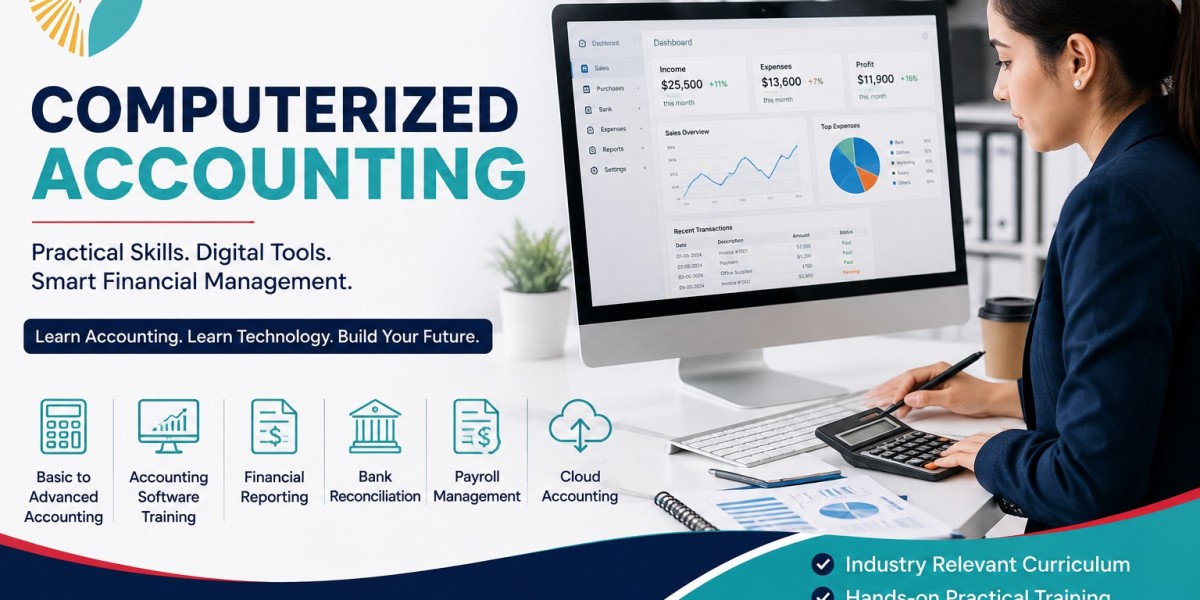


Businesses today rely heavily on technology to manage their financial operations. From recording daily transactions and tracking expenses to preparing reports and monitoring cash flow, digital tools have transformed the way accounting departments work. As organizations continue moving away from manual processes, professionals who understand both accounting principles and technology can bring valuable skills to the workplace.
Computerized accounting refers to the use of accounting software and digital systems to record, organize, process, and analyze financial information. It can make routine accounting tasks more efficient while helping businesses maintain organized and accessible financial records.
For students interested in accounting, bookkeeping, finance, or business administration, learning how digital accounting systems work can be an important step toward developing career-ready skills.
What Is Computerized Accounting?
Traditional accounting often involved handwritten ledgers, physical documents, and manual calculations. Although many businesses still maintain certain paper records, modern organizations increasingly depend on software to perform financial tasks.
A computerized accounting system allows financial information to be entered into software, organized into appropriate accounts, and used to generate reports. Instead of calculating every figure manually, accounting professionals can use software to automate many repetitive processes.
However, technology does not replace accounting knowledge. Users still need to understand financial principles, review information carefully, identify errors, and interpret the results produced by software.
Key Functions of Digital Accounting Systems
Depending on the software and organization, accounting systems can support tasks such as:
- Recording sales and purchases
- Creating and managing invoices
- Tracking income and expenses
- Managing accounts payable
- Managing accounts receivable
- Monitoring cash flow
- Recording payroll information
- Reconciling bank transactions
- Preparing financial reports
- Maintaining customer and supplier records
These functions can help businesses organize their financial activities more efficiently.
Why Is Computerized Accounting Important?
Technology has become an essential part of modern business operations. Organizations of different sizes need accurate financial information to understand their performance and make informed decisions.
Improved Efficiency
Manual accounting can require significant time, especially when businesses handle a large number of transactions. Digital systems can automate calculations and repetitive processes, allowing employees to spend more time reviewing information and supporting business activities.
For example, once transaction information is entered correctly, software can automatically update relevant records and assist with calculations.
Better Organization
Financial information can become difficult to manage when records are spread across multiple spreadsheets, documents, and physical files.
Accounting software provides a centralized environment where information can be stored and organized. This can make it easier for authorized users to find records and generate reports when needed.
Reduced Calculation Errors
Human errors can occur when calculations are performed repeatedly. Accounting software can handle many mathematical calculations automatically.
That does not mean errors disappear completely. Incorrect information entered into a system can still produce incorrect results. Therefore, careful data entry and regular reviews remain essential.
Skills Needed to Work With Accounting Software
Learning accounting software involves more than understanding which buttons to click. Professionals need a combination of accounting knowledge, technical ability, and attention to detail.
Understanding Accounting Principles
Before working with digital systems, students should understand basic accounting concepts.
These may include:
- Assets and liabilities
- Revenue and expenses
- Debits and credits
- Accounts payable
- Accounts receivable
- Cash flow
- General ledgers
- Financial statements
A good understanding of these principles helps users recognize whether information has been recorded correctly.
Developing Technical Skills
Modern accounting professionals should feel comfortable working with computers and digital applications.
Useful technical abilities include:
- Data entry
- Spreadsheet management
- Accounting software navigation
- Digital file organization
- Report generation
- Basic troubleshooting
- Data management
These skills can make it easier to adapt to different workplace systems.
Attention to Detail
Accuracy is one of the most important qualities in accounting. A small mistake in an amount, date, account, or transaction category can affect financial records.
Developing strong checking and verification habits can help reduce mistakes and improve the reliability of financial information.
Common Applications of Computerized Accounting
Digital accounting systems can be used in almost every industry because businesses of all types need to manage money and maintain financial records.
Small Businesses
Small businesses often need efficient ways to manage invoices, expenses, payments, and financial records without maintaining complicated manual systems.
Accounting software can help business owners and accounting staff organize financial information and monitor business performance.
Large Organizations
Larger companies may have dedicated finance and accounting departments. They often use more advanced systems that integrate accounting with payroll, inventory, purchasing, sales, and other business operations.
Professionals working in these environments may need to understand how financial data moves between different departments.
Accounting and Bookkeeping Firms
Accounting firms can use digital systems to manage records for multiple clients. Employees may be responsible for entering transactions, reconciling accounts, preparing reports, and organizing documentation.
This makes software knowledge particularly useful for accounting and bookkeeping professionals.
Benefits of Learning Computerized Accounting
Students who develop digital accounting skills can gain several practical advantages.
Career Flexibility
Accounting knowledge can be useful in many different industries. Healthcare organizations, retail companies, technology businesses, educational institutions, construction companies, and professional services firms all require financial administration.
This means accounting skills can be applied across a wide range of workplaces.
Practical Workplace Preparation
Learning how accounting software works can help students become more comfortable with the types of digital tools used in professional environments.
Practical exercises involving invoices, transactions, reports, and financial records can provide a stronger understanding of everyday accounting responsibilities.
Support for Career Growth
Digital accounting skills can provide a foundation for further professional development. With experience, professionals may choose to specialize in bookkeeping, payroll, accounts payable, accounts receivable, financial administration, or other areas.
Additional education and professional certifications may also support career advancement.
Career Opportunities
A computerized accounting background can be relevant to several entry-level positions. The specific requirements for each role vary depending on the employer and location.
Accounting Clerk
Accounting clerks assist with maintaining financial records and completing routine accounting tasks. Their work may include recording transactions, processing invoices, organizing documentation, and supporting accounting professionals.
Bookkeeping Assistant
Bookkeeping assistants can help maintain financial records and perform routine bookkeeping activities. Accuracy and organizational skills are important in this role.
Accounts Payable Clerk
Accounts payable employees help process bills and maintain records of money owed to suppliers and other parties.
Accounts Receivable Clerk
Accounts receivable professionals generally help track money owed to a business, maintain customer account records, and support payment-related processes.
Payroll Assistant
Payroll assistants may support the preparation and maintenance of employee payroll information. This work requires accuracy, confidentiality, and careful attention to deadlines.
How Cloud Technology Is Changing Accounting
Cloud computing has introduced another major change in the accounting industry. Instead of storing all accounting information on a single local computer, cloud-based systems can allow authorized users to access information through online platforms.
Remote Collaboration
Cloud systems can make it easier for accounting teams to collaborate from different locations. Depending on the software and security arrangements, employees can access relevant information without being physically present in the same office.
Automatic Updates
Many cloud-based platforms provide automatic software updates, helping organizations use newer features and security improvements without manually installing every update.
Data Security
Financial information can be sensitive, so security remains a major consideration. Businesses should use appropriate access controls, strong authentication, secure devices, backups, and organizational security policies.
Employees also need to understand their responsibility when handling confidential financial information.
Choosing the Right Accounting Program
Students interested in this career path should carefully evaluate educational programs before making a decision.
Canadian College for higher studies can be considered by students researching career-focused education related to accounting and business skills.
Look for Practical Learning
A strong program should provide opportunities to apply accounting concepts rather than relying entirely on theory. Practical assignments can help students understand how financial transactions are recorded and processed.
Review the Curriculum
Students should examine whether the program covers accounting fundamentals, bookkeeping, accounting software, financial documentation, spreadsheets, business communication, and other relevant topics.
A well-rounded curriculum can provide a stronger foundation for entering the workplace.
Consider Career Goals
Not every student has the same objective. Some may want to become accounting clerks, while others may be interested in bookkeeping, payroll, business administration, or further studies.
Understanding your long-term goals can help you select education that fits your plans.
How to Become Better at Digital Accounting
Learning does not have to stop when a course ends. Continued practice can help students strengthen their skills.
Practice With Sample Transactions
Working with realistic examples can improve understanding. Students can practice recording sales, expenses, purchases, payments, and other common transactions.
Improve Spreadsheet Skills
Spreadsheets remain widely used in business. Learning formulas, sorting, filtering, formatting, and basic data analysis can complement accounting software knowledge.
Develop Analytical Thinking
Accounting professionals should not simply enter information. They should also be able to notice unusual figures, inconsistencies, or missing information.
Developing analytical thinking can make financial information more meaningful.
The Future of Digital Accounting
Accounting technology continues to evolve. Automation, artificial intelligence, cloud computing, data analytics, and integrated business platforms are changing how financial tasks are performed.
Some repetitive processes can increasingly be automated, but human judgment remains important. Businesses still need professionals who can understand financial information, review data, communicate findings, and make responsible decisions.
This means future accounting professionals may need a combination of traditional accounting knowledge and digital skills.
Canadian College for higher studies can be explored by students who want to build a foundation in modern accounting practices and prepare for technology-driven business environments.
Conclusion
Technology has transformed accounting from a largely manual process into a highly digital profession. Modern accounting systems can improve efficiency, organize financial information, automate calculations, and provide businesses with useful reports.
Learning computerized accounting can help students develop a combination of accounting knowledge, software skills, attention to detail, and workplace confidence. These abilities can be useful for careers in bookkeeping, accounting support, payroll, accounts payable, accounts receivable, and financial administration.
For students considering an education pathway in this area, Canadian College for higher studies may be one institution to research when comparing available programs. The ideal learning experience should combine accounting fundamentals with practical software training and workplace-oriented skills.
Ultimately, technology is a tool, while accounting knowledge and professional judgment remain at the heart of the profession. By developing both, aspiring accounting professionals can prepare themselves for an increasingly digital business world and create a strong foundation for long-term career growth.









