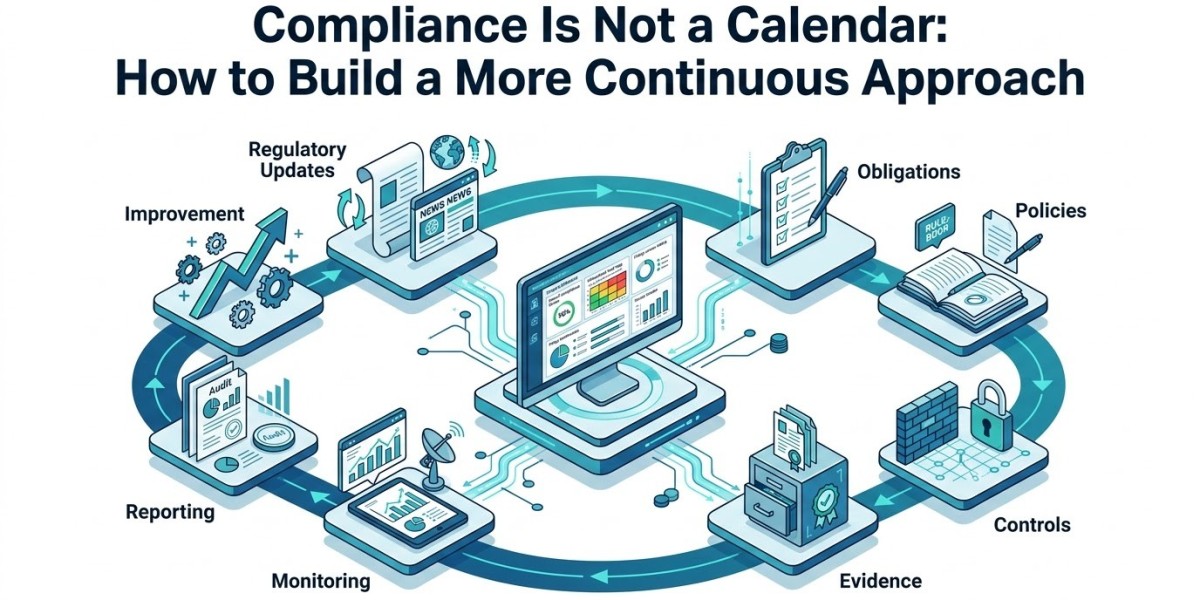


For many organizations, compliance still follows a familiar cycle. Requirements are reviewed. Policies are checked. Evidence is collected. Audits are completed. Reports are prepared.
Then the cycle begins again the following year. This approach can work for some activities, but it becomes difficult when regulatory requirements, business processes and technology change throughout the year.
A compliance program cannot remain effective simply because an annual review has been completed. The more useful question is whether the organization can identify changes and respond to them throughout the year.
Why Is Annual Compliance Management Becoming Difficult?
Regulatory obligations do not necessarily change according to an organization's internal reporting calendar. A new requirement may become relevant between annual reviews. A business may launch a new product. A supplier may introduce a new service. A technology implementation may change how information is processed.
Each of these changes can create new compliance considerations. If compliance is reviewed only at predetermined intervals, there is a possibility that important changes will not be assessed quickly enough.
What Does Continuous Compliance Mean?
Continuous compliance does not mean that compliance teams must constantly review every obligation. Instead, it means the organization has processes for identifying relevant changes, assessing their impact and updating controls or policies when required.
This idea aligns with the principles behind ISO 37301:2021, which provides requirements and guidance for establishing, implementing, evaluating, maintaining and improving an effective compliance management system. ISO describes the standard as applicable to organizations of different types, sizes and sectors.
The focus is therefore not simply on documenting compliance. It is on maintaining a system that can respond as circumstances change.
Why Should Compliance Obligations Be Connected to Controls?
Knowing that a regulation exists is only the first step. Organizations also need to understand how the requirement is addressed.
- Which policy covers it?
- Which control supports it?
- Who owns the control?
- What evidence demonstrates that it is operating?
- What happens if the control fails?
These relationships become particularly important when regulations change. A change to one obligation may affect multiple policies and controls. Without a clear connection between them, compliance teams may have to manually determine what needs to be updated.
How Can Automation Improve Compliance Management?
Manual compliance processes often involve recurring reminders, evidence collection, spreadsheet updates and follow-ups. These tasks may be necessary, but they can consume time that compliance professionals could otherwise spend on analysis and decision-making.
A centralized compliance management solution can help organize obligations, policies and controls within one environment. AssurePlus describes capabilities including automated control testing, evidence collection, regulatory mapping, reminders, escalation workflows and real-time compliance reporting.
Automation does not remove the need for human judgment. Instead, it can make recurring compliance activities more consistent and visible.
What Happens When Evidence Is Scattered?
Evidence is often created by different teams. A finance team may hold one set of records. IT may maintain another. Operations may keep process documentation somewhere else.
When an audit or regulatory review occurs, compliance teams may have to spend considerable time locating and validating evidence. A centralized approach can help establish a clearer record of what evidence exists, who is responsible for it and which obligation or control it supports.
This can also reduce duplication.
Can Compliance Data Help Identify Risk?
Compliance and risk management are closely connected. A compliance gap may indicate a broader operational weakness. For example, if a required control repeatedly fails, the issue may need to be considered as part of the organization's risk assessment.
Similarly, a regulatory change could create a new risk if the organization does not have an appropriate control in place.
This is one reason a connected GRC system can be useful. The organization does not have to treat compliance as an isolated function.
Why Does Reporting Matter?
Compliance reporting should do more than demonstrate that tasks were completed. Leadership needs to understand where the organization is exposed.
Useful reporting can show areas of non-compliance, overdue actions, control performance, emerging issues and trends over time. AssurePlus describes real-time compliance dashboards and reporting designed to help teams identify gaps and communicate compliance performance.
The objective is to turn compliance information into something decision-makers can use.
What Should Happen When a Compliance Gap Is Found?
Finding a gap should trigger a structured response. The organization needs to understand why the gap occurred, determine its potential impact, assign responsibility and establish an appropriate corrective action.
But completing the action should not automatically mean the problem is solved. The organization should also determine whether the corrective action addressed the underlying issue.
For recurring problems, a deeper review may be necessary. This is where compliance management becomes part of continuous improvement rather than simply issue closure.
How Can Organizations Build a More Sustainable Compliance Process?
The first step is to establish a reliable inventory of obligations. From there, organisations can map requirements to policies, controls and responsible owners.
Recurring control tests and evidence requests can be scheduled. Regulatory changes can be assessed when they arise. Gaps can be assigned for remediation, and management can monitor progress through reporting.
The process becomes a cycle:
Identify → Assess → Control → Monitor → Report → Improve
This is more resilient than relying on an annual compliance checklist.
Conclusion
Compliance is not something that happens once a year. Organisations operate in environments where regulations, technologies, suppliers and business processes can change throughout the year.
A continuous approach helps compliance teams identify those changes, understand their impact and respond before small gaps become larger problems. The objective is not to create more compliance work.
It is to create a more structured system where obligations, controls, evidence, responsibilities and corrective actions remain connected.
When compliance becomes part of everyday governance rather than an annual event, organisations can be better prepared for both regulatory reviews and unexpected changes.