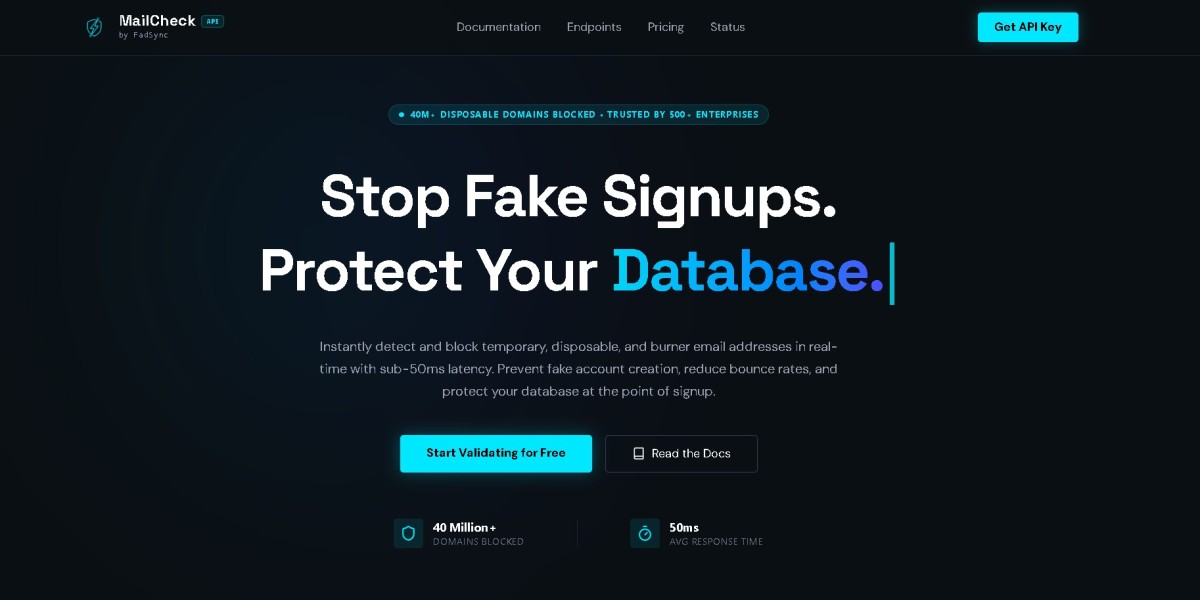


Fake account creation is one of the most persistent problems facing SaaS businesses in 2026. A signup may look like a legitimate customer at first, but some registrations are created solely to exploit free trials, abuse promotional offers, generate spam, test stolen credentials, or consume infrastructure without ever becoming paying customers.
The problem becomes especially difficult when attackers can create large numbers of accounts using disposable email addresses, temporary inboxes, automated signup scripts, and repeated identities.
For SaaS companies, preventing fake account creation isn't simply about blocking suspicious users. The goal is to build a signup process that identifies risky registrations before they become expensive accounts while keeping legitimate users moving through onboarding.
This guide explains how to detect and prevent fake SaaS accounts, which signals to evaluate, where email validation fits into your security stack, and how to build a practical prevention strategy.
What Is Fake Account Creation in SaaS?
Fake account creation happens when someone registers an account without genuine intent to use the SaaS product as a legitimate customer.
Not every suspicious signup is necessarily malicious. For example, someone might create multiple accounts because they forgot their original login. However, repeated or automated registrations can indicate abuse when they are associated with:
Disposable or temporary email addresses
Multiple registrations from the same IP address
Automated signup behavior
Repeated use of free trials
Fake or randomly generated identities
Promotional-code abuse
Bot-generated registrations
Attempts to bypass account restrictions
Email addresses that cannot receive or verify messages
The consequences can extend far beyond the signup database.
Fake accounts may consume database storage, API resources, email-sending capacity, customer-support time, and free-trial infrastructure. If enough fraudulent registrations reach your system, they can also make your user analytics less reliable.
That's why signup protection should be treated as both a security problem and a SaaS cost-control problem.
Why Fake Accounts Are Expensive for SaaS Companies
A common mistake is to measure signup abuse only by the number of fraudulent accounts.
The real cost is often distributed across several systems.
1. Database and infrastructure costs
Every account can create records across your database and supporting systems. Even when an account never converts, its data may remain stored.
Large volumes of low-quality accounts can therefore increase:
Database storage
Backup requirements
Data-processing workloads
Infrastructure usage
Analytics volume
2. Email-sending costs
If your application sends welcome emails, verification emails, onboarding sequences, or notifications, fake registrations can consume part of your email quota.
Worse, repeatedly sending messages to invalid or low-quality addresses can affect your email deliverability.
3. Free-trial abuse
A user who repeatedly creates new accounts can potentially obtain multiple trials.
For SaaS businesses with expensive products or generous trial periods, this can directly reduce revenue.
4. Dirty analytics
Fake accounts distort important SaaS metrics.
For example, if thousands of low-quality registrations enter your funnel, your:
Signup-to-activation rate
Trial conversion rate
Customer acquisition metrics
Retention calculations
Product engagement data
may become less representative of genuine customers.
5. Operational overhead
Fake accounts can also generate support tickets, moderation work, suspicious activity alerts, and manual investigations.
Preventing bad registrations before account creation is therefore often more efficient than cleaning them up later.
7 Ways to Stop Fake Account Creation in SaaS
There isn't a single signal that identifies every fraudulent registration. A stronger strategy combines multiple layers of validation.
1. Detect Disposable Email Addresses
One of the simplest places to start is the email address.
Disposable email services provide temporary inboxes that can often be created quickly and discarded after use. They're not automatically malicious—there are legitimate privacy-related reasons to use temporary addresses—but they can also be attractive for users attempting to repeatedly access free trials or promotional benefits.
Your signup flow can check whether an email belongs to a known disposable or temporary email domain.
A dedicated disposable email detection guide can help developers understand how this layer fits into a signup workflow.
For applications that need programmatic validation, you can also use an email validation API to evaluate addresses before creating accounts.
The important principle is simple:
Don't wait until after account creation to discover that an email address was risky.
Run the check during signup.
2. Combine Email Checks With Other Risk Signals
Email validation shouldn't be your entire anti-abuse system.
A legitimate-looking Gmail, Outlook, or business email address doesn't guarantee that the person behind the registration is legitimate.
Consider combining email information with signals such as:
IP reputation
Signup frequency
Device or browser signals
Rate limits
Verification status
Account behavior
Previous trial usage
Geographic anomalies
Repeated promotional activity
For example, one signup from a normal email address may present very little risk.
But 30 registrations from the same environment within a short period should trigger additional scrutiny—even if every email address looks valid.
This creates a risk-based signup system instead of relying on one binary rule.
3. Add Rate Limiting to Your Signup Endpoint
Automated abuse often depends on being able to submit registrations repeatedly.
Rate limiting puts a boundary around that behavior.
You can establish limits around signals such as:
Registrations per IP
Verification attempts
Password-reset requests
API requests
Trial activations
Signup attempts within a time window
For APIs and backend systems, handling rate limits correctly is important. Your developers can reference this guide on handling 429 Too Many Requests errors when designing resilient API integrations.
Rate limiting doesn't have to mean permanently blocking every user who reaches a threshold.
A better approach can be to progressively increase friction.
For example:
Normal behavior → allow signup
Unusual behavior → require verification
High-risk behavior → require additional validation
Clearly abusive behavior → block the request
4. Require Email Verification
Email verification provides another useful layer between registration and full account activation.
Instead of immediately granting access to every newly created account, you can require the user to prove they control the email address.
This helps filter out:
Mistyped addresses
Nonexistent addresses
Inaccessible inboxes
Some automated registrations
Some low-quality accounts
However, verification alone isn't sufficient.
A disposable email address can still receive verification messages while remaining unsuitable for your business model.
That's why email verification and disposable-email detection solve different problems.
Verification asks:
“Can this person access this inbox?”
Disposable-email detection asks:
“Is this email address associated with a temporary or disposable service?”
For many SaaS signup flows, using both checks provides better coverage.
5. Identify and Block Suspicious Trial Abuse
Free trials are particularly attractive targets for account abuse.
If your SaaS offers a valuable product for 7, 14, or 30 days without requiring payment, someone can potentially attempt to reset their trial by registering again.
This is why trial-abuse prevention should go beyond email addresses.
Track signals such as:
Previous trial participation
Repeated signup patterns
Device characteristics
IP behavior
Payment information where appropriate
Product usage patterns
Promotional-code history
For Stripe-based SaaS products, you can also review this practical guide on preventing free-trial abuse.
The goal isn't to make trials difficult for legitimate customers. It's to make repeated exploitation more difficult than legitimate use.
6. Validate Before Writing to Your Database
One of the most important architectural decisions is where validation happens.
A weak flow might look like:
Signup → Create account → Store user → Validate email → Detect abuse → Delete account
This approach allows unwanted records to enter your systems before they're evaluated.
A stronger flow is:
Signup → Validate email → Evaluate risk → Apply policy → Create account
That distinction matters.
If a disposable email address can be identified in milliseconds, there is little reason to create a complete customer record first.
A real-time email verification API can be integrated into the backend so that your application makes the decision during registration.
For developers building this architecture, the MailCheck developer guides provide additional implementation-focused material.
7. Use Risk-Based Decisions Instead of Blocking Everyone
One of the biggest mistakes in signup protection is making the rules too aggressive.
If you simply block every unusual registration, you may reject legitimate customers.
Instead, create different outcomes based on risk.
Low risk
Allow the registration normally.
Medium risk
Ask for additional verification or apply limited access.
High risk
Block the signup or require stronger validation.
This approach is especially useful because not every disposable email user necessarily represents the same level of risk.
Your product, audience, pricing model, and trial policy should determine how strict your rules are.
A Practical Fake Signup Prevention Architecture
A modern SaaS signup flow can look something like this:
User submits signup ↓Normalize email address ↓Check email syntax ↓Check disposable/temporary domain ↓Evaluate additional risk signals ↓Apply signup rate limits ↓Require email verification ↓Apply business-specific abuse rules ↓Create account ↓Activate trial / onboardingThis architecture moves the most important checks closer to the signup event.
It also creates opportunities to collect useful metrics.
For example, you can track:
Total signup attempts
Disposable addresses detected
Verification failures
Rate-limit events
Blocked registrations
Trial-abuse attempts
Legitimate activation rates
These metrics help you determine whether your prevention system is actually improving the quality of your acquisition funnel.
How Disposable Email Detection Fits Into SaaS Security
Disposable email detection should be viewed as one component of a broader anti-abuse strategy.
It is particularly valuable because the email address is already part of most SaaS registration flows.
You don't necessarily need to redesign your entire authentication system.
Instead, you can add an email-risk check between the user's submission and account creation.
For teams evaluating different solutions, a disposable email detection API can provide a programmatic way to incorporate this check into an existing application.
Developers can then build business rules around the returned result.
For example:
Disposable email detected? ↓ Yes → Reject or request another email ↓ No ↓Continue with normal signup validationThe exact policy depends on your SaaS product.
Some products may completely reject disposable addresses. Others may allow them but restrict free-trial access.
How to Measure Whether Your Strategy Is Working
Don't measure success solely by the number of blocked accounts.
Instead, monitor the quality of your entire signup funnel.
Useful metrics include:
Signup quality
How many new registrations become meaningful product users?
Trial conversion
Are legitimate trial-to-paid conversions improving after abuse prevention?
Block rate
What percentage of registration attempts are being flagged?
False-positive rate
How many legitimate users are being incorrectly rejected?
Infrastructure savings
Are you reducing unnecessary database, email, or other resource consumption?
Support workload
Are there fewer abuse-related tickets and account-cleanup tasks?
The goal is not to maximize the number of blocked registrations.
The goal is to maximize legitimate customer acquisition while minimizing abuse and unnecessary resource consumption.
Common Mistakes to Avoid
Blocking only after account creation
By then, your application may already have stored unwanted data and consumed resources.
Relying exclusively on CAPTCHA
CAPTCHA can help against automated activity, but it doesn't determine whether an email address is disposable or whether a human is abusing your free trial.
Treating email verification as fraud detection
A disposable inbox can potentially pass an email-verification challenge.
Creating overly aggressive rules
Legitimate users can sometimes share IP addresses, travel between locations, or behave differently from your usual customers.
Ignoring your existing data
Your own signup and conversion data can reveal which signals correlate most strongly with abuse.
Final Takeaway
Stopping fake account creation in SaaS requires more than adding a CAPTCHA or verifying an email address.
The strongest approach is a layered signup protection system that evaluates email quality, disposable domains, signup frequency, verification status, trial history, and other relevant risk signals before granting access.
For many SaaS products, disposable email detection is an effective first layer because it can identify temporary addresses before they become permanent records in your application.
If you're building this functionality yourself, start with your email validation implementation, evaluate your available API endpoints, and test your signup flow before deploying stricter rules.
You can also start validating emails for free and determine how disposable-email detection fits into your existing registration architecture.
Ultimately, the best anti-abuse system isn't the one that blocks the most users.
It's the one that keeps legitimate customers moving while making fake account creation expensive, difficult, and ineffective.
Recommended internal links for this article
For your SEO/internal-linking structure, these are the most valuable contextual links to retain:
email validation API →
/validatedisposable email detection guide →
/guides/how-to-detect-and-block-disposable-email-addresseshandling 429 Too Many Requests errors →
/guides/how-to-handle-429-too-many-requests-apipreventing free-trial abuse →
/guides/how-to-prevent-free-trial-abuse-stripe-saasdeveloper guides →
/guidesemail verification API →
/endpointsdisposable email detection API →
/blog/disposable-email-detection-api-stop-fake-accountsemail validation implementation →
/docsstart validating emails for free →
/validate
This gives the article a strong internal-linking path from problem → technical implementation → product → conversion, rather than inserting links unnaturally.






