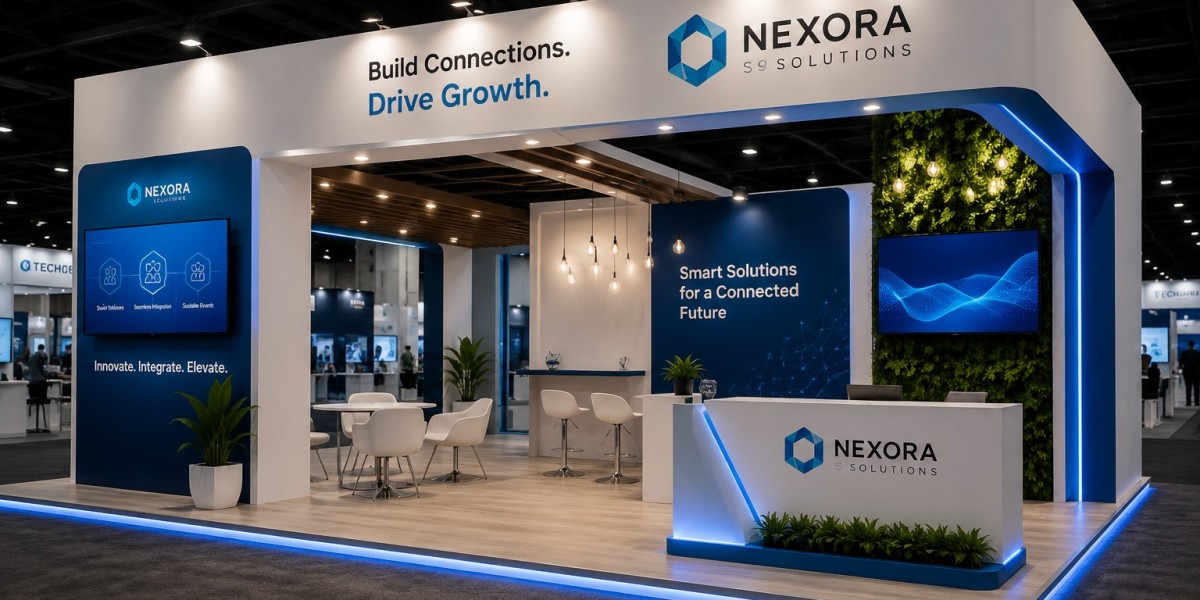


Choosing the right exhibition booth can have a major impact on your trade show experience. Your booth needs to attract attention, communicate your brand message, support meaningful conversations, and fit within your budget and timeline. For many exhibitors, the choice comes down to a Turnkey trade show booth or a fully custom booth solution. While both approaches can create an impressive presence, they differ in terms of planning, flexibility, services, cost considerations, and project management. Understanding these differences can help you determine which option makes the most sense for your next exhibition.
What Is a Turnkey Trade Show Booth?
A turnkey trade show booth is a comprehensive exhibit solution where one provider manages many of the services required to prepare your booth for the show.
Instead of coordinating separate vendors for design, fabrication, graphics, furniture, flooring, transportation, installation, and dismantling, you can work with one exhibit partner.
The exact package varies, but turnkey services may include:
Booth design
Booth construction
Graphic production
Flooring
Furniture
Lighting
Audio-visual elements
Shipping coordination
Installation
Dismantling
Storage
Project management
The objective is to simplify the exhibition process.
What Is a Custom Trade Show Booth?
A custom trade show booth is designed specifically around your brand, objectives, space, and desired visitor experience.
Rather than relying on a standardized booth configuration, custom exhibits can incorporate unique architectural elements, specialized materials, custom meeting rooms, product displays, interactive areas, and other distinctive features.
Custom does not necessarily mean that every component must be completely unique. Instead, it generally means the exhibit is developed specifically for your requirements.
Turnkey vs. Custom: What's the Main Difference?
The biggest difference is not necessarily appearance.
A turnkey solution focuses on convenience and coordinated execution, while a custom booth generally emphasizes maximum design flexibility and personalization.
That distinction becomes important when deciding what matters most to your company.
If you want to simplify project management, turnkey may be attractive.
If you need a highly specific environment that requires unusual architectural or functional elements, a custom approach may provide greater flexibility.
1. Compare Your Exhibition Goals First
Before choosing a booth type, ask a simple question:
What do you want your booth to accomplish?
Your objective might be to:
Generate leads
Launch a product
Demonstrate technology
Meet existing customers
Schedule private meetings
Increase brand awareness
Enter a new market
Create an immersive brand experience
Your goals should influence the design approach.
For example, a company focused on product demonstrations may need open demonstration stations and screens.
A business focused on executive meetings may require private meeting rooms.
A startup focused on lead generation may prefer an efficient and welcoming open layout.
2. Turnkey Booths Offer Convenience
One of the strongest advantages of turnkey exhibiting is convenience.
Trade show preparation can involve many moving parts.
You may need to manage:
Design approvals
Graphic deadlines
Production
Shipping
Labor
Electrical services
Furniture
Installation
Dismantling
Handling these individually can take substantial time.
With a turnkey provider, many of these services can be coordinated through one project.
That gives your marketing team a central point of contact and can simplify communication.
3. Custom Booths Offer Greater Design Freedom
Custom booths can provide more opportunities for creative expression.
If you have a very specific concept in mind, a custom solution may allow you to explore unique shapes, structures, materials, and visitor experiences.
For example, you might want:
Curved architectural elements
Multiple meeting rooms
Elevated branding
Large product displays
Custom demonstration areas
Special lighting features
Interactive installations
Distinctive hanging structures
A custom booth can be developed around these requirements.
4. Which Option Is More Flexible?
The answer depends on what kind of flexibility you need.
Turnkey solutions can still be highly customizable. Many providers allow exhibitors to select graphics, furniture, lighting, layouts, materials, and technology.
However, there may be practical limits based on the booth system and package.
A fully custom exhibit generally provides greater freedom to develop the physical environment from the ground up.
So if your brand requires a very unusual booth structure, custom fabrication may be the better option.
5. Consider Your Budget
Budget is one of the most important factors in exhibition planning.
Neither turnkey nor custom automatically has one fixed price.
Costs can depend on:
Booth size
Materials
Construction
Graphics
Furniture
Lighting
Technology
Shipping
Installation
Dismantling
Storage
Event location
Venue requirements
Turnkey packages can make budgeting easier because multiple services may be bundled into a single proposal.
However, always review the scope carefully.
A package that appears inexpensive initially may exclude services that you later need to purchase separately.
6. Think About Your Internal Resources
How large is your event marketing team?
Do you have people who can manage several vendors?
Do you have experience coordinating booth construction and installation?
If the answer is no, a turnkey solution can be especially useful.
Instead of your team managing every logistical detail, an exhibit partner can coordinate much of the process.
A custom booth can also be managed by a turnkey provider, so the two concepts are not necessarily opposites.
You can have a highly customized exhibit while still using a comprehensive project-management approach.
7. Compare Project Timelines
Your event date should influence your decision.
Custom booths can require more design development, engineering, fabrication, and approvals, particularly when the concept is complex.
Turnkey systems may offer faster implementation when they are based on established components and production processes.
However, complex turnkey projects can also require substantial lead time.
The safest approach is to begin planning early regardless of the booth type you choose.
8. Branding Opportunities
Your booth should look like your company—not like a generic rental structure.
Turnkey exhibits can incorporate:
Brand graphics
Logos
Custom messaging
Product imagery
Branded furniture
Digital displays
Lighting
Custom finishes
Custom booths can go even further by incorporating brand-specific architectural elements.
The important thing is to create a cohesive brand environment.
A simple booth with strong messaging can sometimes be more effective than an elaborate booth with confusing communication.
9. Visitor Experience Matters
Your booth should be designed around the people who will use it.
Visitors should be able to understand:
Who you are
What you offer
Why it matters
What they should do next
Whether you choose turnkey or custom, the visitor journey should be considered from the beginning.
Think about how someone sees your booth from the aisle.
What catches their attention?
Where do they enter?
Where do they speak with your staff?
Where do demonstrations happen?
How do you capture their information?
These questions can guide the layout.
10. Installation and Dismantling
Installation can be one of the most challenging parts of exhibiting.
The booth must arrive at the right time and be assembled correctly before the show begins.
Afterward, everything must be dismantled and prepared for transportation or storage.
A turnkey provider can coordinate these services as part of the overall project.
If you are managing a custom booth independently, you may need to coordinate installation and dismantling teams separately unless your exhibit company provides them.
Always clarify this before signing an agreement.
11. Turnkey Doesn't Mean Basic
Some exhibitors assume turnkey means choosing a simple, generic booth from a catalog.
That is not necessarily true.
Modern turnkey exhibit solutions can be highly customized.
You may be able to select:
Booth configuration
Graphic treatments
Flooring
Lighting
Furniture
Product displays
Screens
Interactive technology
Storage
Meeting areas
The difference is that these elements can be coordinated within a managed solution.
For many brands, this provides a useful balance between customization and convenience.
12. Custom Doesn't Always Mean Better
It's easy to assume that a fully custom booth will automatically perform better.
But a sophisticated structure cannot replace good strategy.
A custom booth can still fail if:
The messaging is unclear
The layout is difficult to navigate
The graphics are cluttered
There is no clear call to action
Staff members are unprepared
Visitors have nowhere comfortable to talk
Lead capture is poorly organized
The goal should not be to create the most expensive booth.
The goal should be to create the most effective booth for your objectives.
13. Reusability and Multiple Shows
If your company exhibits at several events each year, think about how the booth will perform across different venues.
A modular turnkey exhibit can often be adapted to different configurations.
For example, components may be used in:
10 × 10 booths
10 × 20 booths
Larger island exhibits
Regional events
Corporate conferences
A custom exhibit can also be designed for reuse, but this needs to be considered during the initial design process.
If you know you will attend multiple shows, tell your exhibit provider at the beginning.
14. Storage and Transportation
After the show, where will the booth go?
This is an important question that first-time exhibitors sometimes overlook.
Some exhibit solutions are designed for repeated use and can be packed and stored for future events.
Transportation costs can also vary depending on booth size, weight, packaging, and destination.
A turnkey partner may be able to coordinate shipping and storage as part of the broader service.
Make sure you understand the costs and responsibilities before the project begins.
15. Technology Integration
Both turnkey and custom booths can incorporate technology.
Depending on your goals, you could use:
Touchscreens
Large displays
Interactive product demonstrations
Digital catalogs
Charging stations
QR codes
Lead-capture systems
Presentation screens
The key is to use technology purposefully.
For example, if a touchscreen allows visitors to explore a complicated product more easily, it can enhance the experience.
If a screen simply plays a long corporate video that nobody watches, it may not add much value.
16. Meeting Spaces and Privacy
If your trade show strategy involves high-value sales conversations, you may need dedicated meeting space.
Turnkey booths can incorporate meeting tables, lounge areas, counters, and semi-private spaces.
Custom exhibits may offer even greater options for enclosed conference rooms or hospitality areas.
Consider how many meetings your team expects to conduct and how private those conversations need to be.
17. Turnkey Booths Can Reduce Vendor Management
Managing multiple vendors can create unnecessary complexity.
Imagine having one company for graphics, another for fabrication, another for furniture, another for shipping, and another for installation.
Every vendor introduces another communication point.
A turnkey solution can consolidate many of these responsibilities.
This can be particularly valuable when your team is managing several exhibitions simultaneously.
18. Custom Booths Can Strengthen Brand Differentiation
If standing apart from competitors is your primary objective, a custom booth may provide greater opportunities to create something distinctive.
Unique structures, immersive experiences, and creative architectural elements can make your exhibit memorable.
But differentiation should still support your brand message.
Ask whether the design helps visitors understand your company or simply makes the booth look unusual.
The best creative concepts combine visual impact with strategic communication.
19. How to Decide Between Turnkey and Custom
Use the following questions to guide your decision:
Choose Turnkey If You Prioritize:
Simplified project management
Coordinated services
Efficient planning
Predictable workflows
Reusable components
Reduced vendor coordination
Professional execution
Consider Custom If You Prioritize:
Maximum design freedom
Highly specialized environments
Unique architectural elements
Complex meeting spaces
Highly distinctive brand experiences
Specialized product demonstrations
Remember that these categories can overlap.
A turnkey provider may be able to deliver a highly customized booth.
20. A Hybrid Approach May Be the Best Choice
Why choose only one approach?
Many exhibitors can benefit from combining turnkey project management with custom design elements.
For example, you might use a reusable booth structure while adding custom graphics, furniture, lighting, product displays, and technology.
This can provide a balance between personalization and operational simplicity.
A hybrid approach can be particularly useful for brands that attend multiple exhibitions throughout the year.
Questions to Ask Your Exhibit Provider
Before making your decision, ask the provider:
What services are included?
Can the booth be customized?
How many design revisions are included?
Who handles graphic production?
Who manages installation?
Is dismantling included?
How is shipping coordinated?
Is storage available?
Can components be reused?
What venue services are excluded?
What is the project timeline?
Are there additional labor or handling charges?
Clear answers can help you compare proposals accurately.
Final Comparison
| Factor | Turnkey Trade Show Booth | Custom Trade Show Booth |
|---|---|---|
| Project management | Simplified | Depends on provider |
| Design flexibility | High to moderate | Very high |
| Vendor coordination | Usually reduced | Can vary |
| Branding | Highly customizable | Highly customizable |
| Installation | Often coordinated | Can be coordinated |
| Reusability | Often strong | Depends on design |
| Complexity | Easier to manage | Can be more complex |
| Best for | Efficient, coordinated exhibiting | Highly specialized experiences |
Final Thoughts
The choice between a turnkey and custom trade show booth should ultimately depend on your business goals rather than the label attached to the booth. A Turnkey trade show booth can provide an efficient and coordinated way to manage design, production, graphics, logistics, installation, and other exhibition requirements, while a custom booth can offer greater freedom for highly specialized environments. For many businesses, the ideal solution may combine turnkey project management with customized design elements. Start by defining your objectives, budget, timeline, booth size, and visitor experience. Then choose an exhibit solution that supports those priorities. The best booth is not necessarily the biggest or most elaborate—it is the one that helps your brand attract the right audience, communicate its value, and turn conversations into meaningful business opportunities.






