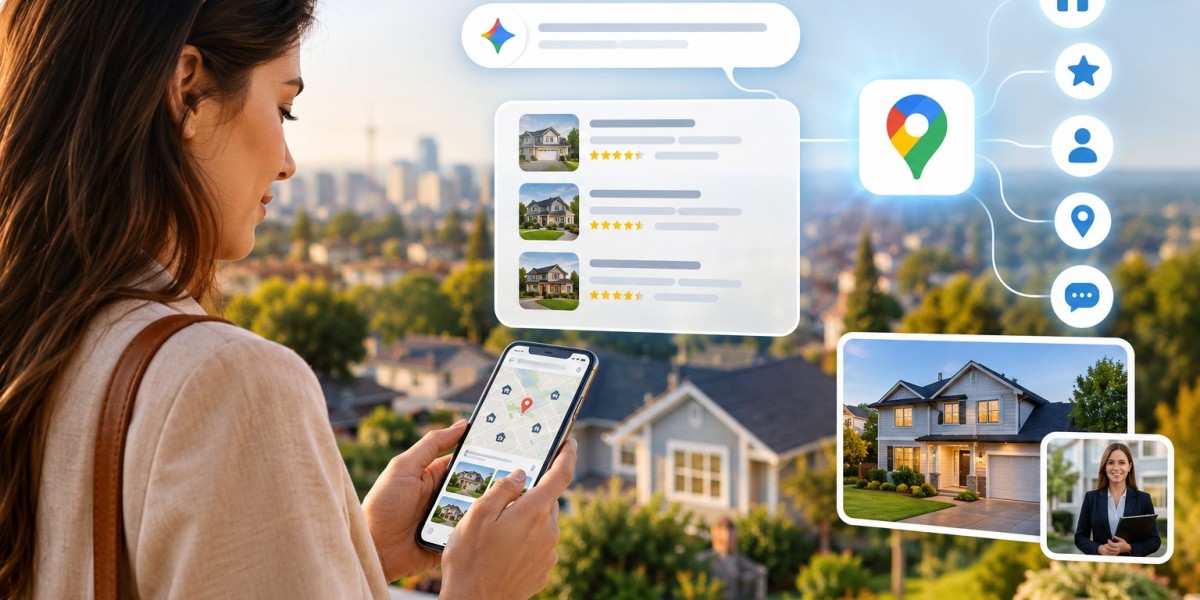


For years, local real estate marketing followed a predictable formula. A buyer or seller would search for something like “real estate agent near me,” scan the results, check a few reviews, visit a website and eventually contact an agent.
That journey is becoming more conversational.
Google is bringing AI-powered capabilities into Maps through Ask Maps, allowing people to ask detailed questions about places and receive recommendations based on information available across the Maps ecosystem. Instead of simply finding businesses, users can describe what they are looking for and expect Google to help narrow down their choices.
That shift deserves serious attention from every Digital Marketing Agency for Real Estate and the businesses they represent.
Why? Because tomorrow's local search may not be about getting your agency into the top three results. It may be about whether Google's AI understands your business well enough to recommend it when a potential client asks the right question.
For real estate companies, that changes the optimization game.
From “Near Me” Searches to Specific Recommendations
Think about how real estate search actually happens.
A buyer rarely wants just “an agent.”
They may want:
- An agent who works with first-time buyers
- Someone familiar with a particular neighborhood
- A realtor experienced with luxury properties
- An agency that handles investment properties
- A professional with strong reviews from local clients
- An agent who specializes in a particular type of transaction
Traditional search required users to figure this out themselves. They searched, opened websites, compared services and read reviews.
Conversational AI can potentially bring those requirements together.
A user might ask Google something like:
“Who are the best-rated real estate agents near me for buying a family home?”
Or:
“Which local agents specialize in luxury properties and have good customer reviews?”
Those are very different searches from simply typing “real estate agent.”
The question isn't only whether your business ranks for a keyword anymore.
It's whether your online presence gives Google enough information to understand when your business is a good fit.
Why This Matters to Real Estate Companies
Real estate is naturally local.
An agent may be highly successful in one neighborhood but have little presence in another. A brokerage might specialize in luxury homes, while others focuses heavily on first-time buyers or investment properties.
Those distinctions matter to customers and they can matter to AI-powered search as well.
This is why real estate businesses need to clearly communicate:
What they do.
Where they work.
Who they help.
What they specialize in.
What customers think about them.
The clearer those signals are across the web, the easier it becomes for search platforms to connect a business with relevant searches.
This doesn't mean Google will recommend a business simply because its website contains the right words. Local search is much more complicated than that.
But vague, incomplete and inconsistent information certainly doesn't help.
Your Google Business Profile Deserves a Fresh Look
If you haven't reviewed your Google Business Profile recently, now is a good time.
Many real estate businesses treat their profile as something they create once and forget. That's a mistake.
Your profile should accurately reflect your business today.
Review your:
- Business category
- Services
- Service areas
- Address and phone number
- Business hours
- Website
- Photos
- Business description
- Reviews
- Other relevant attributes
Pay particular attention to services and specialties.
If you work primarily with residential buyers, sellers, luxury properties or investment clients, make those offerings clear wherever Google allows you to describe them.
Your goal isn't to stuff your profile with keywords.
Your goal is to remove ambiguity.
When someone asks Google for a particular type of real estate professional, your business information should make it obvious what you actually offer.
Reviews Are More Than a Five-Star Score
Reviews have always been important in real estate.
Buying or selling a property is a major decision, and people naturally want to know whether an agent is reliable, responsive and knowledgeable.
But there's a difference between having reviews and having useful customer feedback.
Consider these two examples:
“Great realtor. Highly recommend!”
and:
“Our agent helped us find a home in the area we wanted, explained every step clearly and was always available when we had questions.”
Both are positive.
The second one tells a much bigger story.
It provides context for the experience, the service and the customer's expectations. As search becomes increasingly capable of interpreting natural language, that kind of contextual information becomes valuable.
Real estate businesses should therefore focus on delivering excellent experiences first and encouraging genuine clients to share honest, specific feedback afterward.
Don't manufacture reviews. Don't pressure clients to use particular wording.
Simply make it easy for satisfied customers to tell their story.
Create Content That Answers the Questions Buyers and Sellers Actually Ask
One of the biggest mistakes in real estate marketing is creating content only because a keyword has search volume.
People don't think in keywords.
They think of questions.
A first-time buyer may wonder:
“How much home can I realistically afford?”
A seller may ask:
“Should I renovate before putting my house on the market?”
An investor might search:
“What makes a neighborhood attractive for rental properties?”
These questions are opportunities to demonstrate expertise.
A strong Real Estate Content Marketing strategy should be built around the concerns, decisions and problems your clients face, not simply a list of keywords you want to rank for.
Create practical guides, neighborhood resources, market explainers, FAQs and property-related advice.
And don't be afraid to answer questions that seem basic.
If a client asks it in a meeting, there's a good chance another potential client is searching for the same answer online.
Local Expertise Can Become a Competitive Advantage
There's another opportunity here that real estate businesses shouldn't overlook local expertise.
Anyone can publish an article titled “How to Buy a House.”
Far fewer businesses can produce genuinely useful content about a specific community.
For example, a local agency could publish resources covering:
- Neighborhood characteristics
- Local housing trends
- School-area considerations
- Commuting patterns
- Property types
- Local amenities
- Market changes
- Home-buying considerations specific to the area
This type of content gives your online presence more depth.
It also helps demonstrate that your business isn't simply targeting a location with generic SEO pages. You actually understand the market.
That's an important distinction.
Keep Your Information Consistent Everywhere
Imagine Google finds three different versions of your business information online.
Your website says one phone number.
A directory has an old address.
Your Google profile lists a slightly different business name.
None of these problems may seem dramatic individually, but together they create an inconsistent digital footprint.
Take time to audit your business information across major platforms and directories.
Check:
- Name
- Address
- Phone number
- Website
- Services
- Areas served
- Business categories
Also look for old profiles or duplicate listings that may still appear online.
Consistency isn't exciting work, but it provides an important foundation for local visibility.
Don't Abandon Traditional SEO
The arrival of AI-powered search doesn't mean conventional SEO has suddenly become useless.
Your website still needs strong technical foundations.
Your pages still need useful content.
Your business still benefits from authoritative links, local citations, reviews and relevant mentions.
Your Google Business Profile still matters.
The difference is that businesses now need to think beyond traditional rankings.
Instead of asking only:
“What position do we have for this keyword?”
start asking:
“Does Google have enough trustworthy information to understand our business?”
And:
“Would our business make sense as an answer to the questions our ideal clients are asking?”
Those are much more useful questions in an AI-driven search environment.
What Real Estate Businesses Should Do Now
You don't need to completely change your marketing strategy tomorrow. Start by strengthening the foundation you already have.
1. Audit your Google Business Profile
Make sure your categories, services, contact details, hours and photos are accurate and current.
2. Review your customer feedback
Look beyond your star rating. Identify recurring themes in customer reviews and use those insights to understand what clients value most about your business.
3. Build question-based content
Talk to your sales team and agents. Ask what questions clients repeatedly ask before choosing an agent or moving forward with a transaction.
Those questions can become your next content topics.
4. Strengthen local expertise
Create genuinely useful resources about the communities and property markets you serve.
5. Clean up inconsistent listings
Find outdated addresses, phone numbers, services and duplicate profiles.
6. Improve your conversion journey
More visibility isn't useful if visitors don't know what to do next. Make contacting an agent, requesting a consultation or viewing properties straightforward.
7. Measure real business outcomes
Don't rely solely on rankings and traffic.
Track:
- Calls
- Lead forms
- Consultation requests
- Property inquiries
- Appointment bookings
- Direction requests
- Qualified leads
Visibility matters, but business results matter more.
Your Website Still Has a Job to Do
AI may influence how someone discovers your real estate business, but discovery is only the beginning.
Once a potential client decides to investigate further, your website becomes your opportunity to prove that the recommendation was worthwhile.
That makes Real Estate Website Design about much more than attractive colors, photographs and layouts. Your website needs to communicate expertise quickly, explain your services clearly, establish trust and guide visitors toward the next step.
Showcase real client experiences. Explain your specialties. Make location information easy to find. Keep property information current. Give visitors clear ways to contact your team.
The website should work as the destination that turns digital discovery into a real conversation.
The Future of Local Real Estate Search Is About Being the Right Answer
Google Ask Maps is part of a much larger change in search behavior.
People are becoming more comfortable asking AI systems complete questions instead of entering short keyword phrases. Search engines are becoming better at understanding context, preferences and intent. And local discovery is moving toward recommendations rather than simple lists of businesses.
For real estate professionals, this creates both a challenge and an opportunity.
You can't control every recommendation Google makes.
But you can control the quality of the information you publish, the experience you provide, the reputation you build and the expertise you demonstrate online.
That's where businesses should focus.
Don't chase every new AI feature.
Build a digital presence that clearly tells Google and potential clients who you are, where you work, what you do and why people trust you.
When search becomes more conversational, the businesses with the clearest and most credible digital identities will have a much better chance of becoming the answer people are looking for.









