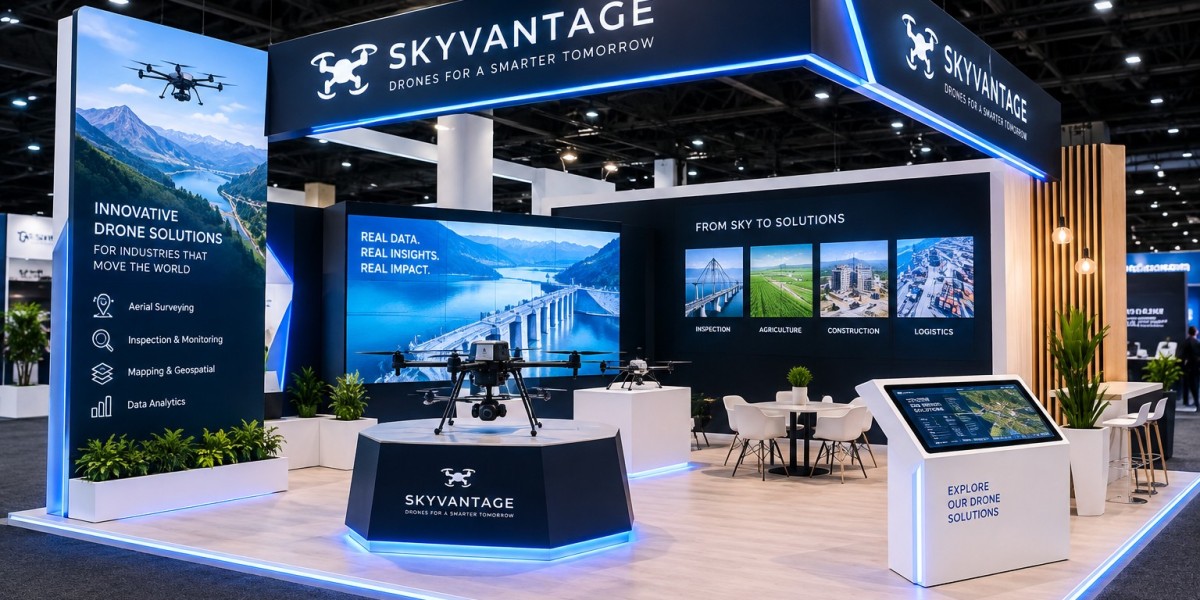


In a competitive exhibition environment, branding can determine whether a visitor notices a company, understands its offering, and remembers it after the event. A strategically planned Drone industry trade show booth design combines visual identity, messaging, product presentation, and visitor experience to create a recognizable presence on the trade show floor. For drone technology companies, strong branding is particularly important because the industry includes manufacturers, software developers, sensor providers, service companies, system integrators, and specialized technology firms competing for the attention of similar audiences.
A trade show booth should therefore do more than display a company logo. It should communicate what the brand represents, what problems it solves, and why visitors should invest their time in learning more. When branding and booth design work together, the exhibition space becomes a physical representation of the company's identity.
Why Branding Matters at Drone Industry Trade Shows
Trade shows are crowded environments. Visitors may walk past hundreds of exhibitors during a single event, often while looking for specific technologies, suppliers, partners, or business opportunities.
In this environment, branding provides an immediate point of recognition.
A strong brand presence can help visitors identify:
The company's name
Its industry specialization
Its primary products
Its key capabilities
Its market positioning
Its professional identity
Its overall value proposition
For drone companies, this recognition is especially useful when the exhibition includes numerous businesses offering similar categories of hardware or services.
A well-branded booth can make a company easier to locate, easier to understand, and easier to remember.
Branding Is More Than a Logo
One common mistake is treating branding as simply placing a large logo above the booth.
A logo is important, but effective exhibition branding involves much more.
It includes:
Brand colors
Typography
Photography
Messaging
Product presentation
Graphic design
Architecture
Lighting
Digital content
Staff appearance
Communication style
These elements should work together to create a consistent experience.
For example, a drone company positioned around precision engineering may use a clean architectural structure, technical graphics, detailed product displays, and concise messaging. A company focused on agricultural drone solutions might use application imagery, field visuals, and outcome-oriented messaging.
The design should reflect the company's actual positioning.
Creating a Recognizable Brand Identity
Recognition is one of the primary objectives of trade show branding.
A visitor should ideally be able to identify the company from a distance before reading every detail.
This requires consistency across the booth.
The same visual language should appear across:
Main signage
Product displays
Back walls
Counters
Digital screens
Brochures
Staff materials
Meeting areas
If every element looks different, the booth can appear disconnected.
A consistent identity creates a stronger sense of professionalism.
Use the Logo Strategically
A logo should be visible, but placing it everywhere is not necessarily effective.
Instead, use the logo at important visual points:
Main overhead signage
Reception or entry point
Product display areas
Digital presentations
Meeting areas
The objective is recognition without visual clutter.
Maintain Consistent Typography
Typography can strongly influence how a brand is perceived.
A technology-focused drone company may benefit from modern, highly legible fonts, while an established industrial company might prefer a more traditional visual system.
Whatever the choice, typography should remain consistent throughout the booth.
Using Brand Colors Effectively
Color is one of the fastest visual signals people recognize.
A company's established colors should generally appear throughout the booth, but they should not overwhelm the visitor.
An effective color strategy often includes:
Primary Brand Color:
Used for major visual elements.
Secondary Colors:
Used for supporting graphics and information.
Neutral Background:
Used to create visual balance.
For example, a company with a strong dark brand color could use it selectively on architectural features while maintaining lighter backgrounds for product demonstrations and technical information.
The objective is to make the booth recognizable while preserving readability.
Connecting Branding With Drone Technology
Branding should reflect the company's relationship with drone technology.
Generic branding can make a booth look similar to other technology exhibitors.
Instead, incorporate visuals that communicate the company's specific role in the drone ecosystem.
Depending on the business, this could include:
Drone aircraft
Sensors
Payloads
Controllers
Mapping imagery
Aerial photography
3D models
Inspection workflows
Agricultural applications
Industrial environments
Data analytics
Autonomous operations
However, these visuals should be selected carefully.
A booth does not need every possible drone image. The visuals should support the company's particular market position.
Make the Value Proposition Highly Visible
Branding and messaging should work together.
A visitor should not have to study a booth for several minutes to determine what the company does.
A strong headline can communicate the primary value proposition quickly.
Instead of using a complicated technical statement, consider messages such as:
“Advanced Aerial Intelligence for Industrial Operations”
or
“Precision Drone Solutions for Modern Agriculture.”
The supporting information can provide technical detail afterward.
This creates a hierarchy:
Brand → Message → Product → Proof → Conversation
Positioning the Brand Through Booth Architecture
The physical structure of a booth can communicate brand positioning before a representative says a word.
Architecture can convey:
Innovation
Reliability
Precision
Sustainability
Scale
Technical expertise
Industrial strength
For example, a company serving major infrastructure projects might use a strong, structured architectural design that reflects reliability and engineering.
A software-focused drone company might instead emphasize digital displays, interactive screens, and a more open technology environment.
The physical environment should reinforce the brand promise.
Designing a Strong Entrance
The entrance is an important branding opportunity.
An open entrance can make a company appear accessible and encourage visitors to explore.
A closed or overly complicated entrance may create psychological barriers.
For many drone technology exhibitors, an effective entrance could include:
Large brand identification
A short value proposition
A visible product
Open sightlines
A clear visitor pathway
The visitor should immediately understand where to go.
Product Displays Should Support the Brand
Products are often the most important physical assets in a drone booth.
Their presentation should therefore be carefully integrated with branding.
Avoid placing drones randomly throughout the space.
Instead, create clear product zones.
For example:
Drone Platforms
Display the main aircraft with concise specifications.
Payload Systems
Show cameras, sensors, or specialized equipment.
Software
Demonstrate the digital platform that turns collected data into useful information.
Applications
Show how the complete system operates in real-world environments.
This creates a connection between the product and the brand story.
Branding Through Application Storytelling
A drone itself may be impressive, but visitors often want to understand what it can accomplish.
Application storytelling can connect branding to business outcomes.
For example:
Problem:
A large industrial facility requires frequent inspections.
Solution:
A drone captures aerial imagery and sensor data.
Analysis:
The software processes the information.
Outcome:
The operations team receives actionable inspection insights.
This story can be presented through graphics, digital displays, or demonstrations.
The company becomes associated not merely with a drone, but with a complete solution.
Digital Branding in the Booth
Modern trade show booths often use digital technology to extend brand communication.
Digital displays can feature:
Product demonstrations
Company videos
Customer stories
Application footage
Interactive maps
3D product models
Technical diagrams
Data visualizations
The digital content should follow the same visual identity as the physical booth.
Use consistent:
Fonts
Logo placement
Color system
Photography style
Messaging
This creates continuity between physical and digital experiences.
Video Content and Brand Recognition
Video can be especially powerful for drone companies because aerial technology is naturally visual.
A short video can demonstrate something that static graphics cannot.
Examples include:
A drone inspecting a tower
A UAV surveying a construction site
Agricultural field monitoring
Mapping operations
Industrial inspection
Autonomous flight
Data analysis
Videos should be concise and easy to understand without sound.
Visitors often walk past screens without stopping, so the first few seconds should communicate the central idea.
Use Real Drone Footage
Whenever possible, authentic footage can strengthen credibility.
Real-world footage helps visitors visualize the technology in operation.
Instead of relying exclusively on stock photography, companies can show:
Actual flight operations
Customer environments
Product demonstrations
Mission workflows
Before-and-after examples
This gives the brand a more authentic identity.
Branding Through Staff Presentation
Employees are part of the booth experience.
Even a beautifully designed exhibition space can feel inconsistent if staff presentation does not match the brand.
Staff clothing can incorporate:
Brand colors
Company logos
Professional styling
Consistent identification
However, staff uniforms do not need to be overly promotional.
The most important consideration is professionalism and approachability.
Employees should also communicate in a way that matches the brand.
A technical engineering brand may emphasize precision and expertise, while a customer-focused solutions provider may use a more conversational communication style.
Creating a Consistent Visitor Experience
Every visitor interaction should reinforce the brand.
Consider the entire journey:
Seeing the Booth → Entering → Exploring Products → Watching Demonstration → Speaking With Staff → Receiving Information → Following Up
Each stage should feel connected.
For example, if the booth communicates advanced engineering but the product demonstration is poorly organized, the brand experience becomes inconsistent.
Similarly, if the booth looks premium but printed materials are poorly designed, visitors may question the company's attention to detail.
Brand consistency builds trust.
How Branding Helps Differentiate Drone Companies
The drone industry includes many companies offering overlapping technologies.
A strong brand can help create differentiation beyond product specifications.
Two companies may offer drones with similar flight times and payload capabilities, but their positioning can be completely different.
One may focus on:
Industrial Reliability
Another may focus on:
Data Intelligence
Another may emphasize:
Agricultural Productivity
Another may specialize in:
Surveying and Mapping
Branding allows the company to communicate this difference quickly.
Avoiding Common Branding Mistakes
Overcrowding the Booth
Too many logos, graphics, messages, and product specifications can create visual confusion.
Using Inconsistent Colors
Too many unrelated colors can weaken brand recognition.
Relying on Generic Stock Images
Generic imagery can make the booth look interchangeable with competitors.
Making the Logo Too Dominant
A huge logo does not automatically create a stronger brand.
The overall experience matters more.
Using Excessive Technical Language
Complex terminology may confuse visitors who are not specialists.
Ignoring White Space
Empty space can help important information stand out.
Changing the Brand at Every Event
Trade show creativity is valuable, but core brand recognition should remain consistent.
Branding for Small and Large Booths
Branding principles apply regardless of booth size.
A small booth does not need to compete with a large booth by using more graphics.
Instead, it should focus on:
Strong brand identification
One clear message
One or two hero products
High-quality visuals
Simple navigation
Focused conversations
Large booths have more space to create separate branded experiences.
They may include:
Product zones
Demonstration areas
Interactive technology
Meeting rooms
Application displays
Hospitality areas
However, larger space also requires greater design discipline.
More space should not mean more clutter.
Branding for Startups in the Drone Industry
Startups often have limited budgets but still need a credible exhibition presence.
The key is prioritization.
Focus investment on:
High-quality main signage
Clear messaging
Strong product presentation
Professional graphics
One memorable demonstration
Knowledgeable staff
A startup does not necessarily need a massive booth to look credible.
A focused, well-branded environment can communicate professionalism without excessive expenditure.
Sustainability and Brand Perception
Sustainability is increasingly relevant to exhibition design and corporate identity.
Companies can consider reusable booth structures, modular displays, recyclable materials, energy-efficient lighting, and digital information instead of excessive printed materials.
For drone companies working in agriculture, infrastructure, environmental monitoring, or logistics, sustainability can also become part of the broader brand narrative.
However, sustainability claims should be genuine and supported by actual practices.
Measuring the Impact of Branding
Branding should not be evaluated only by appearance.
Companies can measure several outcomes.
Brand Recognition
Ask visitors how they heard about the company or whether they recognize the brand after the event.
Engagement
Measure booth visits, demonstrations, and meaningful conversations.
Lead Quality
Evaluate whether visitors match the company's target audience.
Meeting Requests
Track scheduled follow-up meetings.
Digital Engagement
Measure interactions with screens, QR codes, downloads, or online resources.
Post-Show Recall
Sales teams can assess whether prospects remember the company's positioning during follow-up conversations.
These measurements can help determine whether booth branding is contributing to business objectives.
Building a Strong Brand Message for the Trade Show
Before designing the booth, define three basic questions:
Who are we?
This establishes brand identity.
What do we provide?
This explains the product or service.
Why does it matter?
This communicates the business value.
The answers should influence every major design decision.
For example:
Who are we?
A provider of industrial drone inspection technology.
What do we provide?
Integrated UAV, sensor, and data solutions.
Why does it matter?
We help organizations collect actionable inspection data more efficiently.
That message can then be translated into architecture, graphics, demonstrations, and conversations.
A Practical Branding Framework
A useful framework for drone trade show booth branding is:
1. Recognition
Make the company easy to identify.
2. Relevance
Show visitors why the technology matters to their industry.
3. Clarity
Communicate the offering without unnecessary complexity.
4. Experience
Allow visitors to interact with products and technology.
5. Credibility
Use demonstrations, case studies, technical expertise, and real-world examples.
6. Memorability
Create one or two distinctive experiences visitors are likely to remember.
7. Continuity
Maintain the same brand identity before, during, and after the event.
Final Thoughts
Branding plays a central role in transforming a trade show booth from a simple exhibition space into a recognizable business environment. For drone companies, effective branding should connect the company's identity with its technology, applications, expertise, and customer value. Every element—from architecture and colors to product displays, digital content, messaging, and staff interactions—can contribute to how visitors perceive the company.
The strongest exhibition strategies do not rely on visual impact alone. They create a consistent story that visitors can understand quickly and remember afterward. When brand identity and booth experience are aligned, exhibitors can create stronger recognition, more relevant conversations, and a clearer position within a competitive technology marketplace. A well-planned Drone industry trade show booth design gives drone companies the opportunity to turn their brand into a tangible experience that communicates innovation, expertise, and practical value from the moment visitors approach the booth.