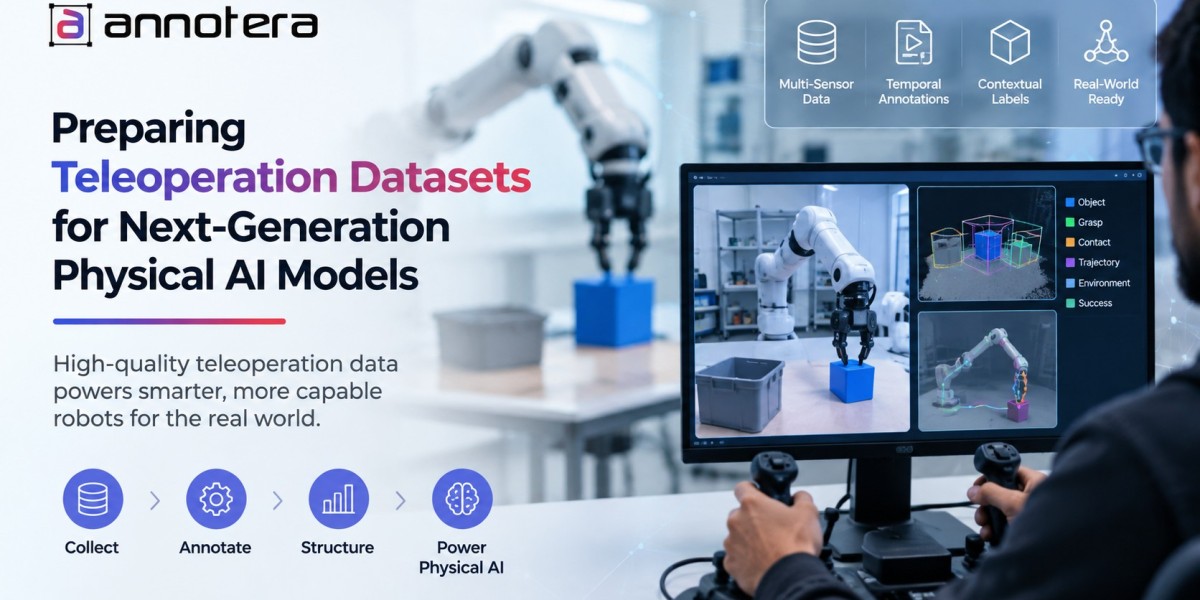


As robots move beyond controlled environments and into warehouses, laboratories, healthcare facilities, homes, and industrial settings, their ability to understand and respond to the physical world becomes increasingly important. This shift is driving interest in Physical AI training data, where models learn not only from digital information but also from real-world interactions, movements, and outcomes.
Teleoperation is one of the most valuable sources of this training data. By allowing a human operator to control a robot while performing a task, teleoperation systems generate demonstrations that capture how actions are planned, executed, corrected, and adapted to changing environments. However, raw demonstrations alone are not enough. Preparing high-quality teleoperation datasets requires careful organization, annotation, validation, and contextualization.
For robotics developers building next-generation Physical AI models, dataset preparation has therefore become a strategic priority.
Why Teleoperation Data Matters for Physical AI
Physical AI systems need to connect perception with action. A robot must recognize objects, understand spatial relationships, determine what needs to be done, and execute movements while responding to physical feedback.
Teleoperation demonstrations provide examples of this complete interaction loop. An operator may approach an object, adjust the robot's trajectory, establish contact, grasp the object, reposition it, and release it at a target location. Each stage contains information that can help a learning system understand the relationship between observations and actions.
Unlike datasets containing isolated images or predefined labels, teleoperation data can capture:
Robot trajectories and movements
Object interactions and manipulation states
Environmental changes
Contact and collision events
Operator corrections
Task success and failure
Temporal relationships between actions
Multi-sensor observations
When structured correctly, these demonstrations can become valuable inputs for imitation learning, reinforcement learning, vision-language-action models, and other robotics learning approaches.
Start With a Clear Dataset Structure
Before annotation begins, teleoperation datasets should have a consistent structure. Every demonstration should ideally contain relevant information about the task, environment, robot configuration, sensors, operator actions, and outcome.
Metadata can describe factors such as task category, object type, workspace, robot platform, camera configuration, environmental conditions, and demonstration duration. This information makes datasets easier to filter and helps researchers identify which demonstrations are appropriate for specific training objectives.
A structured dataset also makes it easier to scale annotation workflows. When thousands or millions of demonstrations are involved, inconsistent file structures or missing metadata can significantly reduce the usefulness of the collection.
Annotate Actions at the Right Temporal Granularity
Robotic behavior is inherently temporal. A single demonstration may contain dozens of meaningful transitions, and treating the entire recording as one event can hide important learning signals.
Annotation should therefore identify meaningful action segments. For example, a manipulation sequence could be divided into:
Object approach
Alignment
Contact initiation
Grasp establishment
Object lifting
Movement
Placement
Release
Temporal boundaries help models associate specific observations with corresponding actions. They can also identify transitions where the robot changes its strategy.
This is particularly important for long-horizon tasks, where successful completion depends on a sequence of interdependent behaviors rather than one isolated action.
Capture Context, Not Just Robot Motion
A robot's movement rarely makes sense without environmental context. A trajectory may change because an object moved, an obstacle appeared, a grasp became unstable, or the operator detected an unexpected condition.
For this reason, teleoperation annotation should go beyond labeling robot actions. Annotators should capture relevant environmental changes and contextual events surrounding those actions.
Contextual labels may include object movement, object visibility, obstacles, human presence, contact states, grasp conditions, and changes in workspace configuration.
This additional information helps Physical AI models learn that actions are responses to particular physical circumstances rather than arbitrary motion patterns.
Integrate Multi-Modal and Multi-Sensor Information
Modern teleoperation systems can generate data from multiple sources, including RGB cameras, depth sensors, force-torque sensors, joint encoders, proprioceptive signals, controller inputs, and robot state information.
The challenge is not simply collecting these modalities but aligning them accurately.
Multi-sensor annotation can establish relationships between visual observations, robot movements, and physical interactions. For example, a change in camera imagery may coincide with a force increase and a corresponding change in gripper position. Together, these signals can indicate contact or grasp establishment more reliably than any single modality.
Timestamp synchronization and consistent labeling conventions are essential. Without them, models may learn misleading relationships between sensor observations and robot actions.
Label Success, Failure, and Recovery
Successful demonstrations are valuable, but failures can also provide critical learning signals.
A teleoperation dataset should identify events such as failed grasps, object drops, collisions, trajectory deviations, unexpected resistance, and incomplete task execution. Where possible, annotations should also capture recovery behavior.
For example, an operator may attempt to grasp an object, recognize that the grip is unstable, reposition the end effector, and try again. This sequence provides information about both failure recognition and corrective behavior.
Including these examples can make datasets more representative of real-world robotics, where uncertainty and recovery are unavoidable.
Use Human Demonstrations Strategically
Human operators naturally adapt their behavior based on visual and physical feedback. They may slow down near fragile objects, change their approach angle, or modify a trajectory when an obstacle becomes apparent.
These adjustments are valuable because they demonstrate decision-making under physical constraints.
However, operator demonstrations can vary significantly. Different operators may perform the same task using different trajectories or levels of precision. Dataset preparation should therefore preserve meaningful behavioral diversity while maintaining consistent annotation standards.
Clear annotation guidelines, reviewer processes, and quality-control procedures can help distinguish legitimate behavioral variation from labeling errors.
Quality Control Is Essential
High-volume teleoperation datasets require systematic quality assurance. A single inconsistent label may have limited impact, but repeated inconsistencies across thousands of demonstrations can introduce significant noise.
Quality-control workflows can include annotation reviews, inter-annotator agreement checks, temporal-boundary verification, sensor alignment checks, missing-label detection, and automated validation rules.
Samples with ambiguous events should be flagged for expert review rather than forcing annotators to make unsupported assumptions. This creates a more reliable dataset and improves confidence in downstream model training.
How Robotics Data Annotation Services Support Dataset Preparation
Preparing large teleoperation datasets requires both robotics knowledge and scalable annotation capabilities. Professional robotics data annotation services can help robotics companies transform raw demonstrations into structured, machine-learning-ready datasets.
Annotation workflows can be customized for different robotic platforms, manipulation tasks, sensor configurations, and model objectives. Teams can define taxonomies for actions, object states, contact events, environmental changes, failures, and task outcomes while applying those standards consistently across large datasets.
For organizations developing Physical AI systems, this approach can reduce the burden of manual dataset preparation while supporting the consistency required for model development.
Preparing Data for the Next Generation of Physical AI
The next generation of Physical AI models will require datasets that represent more than successful robot movements. They will need demonstrations containing temporal structure, environmental context, multimodal observations, physical interactions, operator decisions, and recovery behaviors.
A well-prepared teleoperation dataset should therefore answer three fundamental questions: What did the robot observe? What action did it take? Why did that action occur?
When these relationships are clearly represented, teleoperation data becomes much more than recorded robot control. It becomes a structured representation of interaction between an intelligent agent and the physical world.
At Annotera, we understand that high-quality training data is foundational to robotics intelligence. Through scalable annotation workflows, contextual labeling, multi-sensor data handling, and rigorous quality control, organizations can prepare teleoperation datasets designed for increasingly capable Physical AI models.
As robotics continues to evolve, the quality, structure, and context of training data will play a central role in determining how effectively robots can learn, adapt, and operate in the real world.









