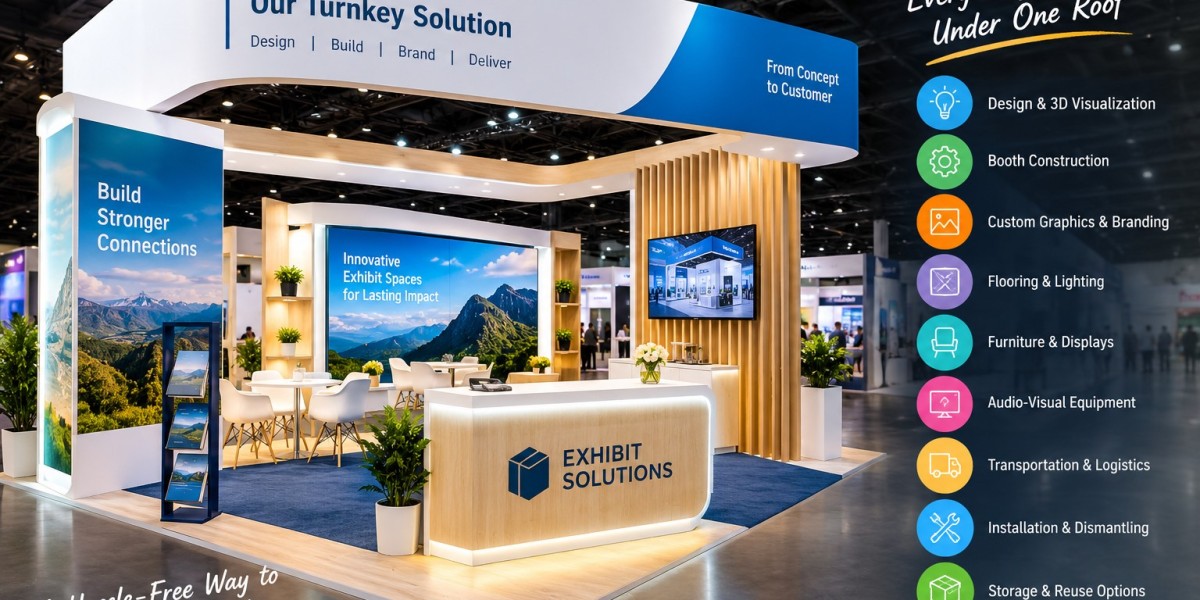


Choosing the right type of trade show exhibit is an important decision for any company preparing to participate in an exhibition. Businesses must consider their goals, booth size, branding requirements, event schedule, budget, and plans for future shows. Both custom and rental exhibits can create impressive brand experiences when they are planned correctly. Working with experienced Las Vegas trade show booth builders can help exhibitors understand the advantages of each approach and determine which solution is best suited to their exhibition strategy.
Understanding Custom Trade Show Exhibits
A custom trade show exhibit is designed specifically for a particular brand.
Every part of the booth can be developed around the company's identity, products, audience, and marketing objectives. This approach provides a high level of creative flexibility.
Custom exhibits can incorporate distinctive architectural structures, specialized product displays, private meeting rooms, storage areas, branded environments, hanging signs, lighting features, and interactive technology.
The design can be developed from the ground up rather than being adapted from an existing system.
This makes custom exhibits especially attractive to companies that want a unique and recognizable presence at major trade shows.
What Are Rental Exhibits?
Rental exhibits provide another approach to trade show participation.
Instead of purchasing an exhibit structure outright, a company rents the booth components for a specific event or period.
Rental solutions can include many of the same visual and functional features available with custom exhibits.
For example, a rental booth may include branded graphics, counters, shelving, lighting, furniture, meeting spaces, product displays, and digital elements.
The difference is primarily in ownership.
After the event, the rental structure can be dismantled and returned or handled according to the rental agreement.
This can make rental exhibits particularly useful for businesses that participate in occasional trade shows or want to manage upfront costs.
Custom vs. Rental: The Basic Difference
The biggest distinction between the two options is ownership and long-term strategy.
A custom exhibit is generally created as a long-term physical marketing asset. The company owns or invests in a booth system that can potentially be reused and modified for future events.
A rental exhibit is designed for temporary use.
This means companies can obtain a professional exhibition environment without necessarily committing to owning and storing the physical booth.
Neither option is automatically better.
The right choice depends on how frequently you exhibit and what you want your booth to accomplish.
When a Custom Exhibit Makes Sense
A custom booth may be a strong choice for companies that exhibit frequently.
If your organization attends numerous trade shows each year, investing in a reusable exhibit system may provide greater long-term value.
Custom exhibits can also make sense when branding is a major priority.
Companies with complex products, distinctive brand identities, or highly specialized demonstrations may benefit from having complete control over the booth's design.
A custom exhibit can be created around very specific requirements.
For example, a company may need a large demonstration area, multiple private meeting rooms, integrated storage, or a particular architectural feature that is difficult to achieve with a standard rental system.
When a Rental Exhibit Makes Sense
Rental exhibits can be particularly useful for businesses that want flexibility.
If you only attend a few trade shows each year, purchasing and storing a booth may not always be the most practical approach.
Rental exhibits can also be useful when your booth requirements change from event to event.
For one exhibition, you may need a large island booth. For another, a smaller inline configuration may be more appropriate.
A rental approach can provide flexibility without requiring you to own multiple booth structures.
It can also reduce the responsibility associated with long-term storage.
Comparing Upfront Costs
Budget is one of the most important factors when comparing custom and rental exhibits.
Custom exhibits generally require a larger initial investment because the structure is designed and produced specifically for the exhibitor.
However, that investment can potentially be spread across multiple events if the booth is reused.
Rental exhibits typically involve lower initial commitments because the physical structure is not being purchased.
This can make them attractive to companies working with limited event budgets or testing a new exhibition strategy.
However, exhibitors should evaluate total costs rather than looking only at the initial price.
Expenses such as graphics, shipping, installation, dismantling, storage, furniture, technology, and venue services should all be considered.
Looking at Long-Term Value
A custom exhibit can provide long-term value when used repeatedly.
Suppose a company participates in ten or more trade shows over several years. A well-designed modular custom booth could potentially be adapted for different spaces and reused across those events.
The value comes from the ability to modify and redeploy the exhibit.
Rental booths can also provide long-term marketing value, but their financial advantage is often related to flexibility and reduced ownership responsibilities.
Companies should compare their expected number of events against the cost of purchasing, maintaining, transporting, and storing a custom exhibit.
A simple cost comparison can help determine which option makes more sense.
Flexibility Across Different Booth Sizes
Trade show booth sizes can vary significantly.
A company may exhibit in a small inline space at one event and a large island footprint at another.
This is where modular design can become valuable.
Custom modular exhibits can be engineered to accommodate different configurations.
Rental systems may also provide flexibility because exhibitors can select different booth packages or configurations depending on the event.
When speaking with a booth builder, ask how easily the design can be adapted.
A booth that looks excellent in one space may not work as effectively in another if its components cannot be reconfigured.
Branding Considerations
Brand consistency is essential for trade show marketing.
Whether you choose a custom or rental exhibit, your booth should communicate your company's identity clearly.
Graphics, typography, colors, messaging, imagery, and architectural elements should work together.
Rental does not necessarily mean generic.
A well-planned rental exhibit can still feature highly branded graphics and customized visual elements.
The difference is that the underlying structure may come from a reusable rental system.
Companies should therefore evaluate the level of branding and customization available from the booth provider rather than assuming that rental means limited creativity.
Design Creativity
Custom exhibits generally offer the greatest level of design freedom.
If you have a very specific concept in mind, a custom approach may make it easier to execute.
You can control the structure, dimensions, materials, storage, lighting, product presentation, and visitor flow.
Rental exhibits can also be creative, particularly when experienced designers combine standard components with custom graphics, furniture, lighting, and technology.
The quality of the final result depends heavily on the booth builder's design capabilities.
A creative designer can make a rental system feel highly personalized.
Technology Integration
Both custom and rental booths can incorporate technology.
Technology might include:
LED displays
Touchscreens
Product demonstrations
Interactive kiosks
QR codes
Digital lead capture
Charging stations
Presentation screens
Immersive experiences
Custom exhibits may make it easier to integrate technology into the architecture from the beginning.
Rental booths can also support technology, but exhibitors should confirm the available power, mounting, cabling, and structural options before finalizing the design.
Technology should always support the visitor experience.
A complicated system that creates technical problems is unlikely to improve your exhibition results.
Storage and Transportation
Storage is another important difference between custom and rental solutions.
Owning a custom exhibit means the company needs a plan for storing its components between events.
Large structures can require significant storage space.
Transportation must also be planned carefully.
Rental exhibits reduce some of these ownership responsibilities because the booth components are typically managed through the rental provider.
For companies with limited storage space, this can be a significant advantage.
Before selecting either option, ask about shipping, storage, packaging, and handling requirements.
Installation and Dismantling
Regardless of whether you choose custom or rental, installation is an important part of the exhibition process.
A professional team needs to assemble the booth correctly and ensure that graphics, lighting, furniture, technology, and other components are positioned according to the approved design.
Dismantling is equally important.
For custom exhibits, components may need to be carefully packed for future use. Rental components need to be prepared for return or continued circulation within the provider's inventory.
A booth builder that offers comprehensive installation and dismantling services can simplify the process.
Customization of Meeting Areas
Meeting space is increasingly important for businesses attending trade shows.
Sales teams often need areas where they can discuss pricing, product specifications, partnerships, or business opportunities away from the busiest part of the show floor.
Custom exhibits can be designed around specific meeting requirements.
A company may request multiple meeting rooms, a private conference area, or a hospitality lounge.
Rental exhibits can also incorporate meeting areas depending on the size and configuration selected.
When comparing options, consider how many conversations you expect to have and how much privacy those discussions require.
Sustainability Considerations
Sustainability can also influence the custom-versus-rental decision.
Reusable exhibits can reduce the need to produce an entirely new booth for every event.
Custom modular systems can be designed for repeated use and reconfiguration.
Rental exhibits also support reuse because the same structural components can be used for different clients and events.
Companies interested in sustainable exhibiting should ask booth providers about reusable materials, modular structures, recyclable graphics, and energy-efficient lighting.
The goal should be to create an attractive exhibit while minimizing unnecessary waste.
How Often Do You Exhibit?
Your event calendar is one of the most useful factors when making this decision.
If your company participates in many exhibitions throughout the year, a custom exhibit may offer strong long-term value.
If you attend only one or two events, renting may provide greater flexibility.
However, frequency is not the only consideration.
The size of your booths, the importance of each event, your branding requirements, and your expected return should also be considered.
A major annual industry event may justify a custom investment even if it is your only exhibition of the year.
Consider Your Marketing Goals
Your marketing goals should guide the booth decision.
If your primary goal is brand awareness, you may prioritize a visually distinctive environment.
If lead generation is the priority, you may need an open layout with multiple interaction points and lead-capture stations.
If product education is important, demonstration areas may become the central focus.
If executive meetings are the priority, private spaces may be more important.
Once your objectives are clear, a booth builder can recommend a structure and layout that supports those goals.
Don't Choose Based on Price Alone
It can be tempting to select the least expensive option.
However, the cheapest booth may not deliver the strongest value.
A low-cost solution may lack the graphics, functionality, storage, technology, or visitor experience required for your event.
At the same time, an expensive custom booth may be unnecessary if your company only participates in occasional events.
The best decision is based on value.
Compare what each option provides, how often it can be used, what services are included, and how well it supports your marketing objectives.
Questions to Ask Your Booth Builder
Before making a decision, ask your booth provider several practical questions.
Can the booth be customized?
What is included in the quoted price?
Are graphics included?
Can the booth be adapted for different booth sizes?
Who handles installation and dismantling?
How is shipping coordinated?
What storage options are available?
Can technology be integrated?
Can meeting spaces be included?
Can components be reused?
These questions can help you understand the complete offering and avoid unexpected costs.
Combining Custom and Rental Elements
The choice does not always have to be completely custom or completely rental.
Some exhibitors use a hybrid approach.
For example, a company may invest in custom branded elements while renting structural components, furniture, or specialized equipment.
This approach can provide a balance between personalization and flexibility.
A hybrid solution may be especially useful when a company wants certain signature elements to remain consistent across events while changing the booth configuration depending on the venue.
Discussing these possibilities with your booth builder can reveal additional options.
Preparing for Las Vegas Trade Shows
Las Vegas is a major destination for exhibitions, conferences, and business events.
The competitive environment means exhibitors should carefully consider how their booths will attract attention and support visitor engagement.
Planning should begin well before the event.
Start by identifying your booth size, marketing goals, budget, product priorities, and desired visitor experience.
Then work with your exhibit partner to determine whether a custom, rental, or hybrid solution makes the most sense.
Early planning also gives you more time to finalize graphics, prepare staff, coordinate logistics, and develop promotional campaigns.
Making the Final Decision
There is no universal answer to the custom-versus-rental question.
Your business circumstances should determine the choice.
Choose a custom solution when long-term reuse, highly specialized design, and complete creative control are priorities.
Consider a rental solution when flexibility, reduced ownership responsibilities, and event-specific configurations are more important.
Consider a hybrid approach when you want both customization and adaptability.
The right booth builder should not simply try to sell you one option. They should first understand your objectives and recommend an exhibition solution that fits your strategy.
Final Thoughts
Custom and rental trade show exhibits can both deliver professional, engaging experiences when they are designed around clear business goals. The best choice depends on your event schedule, budget, branding requirements, booth size, storage needs, desired customization, and long-term exhibition strategy. Instead of focusing only on the initial price, consider the total value and practical responsibilities associated with each option.
Whether you choose a custom, rental, or hybrid solution, experienced Las Vegas trade show booth builders can help you evaluate your options and create an exhibit that reflects your brand, engages visitors, supports meaningful conversations, and makes your trade show investment work harder.