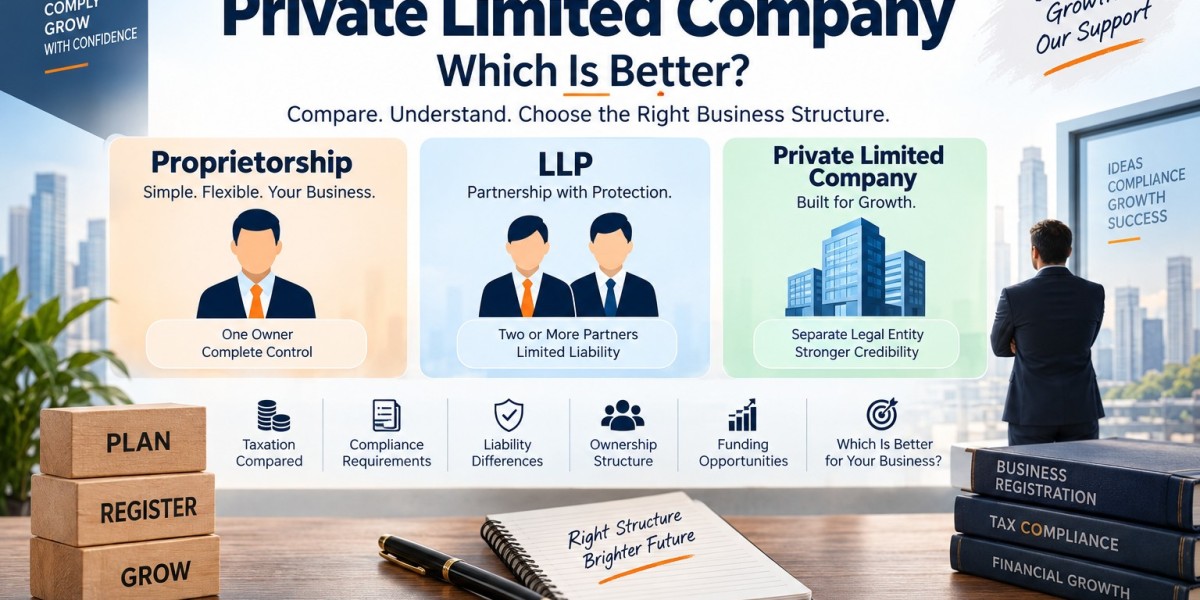


One of the most crucial decisions for any entrepreneur in India is to choose a suitable business organizational structure. The legal structure you choose can affect your taxes, regulatory compliance, liability exposure, financing options, business credibility and ability to grow down the line.
Some of the most popular business structures are Sole Proprietorship, Limited Liability Partnership (LLP) and Private Limited Company. But which one is the best for your business?
Proprietorship vs LLP vs Private Limited Company in this guide to help you understand the key differences and choose the one that best suits your business goals.
What Is a Sole Proprietorship?
Sole Proprietorship is the easiest way to start a business in India. It is owned and controlled by a single man. The proprietor has no legal independence from the business in most cases.
It is most favored by freelancers, consultants, small traders, home-based businesses and professionals wanting to start operations with relatively simple compliance.
Advantages of Proprietorship
Easy to start and operate
Lower compliance requirements
Complete control with the owner
Relatively simple accounting and taxation
Suitable for small businesses and individual professionals
Disadvantages of Proprietorship
The major disadvantage is that the owner typically has unlimited personal liability for the debts of the business. Also, it can be hard to attract major external investment as the business is so tied to its owner.
What Is an LLP?
An LLP ( Limited Liability Partnership ) is a hybrid of a normal ( general ) partnership and limited liability .
An LLP is a separate legal entity from its partners and the liability of the partners is generally limited to the contribution agreed to be made by the partners, subject to applicable law.
LLPs are suitable for professional practices, service providers, consultants and businesses where two or more people wish to work together and have a fairly flexible structure.
Advantages of LLP
Separate legal entity
Limited liability protection for partners
Suitable for two or more partners
Flexible internal management
Generally fewer compliance requirements than a private limited company
No requirement to issue shares like a company
Disadvantages of LLP
An LLP may not be the ideal structure if your primary objective is to raise significant equity investment from outside investors. Its ownership and investment structure is also different from that of a company.
What Is a Private Limited Company?
A Private Limited Company is a separate legal entity which is incorporated under the Companies Act, 2013. It’s one of the most common structures for startups and businesses that want to grow significantly.
A private limited company allows for shareholders and directors and is more appropriate for businesses that want a structured ownership model and may plan to raise equity capital.
Advantages of Private Limited Company
Separate legal identity
Limited liability of shareholders
Structured ownership through shares
Better suited for external equity investment
Strong business credibility
Suitable for businesses planning long-term expansion
Disadvantages of Private Limited Company
The main disadvantage is higher compliance compared with a proprietorship. Companies generally have more regulatory, accounting, filing, and corporate governance requirements.
Proprietorship vs LLP vs Private Limited Company: Key Differences
Factor | Proprietorship | LLP | Private Limited Company |
Owners | One | Two or more partners | Shareholders |
Separate legal entity | No | Yes | Yes |
Liability | Generally unlimited | Limited, subject to law | Limited, subject to law |
Compliance | Low | Moderate | Comparatively high |
Ownership structure | Individual | Partnership interest | Shares |
External equity funding | Difficult | Limited suitability | Better suited |
Management | Owner-controlled | Partners | Directors |
Best suited for | Small businesses | Professional/service businesses | Startups & growing businesses |
Which Structure Is Best for a Small Business?
If you are starting a new small business that carries little risk and do not expect any major outside investment, then a sole proprietorship can be a practical option.
For example, an individual consultant, a freelancer, a local trader or a small service provider may choose for a proprietorship as the structure is relatively simple to operate.
The business owners need to consider the future growth of the business and the potential liability before making a decision.
Which Is Better for a Professional Firm?
An LLP can be a good structure for professional or service-oriented businesses where two or more professionals want to work together.
It gives a separate legal entity and limited liability but is normally more flexible in operation than a company.
The degree of appropriateness varies depending on the type of profession, applicable regulatory requirements, ownership arrangement, and long-term goals..
Which Is Better for Startups?
If you are a startup that wants to grow quickly, attract investors, issue equity, or develop a formal ownership structure, then a Private Limited Company is often the best choice.
Ownership percentages and future equity transactions may be set according to the share-based ownership structure.
But startups should not opt for a private limited company just because it sounds more prestigious. You should consider expected funding needs, compliance costs, business risk, number of founders and growth strategy.
Taxation and Compliance Considerations
Taxation: Another important factor while comparing Proprietorship vs LLP vs Private Limited Company.
Business income of a proprietorship is generally tied to the proprietor’s personal tax return whereas LLPs and companies have their own tax and compliance structures.
Besides income tax, there are other business considerations such as GST registration, GST returns, TDS, accounting, annual filings, payroll compliance and other applicable regulations.
The actual tax impact will depend on variables such as business income, expenses, tax provisions applicable, turnover, deductions and the tax regime selected.
Therefore, when choosing a structure, entrepreneurs should consider the total tax and compliance costs rather than just choosing on the basis of one tax rate.
Liability: An Important Difference
Liability is one of the biggest factors to consider when choosing these structures.
In a proprietorship, the owner and the business are generally not legally separate. This means that depending on the applicable law, business liabilities could possibly endanger the owner's personal assets.
LLPs and private limited companies offer a separate legal entity and a limited liability regime. Limited liability, however, is not a concept without exceptions. Personal exposure can arise from personal guaranties, fraud, wrongful acts, statutory obligations or other circumstances.
The level of business risk is an important factor for entrepreneurs when choosing a structure.
How to Choose the Right Business Structure?
There is no single structure that works best for all businesses.
If you are a sole operator, just starting out, want relatively simple compliance and do not need external equity investment at this time, go for a Proprietorship.
If you have partners and want a separate legal entity with a flexible partnership based structure, then choose an LLP, especially if you run a professional or service business.
Choose a Private Limited Company if you are looking for scalable business, want external investment, want share-based ownership or are planning for significant expansion.
Before you register it is worth taking a moment to consider your business model, projected turnover, liability exposure, funding plans, number of owners and tax and compliance needs.
Get Professional Business & Tax Guidance
The legal structure you choose can have long term implications for your business. Professional guidance can help you get to know the registration process, taxation, accounting, GST, annual compliance and other legal requirements for your business.
If you are looking for CA Firm in Noida, TaxCaller provides professional tax and business compliance services for startups, entrepreneurs and established businesses. With services ranging from GST and income tax to accounting and business compliance, professional help can guide you in making informed decisions and ensuring that you’re compliant.
Conclusion
Ultimately, the decision to go for Proprietorship vs LLP vs Private Limited Company depends on your business size, ownership structure, risk level, funding needs, ability to comply and long term goals.
A sole trader is best for a single person business, an LLP is best for a business run by more than one partner and a private limited company is best for a business that is looking to grow and get outside investment.
Assess your existing business needs and future plans instead of choosing a structure simply because it is popular. A strong structure can serve as a better foundation for sustainable business growth and regulatory compliance.
Read More Blogs:
Who Needs to File an Income Tax Return in India? A Complete Guide
Last Date for Filing Income Tax Return (ITR) in India: Complete Guide
Local GST Consultant in Noida vs Online GST Portals: A Complete Comparison
ITR-1 vs ITR-2 vs ITR-3 vs ITR-4 Explained
Why Businesses Prefer Tax Consultants in Delhi NCR
CA Firm vs Tax Consultant
How to Choose the Right CA Firm for Your Business
How to Choose the Best GST Consultant for Your Business
GST Consultant vs DIY GST Filing
GST Registration Rejected? Top Reasons How to Fix It
How Much Does GST Registration Cost in India
When Does a Business Need a CA Firm in Delhi NCR
15 ITR Filing Mistakes That Can Trigger an Income Tax Notice
7 Signs Your Business Needs a Professional Tax Consultant
Is Audit Mandatory for All Companies in India
TDS on Contractor Limit in India: Threshold, Rates, Rules & Payment Guide
Difference Between Partnership and Proprietorship









