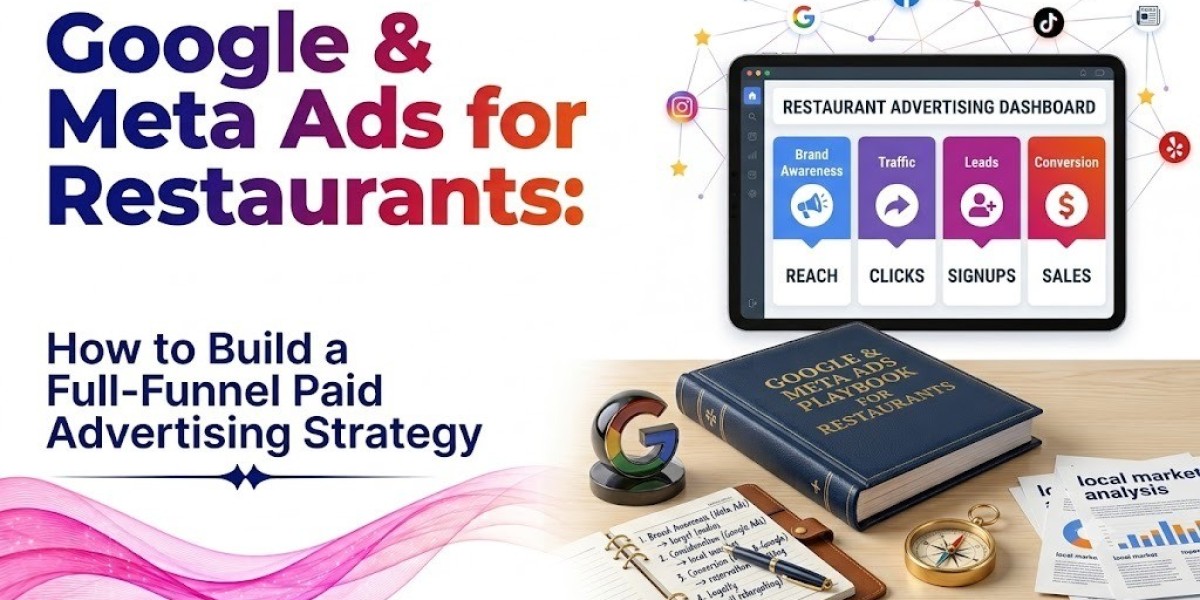


Google & Meta Ads for Restaurants: How to Build a Full-Funnel Paid Advertising Strategy
Restaurants often treat Google Ads and Meta Ads as two completely separate advertising channels.
One campaign targets people searching for restaurants, while another promotes food photos and offers on Instagram or Facebook. But when these platforms are planned together, they can do much more than generate individual clicks.
They can create a full-funnel paid advertising strategy that moves potential customers from awareness to consideration, conversion, and eventually repeat business.
Someone might first discover a restaurant through an Instagram video, search for the restaurant on Google a few days later, visit the website, check the menu, read reviews, and finally make a reservation.
That customer journey can involve multiple touchpoints.
For restaurants competing for local customers in Vancouver, Chilliwack, Surrey, and across British Columbia, combining Google & Meta Ads for restaurants can create a more connected approach to customer acquisition.
The objective isn't simply to spend money on two advertising platforms.
It is to give each platform a specific role in the customer journey.
What Is a Full-Funnel Restaurant Advertising Strategy?
A full-funnel strategy recognizes that customers do not all start at the same point.
Some have never heard of your restaurant.
Others already know your brand but have not visited.
Some are actively searching for a restaurant tonight.
And existing customers may need a reason to return.
A simplified funnel looks like this:
Funnel Stage | Customer Mindset | Main Objective |
Awareness | “What's available nearby?” | Introduce the restaurant |
Interest | “This looks interesting.” | Build curiosity |
Consideration | “Should I choose this place?” | Build trust |
Intent | “I need a restaurant.” | Capture demand |
Conversion | “I'm ready to book/order.” | Generate action |
Retention | “I'll come back.” | Encourage repeat visits |
Google and Meta can contribute differently across these stages.
Meta is often useful for creating discovery and interest through visual content, while Google can capture customers when they actively search for relevant restaurants, cuisines, services, or occasions.
The strategy becomes stronger when these channels are connected rather than managed in isolation.
1. Start With the Restaurant's Business Goal
Before creating campaigns, define what the restaurant actually wants from paid advertising.
Possible goals include:
More reservations
More online orders
More phone calls
More catering enquiries
More event bookings
More first-time customers
More weekday traffic
More customers during slower hours
More awareness in a new local market
More repeat visits
For example, a restaurant with strong weekend traffic may not need to advertise heavily for Saturday dinner.
Instead, its campaign could focus on filling slower periods such as:
Monday–Thursday evenings
Weekday lunch
Early dinner
Seasonal periods
Special events
This is where a strong restaurant advertising strategy starts making a business impact.
The goal should determine the campaign—not the other way around.
2. Give Google Ads and Meta Ads Different Jobs
One of the biggest mistakes restaurants make is showing the same message everywhere.
Google and Meta provide different advertising environments.
Google Ads: Capture Existing Demand
Google Search is useful when customers are actively looking for something.
Examples include:
“Italian restaurant Vancouver”
“best brunch near me”
“Indian restaurant Chilliwack”
“restaurant for birthday dinner”
“restaurants open late”
“best pizza near me”
The customer already has a problem or need.
They are searching for a solution.
This makes Google particularly useful for high-intent customer acquisition.
Meta Ads: Create Discovery and Demand
Meta platforms can introduce customers to a restaurant before they actively search for it.
A customer may see:
A signature dish
A chef video
A restaurant tour
A seasonal menu
A special event
A brunch promotion
A behind-the-scenes video
A customer experience
The person may not be looking for a restaurant at that exact moment.
But the content can create interest.
This makes Meta useful for awareness, discovery, consideration, and retargeting.
3. Build the Awareness Stage With Meta
At the top of the funnel, the objective is not always to generate an immediate reservation.
It may be to introduce your restaurant to relevant local customers.
For example, a Vancouver restaurant launching a new weekend brunch could create short-form video content showing:
Signature brunch dishes
Restaurant atmosphere
Table setup
Chef preparation
Customer experience
Location
The advertisement can target relevant local audiences.
The goal is to make the restaurant memorable.
This is where Meta Ads for restaurants can complement organic restaurant social media marketing.
Instead of relying entirely on people discovering the restaurant organically, paid distribution can help put relevant content in front of additional local audiences.
4. Build Consideration Through Trust and Social Proof
Once someone knows about the restaurant, the next question becomes:
“Why should I choose this restaurant?”
This is where trust becomes important.
Customers may look at:
Google reviews
Restaurant photos
Menu
Prices
Location
Atmosphere
Social media
Website
Customer experiences
Your advertising should therefore support the information customers need to make a decision.
For example, Meta creative could highlight:
“4-course anniversary dinner in downtown Vancouver.”
The landing page could then show:
Menu
Restaurant photography
Location
Reviews
Reservation options
Opening hours
The advertisement creates interest.
The website helps turn that interest into consideration.
5. Use Google Ads to Capture High-Intent Searches
Once a customer actively searches, Google becomes especially valuable.
Imagine someone searches:
“best restaurant for date night Vancouver”
or:
“Italian restaurant near me”
The person is much closer to choosing a restaurant than someone casually scrolling through social media.
This is where Google Ads for restaurants can capture existing demand.
Search campaigns can be organized around relevant themes such as:
Cuisine
Italian restaurant
Indian restaurant
Japanese restaurant
Mexican restaurant
Occasion
Date night restaurant
Birthday restaurant
Family dinner restaurant
Location
Restaurants in Vancouver
Restaurants in Chilliwack
Restaurants near downtown
Service
Catering
Private dining
Event dining
Takeout
The key is relevance.
The advertisement should closely match what the customer searched for.
6. Create Dedicated Landing Pages
Sending every advertisement to the homepage is one of the easiest ways to weaken a paid campaign.
If the advertisement says:
“Book Your Weekend Brunch in Vancouver”
the customer should land on a page that immediately explains the brunch experience.
That page could include:
Brunch menu
Food photography
Price information
Opening hours
Location
Reviews
Reservation button
Phone number
Frequently asked questions
This is where restaurant website optimization and conversion optimization become important.
The customer should not have to hunt for the information promised in the advertisement.
7. Use Retargeting to Reconnect With Interested Customers
Not every visitor converts immediately.
Someone might visit the restaurant website and leave.
Another person might watch a video but not visit the website.
Someone else might view the menu without making a reservation.
These audiences can potentially be used for retargeting, subject to platform rules, privacy requirements, and available tracking.
For example:
First interaction
Customer sees a Meta video featuring the restaurant.
Second interaction
Customer visits the website.
Third interaction
Customer sees another relevant advertisement.
Fourth interaction
Customer searches for the restaurant on Google.
Fifth interaction
Customer books a table.
The important insight is that conversion may happen after multiple interactions.
This is why retargeting for restaurants can play an important role in the middle and lower funnel.
8. Use Different Creative for Different Funnel Stages
Your creative should evolve as the customer becomes more familiar with the restaurant.
Awareness Creative
Focus on:
Food
Atmosphere
Brand personality
Location
Experiences
Example:
“Discover a new dining experience in Chilliwack.”
Consideration Creative
Focus on:
Signature dishes
Reviews
Menu
Experience
Unique selling points
Example:
“Looking for a memorable dinner in Vancouver? Explore our seasonal menu.”
Conversion Creative
Focus on:
Reservations
Limited availability
Events
Specific dining occasions
Clear calls to action
Example:
“Planning dinner this weekend? Reserve your table.”
The customer does not need the same message at every stage.
9. Connect Google and Meta Instead of Comparing Them
Restaurants sometimes ask:
“Should I use Google Ads or Meta Ads?”
A more useful question is:
“What role should each channel play in my customer journey?”
Consider this example:
Step 1 — Meta
A local customer sees an Instagram video featuring the restaurant.
Step 2 — Website
They visit the website and browse the menu.
Step 3 — Google
A few days later, they search for the restaurant by name.
Step 4 — Google Search Ad
The restaurant appears when the customer searches.
Step 5 — Conversion
The customer books a table.
In this example, asking which platform “got the customer” can oversimplify the journey.
Both channels contributed different touchpoints.
This is the foundation of a connected restaurant paid advertising strategy.
10. Target Geography Carefully
Restaurants generally have a limited practical customer radius.
A local restaurant does not necessarily need to advertise to everyone in a large metropolitan area.
Consider:
Neighbourhoods
Nearby residential areas
Office districts
Hotels
Tourist areas
Shopping centres
Event venues
Local attractions
Customer travel patterns
For example, a restaurant in Chilliwack may need a different geographic strategy from a downtown Vancouver restaurant.
The right radius depends on:
Cuisine
Restaurant type
Price point
Customer behaviour
Competition
Parking
Accessibility
Destination appeal
Geographic targeting should therefore be based on the restaurant's actual customer acquisition economics.
11. Build Campaigns Around Specific Customer Segments
Not every customer has the same motivation.
You might have:
Local residents
Looking for regular dining options.
Office workers
Looking for lunch or after-work dining.
Couples
Looking for date-night experiences.
Families
Looking for convenient family dining.
Tourists
Looking for highly rated local restaurants.
Event customers
Looking for catering or private dining.
Instead of sending one generic advertisement to everyone, create messaging that reflects each segment where appropriate.
This can improve relevance and make your digital marketing for restaurants more customer-focused.
12. Track Real Revenue, Not Just Clicks
A full-funnel strategy requires meaningful measurement.
Important metrics can include:
Impressions
Reach
Video views
Click-through rate
Cost per click
Website engagement
Conversion rate
Calls
Reservations
Online orders
Catering enquiries
Cost per acquisition
Customer acquisition cost
Revenue
Return on ad spend
For example:
Campaign A
$1,000 spend → 80 reservations
Campaign B
$1,000 spend → 25 reservations
But even this comparison is incomplete if the average customer value differs.
A campaign generating catering enquiries could produce fewer conversions but substantially higher revenue per customer.
The right measurement system therefore connects advertising activity to actual business outcomes.
13. Use Google Business Profile Alongside Paid Ads
Paid advertising does not replace your organic local presence.
A potential customer may click an advertisement and then search your restaurant separately.
They may look at your Google Business Profile before deciding.
That makes Google Business Profile optimization an important supporting element.
Keep your:
Name
Address
Phone number
Hours
Website
Menu
Photos
Categories
Reviews
accurate and up to date.
The advertising may create the first interaction.
Your broader online presence can influence the final decision.
14. Test, Learn, and Scale
A full-funnel campaign should not be launched once and forgotten.
Test:
Audiences
Different local customer segments.
Creative
Images versus short-form videos.
Messaging
Food-focused versus experience-focused.
Offers
Seasonal promotions versus evergreen messaging.
Calls to action
“Book Now” versus “View Menu.”
Landing pages
Homepage versus dedicated campaign page.
Search themes
Cuisine versus location versus occasion.
The goal is to learn which combinations produce meaningful customer actions.
Once reliable patterns emerge, budget can be allocated based on evidence rather than assumptions.
Common Google & Meta Ads Mistakes Restaurants Make
1. Running both platforms without a strategy
Having two campaigns does not automatically create a full funnel.
2. Using the same creative everywhere
Search ads and social ads serve different customer behaviours.
3. Targeting too broadly
Large audiences can waste budget when the restaurant primarily serves a small geographic area.
4. Optimizing for clicks
Traffic is useful only when it contributes to meaningful business outcomes.
5. Sending traffic to a weak website
A good advertisement cannot compensate for a confusing booking experience.
6. Ignoring retargeting
Potential customers often need multiple interactions before converting.
7. Failing to track conversions
Without conversion tracking, it becomes difficult to determine whether advertising is generating real business.
A Practical Full-Funnel Framework for Restaurants
A restaurant can use the following structure as a starting point:
TOFU — Awareness
Platform: Meta
Content: Food videos, atmosphere, brand stories
Goal: Reach relevant local audiences
↓
MOFU — Consideration
Platform: Meta + retargeting
Content: Reviews, menu, signature dishes, experiences
Goal: Build trust and interest
↓
BOFU — Intent
Platform: Google Search
Content: Cuisine, location, occasion, restaurant-specific searches
Goal: Capture high-intent demand
↓
Conversion
Platform: Google + Meta
Content: Reservation, order, catering, event CTA
Goal: Generate measurable action
↓
Retention
Platform: CRM, email, social, remarketing
Content: New menu items, events, loyalty, seasonal experiences
Goal: Encourage repeat visits
This framework gives every channel a clear purpose.
How a Hospitality Marketing Agency Can Help
Managing Google Ads, Meta Ads, social media, local SEO, reputation management, website conversion, and customer retention separately can create disconnected marketing activities.
A hospitality marketing agency can bring these channels together into a coordinated customer acquisition strategy.
At Third Eye Marketing, the focus is on helping restaurants and hospitality businesses build stronger local visibility, attract relevant audiences, improve conversion opportunities, and create measurable digital marketing systems.
The objective is not simply to increase advertising spend.
It is to understand:
Who is the customer?
Where are they in the buying journey?
Which channel can reach them?
What message will move them forward?
And what business result did the campaign actually generate?
Google and Meta Ads can play very different roles in restaurant marketing.
Meta can help restaurants build awareness, showcase food and experiences, and introduce the brand to relevant local audiences. Google can capture customers when they actively search for restaurants, cuisines, locations, or dining experiences.
When these channels are connected through a full-funnel strategy, they can support the customer journey from discovery to consideration, search intent, conversion, and retention.
The key is not choosing one platform simply because it is popular.
It is building a system where every advertising channel has a clear purpose.
Meta creates discovery. Google captures intent. Retargeting reconnects with interested customers. Your website converts them. And your customer experience determines whether they come back.
That is what turns paid advertising from a collection of campaigns into a customer acquisition system.
Ready to Build a Full-Funnel Restaurant Advertising Strategy?
Third Eye Marketing helps restaurants with Google Ads, Meta Ads, local SEO, Google Business Profile optimization, social media marketing, reputation management, website conversion, and customer retention.
If you're ready to connect your paid advertising channels and build a strategy focused on measurable local customer acquisition, contact Third Eye Marketing for a free consultation.
Website: thirdeyemarketing.ca
Phone: +1 236-880-3783
FAQs
1. Should restaurants use both Google Ads and Meta Ads?
Google and Meta serve different roles. Google can capture existing search intent, while Meta can support awareness, discovery, consideration, and retargeting. Using both can make sense when they are connected through a clear customer journey and measurable goals.
2. What is a full-funnel advertising strategy for restaurants?
It is a paid advertising approach that addresses multiple stages of the customer journey—from awareness and consideration to high-intent searches, conversions, and retention.
3. Are Google Ads or Meta Ads better for restaurant marketing?
There is no single channel that fits every restaurant. The appropriate mix depends on the restaurant's location, audience, goals, budget, customer journey, and conversion process.
4. What should restaurants track from Google and Meta Ads?
Restaurants can track metrics such as cost per click, conversion rate, calls, reservations, online orders, catering enquiries, customer acquisition cost, revenue, and return on ad spend.
5. How can restaurants improve paid advertising results?
Restaurants can improve campaigns by defining clear objectives, targeting relevant geographic areas, creating platform-specific creative, using dedicated landing pages, implementing conversion tracking, testing campaigns systematically, and connecting paid advertising with local SEO and reputation management.






