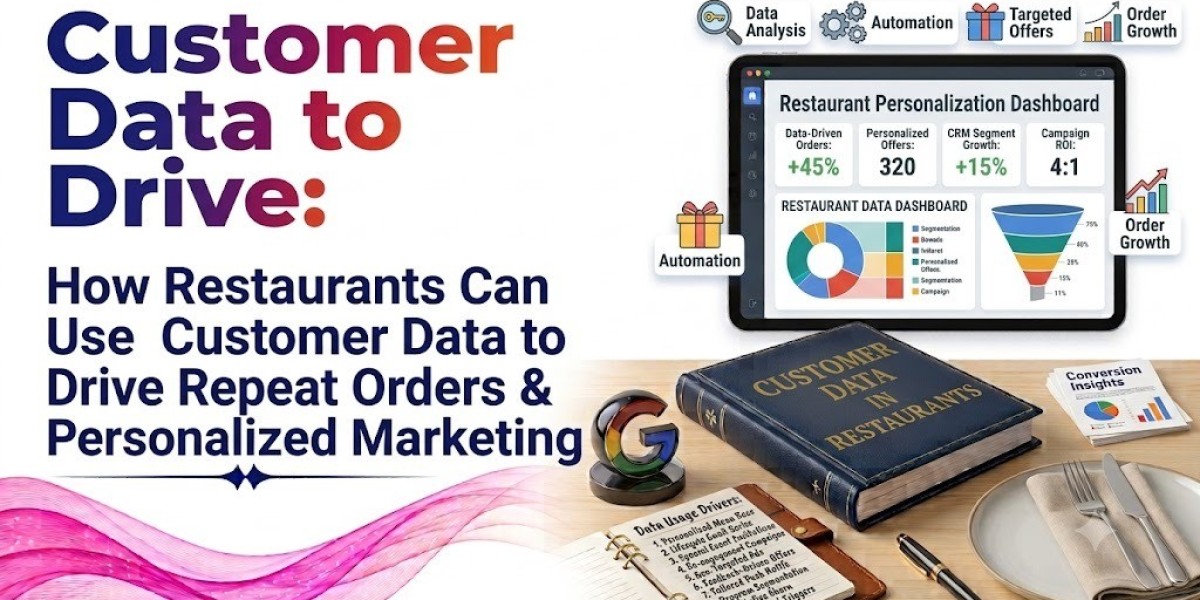


How Restaurants Can Use Customer Data to Drive Repeat Orders & Personalized Marketing
A restaurant can learn a lot from every order, reservation, website visit, loyalty interaction, and customer engagement.
The challenge is turning that information into useful marketing.
When used responsibly, customer data can help restaurants understand what customers prefer, identify opportunities for repeat orders, personalize communication, and build stronger long-term relationships.
Instead of sending the same promotion to everyone, a restaurant can use customer behaviour to make marketing more relevant.
For example, a customer who regularly orders pizza may respond differently to a customer who frequently visits for brunch. A customer who hasn't ordered in six months may also need a different message from someone who orders every week.
This is where customer data for restaurants becomes valuable.
A practical journey can look like:
Customer Interaction → Data Collection → Segmentation → Personalized Marketing → Repeat Order → Customer Retention
The objective isn't to collect as much information as possible.
It is to collect useful information, handle it responsibly, and use it to create a better customer experience.
What Is Customer Data for Restaurants?
Customer data is information a restaurant collects through legitimate customer interactions and consent-based channels.
Depending on the restaurant and its technology stack, this may include:
Order history
Reservation history
Visit frequency
Average order value
Favourite dishes
Loyalty activity
Email engagement
SMS engagement
Website behaviour
Online ordering activity
Customer feedback
Event participation
Customer preferences
For example, an online ordering system may show that a customer frequently orders vegetarian dishes on weekends.
A loyalty platform may show that another customer visits twice a month.
A reservation system may indicate that another group regularly books tables for larger gatherings.
These patterns can help restaurants make their marketing more relevant.
However, customer data should be collected, stored, and used according to applicable privacy requirements and the permissions customers have provided.
Why Customer Data Matters for Restaurant Marketing
Traditional restaurant marketing often uses broad messages:
“20% off this weekend!”
That may reach many people, but not everyone will find it relevant.
Customer data allows restaurants to ask better questions:
Who is this customer?
What do they usually order?
How often do they visit?
When did they last purchase?
What type of experience do they prefer?
Have they stopped ordering?
What might encourage them to return?
This can improve the relevance of customer retention marketing.
Instead of treating every customer identically, restaurants can create different experiences for different customer groups.
The result can be a more structured approach to:
Repeat orders
Customer retention
Customer engagement
Loyalty
Personalization
Customer lifetime value
1. Start With the Data You Already Have
Restaurants do not necessarily need an advanced data platform to begin.
Start by examining information already available through existing systems.
Potential sources include:
Online Ordering System
Can reveal:
Order frequency
Average order value
Popular items
Ordering times
Pickup versus delivery behaviour
Reservation System
Can reveal:
Visit frequency
Party size
Reservation patterns
Preferred dining times
Loyalty Program
Can reveal:
Reward activity
Purchase behaviour
Engagement
Repeat visits
Website Analytics
Can reveal:
Traffic sources
Popular pages
Menu interest
Conversion behaviour
Email Marketing
Can reveal:
Opens
Clicks
Campaign engagement
Unsubscribes
The goal is to connect useful information rather than collecting data simply because it is available.
2. Segment Customers Based on Behaviour
One of the most useful applications of customer data is segmentation.
Instead of putting every customer into one marketing audience, create meaningful groups.
For example:
New Customers
Customers who have made their first purchase or visit.
Goal: Encourage the second visit.
Repeat Customers
Customers who regularly purchase.
Goal: Strengthen the relationship.
High-Value Customers
Customers with higher spending or frequent visits.
Goal: Increase loyalty and engagement.
Inactive Customers
Customers who haven't ordered or visited recently.
Goal: Encourage re-engagement.
Occasion-Based Customers
Customers who regularly visit for birthdays, celebrations, or group events.
Goal: Promote relevant experiences.
Segmentation allows a restaurant to communicate differently with each audience.
3. Use Order History to Personalize Marketing
Order history can provide valuable behavioural signals.
For example, imagine a customer has ordered:
Butter chicken several times
Garlic naan regularly
Indian desserts occasionally
Instead of sending a generic message, a restaurant could promote a new dish that complements their previous preferences.
Similarly, a customer who frequently orders brunch could receive communication about a new brunch menu.
The principle is:
Use previous behaviour to make future communication more relevant.
This can support personalized marketing for restaurants without making every message feel like a generic advertisement.
4. Create Personalized Repeat-Order Campaigns
The most obvious opportunity is using customer data to encourage repeat orders.
Consider a customer who typically orders every two weeks.
If they haven't ordered for significantly longer than their usual interval, that may represent an opportunity for a carefully timed re-engagement campaign.
A campaign could say:
“Missing your usual favourites? We're serving them this weekend.”
The message can be connected to their previous behaviour without revealing unnecessary personal information.
Another example:
First Order → Follow-Up → Favourite Item Reminder → New Recommendation → Repeat Order
This creates a simple retention cycle.
5. Build a Win-Back Strategy
Not every inactive customer is permanently lost.
Some customers simply haven't had a reason to return.
Customer data can help identify customers whose activity has declined.
For example:
Active → Less Active → Inactive
The restaurant can establish appropriate re-engagement rules based on its normal purchase cycle.
A win-back campaign could include:
A new menu announcement
A seasonal dish
A relevant event
A personalized recommendation
A loyalty reminder
A carefully selected incentive
The objective is not always to offer a discount.
Sometimes the strongest reason to return is simply showing customers something new or relevant.
6. Use Customer Data to Improve Loyalty Programs
A restaurant loyalty program becomes more useful when it is connected to actual customer behaviour.
For example, customer data can help identify:
Which rewards customers redeem
How frequently members visit
Which menu categories are popular
How many members become repeat customers
Which rewards encourage another visit
This allows restaurants to improve their loyalty strategy over time.
Instead of asking:
“How many people joined our loyalty program?”
ask:
“Did joining the program change customer behaviour?”
Useful measurements include:
Repeat purchase rate
Visit frequency
Average order value
Reward redemption
Customer retention
Customer lifetime value
7. Personalize Based on Timing
Personalization isn't only about what customers buy.
It can also be about when they buy.
Suppose data shows that a customer typically orders on Friday evenings.
Sending a relevant communication on Friday afternoon may be more useful than sending it randomly on Tuesday morning.
Similarly:
Brunch customers → Weekend communication
Lunch customers → Weekday communication
Event customers → Relevant upcoming events
Seasonal customers → Seasonal campaigns
Timing can make a marketing message feel more useful and less intrusive.
However, frequency should also be managed carefully.
Too many messages can create fatigue and increase unsubscribes.
8. Connect Customer Data With Email and SMS Marketing
Email and SMS can become more effective when campaigns are segmented.
Instead of one message for everyone, restaurants can create different campaigns.
New Customer Campaign
Welcome → Restaurant Story → Menu Recommendations → Second Visit
Repeat Customer Campaign
New Dish → Favourite Category → Loyalty Reminder
Inactive Customer Campaign
We Miss You → New Experience → Return Opportunity
High-Value Customer Campaign
Exclusive Event → Early Access → Special Experience
The exact communication should depend on customer permissions, applicable privacy rules, and the information the customer has voluntarily provided.
The goal is to make communication more relevant—not more frequent.
9. Use Customer Feedback as Data
Customer data isn't limited to transactions.
Feedback can also provide valuable insights.
Restaurants can collect and analyze:
Reviews
Surveys
Feedback forms
Customer service interactions
Social media comments
Post-visit feedback
Suppose customers repeatedly mention:
“The seafood pasta is excellent.”
That information can support marketing around the dish.
If multiple customers mention:
“The reservation process was confusing.”
that may indicate a website or customer-experience problem.
This creates an important cycle:
Feedback → Insight → Improvement → Better Experience → Stronger Retention
Customer feedback can therefore support both marketing and operations.
10. Connect Customer Data With Website Personalization
A restaurant website can also become part of the customer data ecosystem.
For example, analytics can help identify:
Most visited menu pages
Popular landing pages
Reservation activity
Online ordering behaviour
Traffic sources
Returning visitors
This can inform conversion optimization.
If customers frequently visit a particular menu page but rarely proceed to order, investigate why.
Potential issues could include:
Poor calls to action
Complicated ordering
Missing information
Slow page speed
Weak mobile experience
Customer data should ultimately help the restaurant improve the customer journey.
11. Use Customer Data to Increase Customer Lifetime Value
One of the most important concepts in retention marketing is customer lifetime value.
A customer isn't necessarily valuable because of one transaction.
Their value may come from repeated behaviour over time.
A simplified example:
$60 average order × 10 orders = $600
If the customer continues ordering, their potential value increases.
This changes the restaurant's marketing perspective.
Instead of focusing only on:
“How do we get another order?”
the business can ask:
“How do we encourage this customer to remain active for another six months?”
That can lead to better decisions around:
Loyalty
Personalization
Customer experience
Retention campaigns
Marketing investment
12. Use Data to Identify Cross-Selling Opportunities
Customer behaviour can also reveal opportunities to introduce related products.
For example:
A customer regularly orders a main dish.
The restaurant may recommend:
A side
A drink
A dessert
A complementary appetizer
Similarly, a brunch customer may be interested in a seasonal brunch special.
Cross-selling should be relevant rather than excessive.
The goal is to help customers discover products they are likely to enjoy.
13. Build a Customer Journey Around Data
Customer data becomes much more valuable when connected across the entire customer lifecycle.
A restaurant might structure its journey like this:
Stage 1: Discovery
Customer finds the restaurant through Google, social media, advertising, or referrals.
Stage 2: First Purchase
Customer places an order or makes a reservation.
Stage 3: Engagement
Customer joins an appropriate loyalty or communication channel.
Stage 4: Personalization
Restaurant uses relevant behavioural information to communicate appropriately.
Stage 5: Repeat Purchase
Customer orders or visits again.
Stage 6: Retention
Restaurant continues delivering relevant experiences.
Stage 7: Advocacy
Satisfied customer leaves a review or recommends the restaurant.
This creates a connected marketing system:
Acquisition → Conversion → Retention → Loyalty → Advocacy
Common Customer Data Marketing Mistakes Restaurants Should Avoid
1. Collecting Data Without a Clear Purpose
More data does not automatically mean better marketing.
Collect information that has a legitimate business and customer-experience purpose.
2. Sending the Same Message to Everyone
A first-time customer and a frequent customer may need very different communication.
3. Over-Personalizing
Personalization should feel helpful, not intrusive.
4. Ignoring Privacy Requirements
Restaurants should understand applicable privacy laws, consent requirements, and communication rules before using customer information for marketing.
5. Focusing Only on Discounts
Customer data can support personalized experiences, recommendations, events, and loyalty—not just promotions.
6. Measuring Sign-Ups Instead of Behaviour
A large loyalty database means little if customers don't return.
7. Keeping Data in Separate Silos
When possible, useful systems should work together so the business can understand the customer journey more clearly.
8. Not Testing Campaigns
Customer preferences should be learned through measurable results rather than assumptions.
Step-by-Step Customer Data Strategy for Restaurants
Step 1: Audit Your Existing Data
Identify what information is already available through ordering, reservations, loyalty, website analytics, and marketing systems.
Step 2: Define Your Goal
Choose a specific objective:
More repeat orders
Higher visit frequency
Higher average order value
Better retention
Higher customer lifetime value
Step 3: Create Customer Segments
Separate customers based on meaningful behaviour.
Step 4: Build Relevant Campaigns
Create different communication journeys for different segments.
Step 5: Personalize Carefully
Use preferences, timing, purchase behaviour, and engagement to improve relevance.
Step 6: Test Campaigns
Experiment with:
Message
Timing
Offer
Product recommendation
CTA
Channel
Step 7: Measure Results
Track:
Repeat orders
Repeat visits
Conversion rate
Average order value
Retention
Customer lifetime value
Campaign engagement
Step 8: Improve Continuously
Use results to refine segmentation, messaging, customer experiences, and marketing campaigns.
Key Metrics to Track
A customer-data strategy should connect marketing activity to business outcomes.
Important metrics can include:
Metric | What It Helps Measure |
Repeat Order Rate | How many customers order again |
Customer Retention Rate | How well the restaurant keeps customers |
Purchase Frequency | How often customers return |
Average Order Value | Revenue generated per transaction |
Customer Lifetime Value | Long-term customer value |
Loyalty Participation | Customer engagement with the program |
Email/SMS Engagement | Communication effectiveness |
Win-Back Rate | Re-engagement of inactive customers |
Conversion Rate | Percentage completing the desired action |
Revenue per Customer | Overall customer value |
The principle is simple:
You cannot improve what you do not measure.
How Third Eye Marketing Can Help
Customer data works best when it is connected to a broader restaurant marketing strategy.
Third Eye Marketing can help restaurants bring together relevant areas such as:
Restaurant digital marketing
Local SEO
Google Business Profile optimization
Social media marketing
Paid advertising
Website optimization
Conversion optimization
Customer retention marketing
Reputation management
Analytics and reporting
The objective isn't simply to collect customer information.
It is to turn useful insights into better marketing decisions.
For example:
Google Search → Website → First Order → Customer Data → Segmentation → Personalized Campaign → Repeat Order → Loyalty → Review
This creates a connected growth system.
For restaurants in Vancouver, Chilliwack, Surrey, and across British Columbia, customer data can help businesses better understand local audiences and create marketing experiences that are more relevant to their customers.
Third Eye Marketing can support this process by combining customer acquisition with retention and conversion strategies.
The focus should always remain on the business outcome:
More relevant marketing, stronger customer relationships, and more repeat business.
Customer data can become one of the most useful assets in a restaurant's marketing strategy when it is collected responsibly and used thoughtfully.
Order history, reservations, loyalty activity, website behaviour, feedback, and marketing engagement can reveal patterns that help restaurants understand their customers better.
But data alone doesn't create loyalty.
The real value comes from what the restaurant does with those insights.
A successful strategy can look like:
Collect → Understand → Segment → Personalize → Engage → Measure → Improve
Instead of sending the same message to every customer, restaurants can create more relevant experiences based on customer behaviour.
Instead of focusing only on acquiring new customers, they can also invest in turning existing customers into repeat customers.
And instead of measuring marketing only through clicks or impressions, restaurants can connect campaigns to outcomes such as repeat orders, reservations, retention, and customer lifetime value.
The ultimate goal is simple:
Use customer data to make the next customer experience more relevant than the last one.
Ready to Turn Customer Data Into More Repeat Business?
Third Eye Marketing helps restaurants connect digital marketing, customer retention, local SEO, website conversion, social media, paid advertising, reputation management, and analytics into a practical growth strategy.
If your restaurant has customer data but isn't sure how to turn it into repeat orders and personalized marketing, book a free consultation with Third Eye Marketing.
Website: thirdeyemarketing.ca
Phone: +1 236-880-3783
FAQs
1. What customer data should restaurants collect?
Useful data can include order history, reservation history, visit frequency, average order value, loyalty activity, customer preferences, website behaviour, marketing engagement, and feedback. Restaurants should collect and use information responsibly and according to applicable privacy and consent requirements.
2. How can restaurants use customer data to increase repeat orders?
Restaurants can use customer behaviour to segment audiences, personalize recommendations, identify inactive customers, create relevant win-back campaigns, and communicate at appropriate times.
3. How does personalization improve restaurant marketing?
Personalization can make marketing more relevant by connecting messages, products, timing, and experiences with customer interests and previous behaviour rather than treating every customer the same.
4. Can customer data help improve restaurant loyalty programs?
Yes. Restaurants can analyze loyalty participation, purchase frequency, reward redemption, and repeat visits to understand which aspects of a loyalty program encourage meaningful customer behaviour.
5. What is the most important metric for restaurant customer data marketing?
There isn't one universal metric. Depending on the objective, restaurants can track repeat order rate, retention rate, purchase frequency, average order value, customer lifetime value, conversion rate, and win-back rate.






