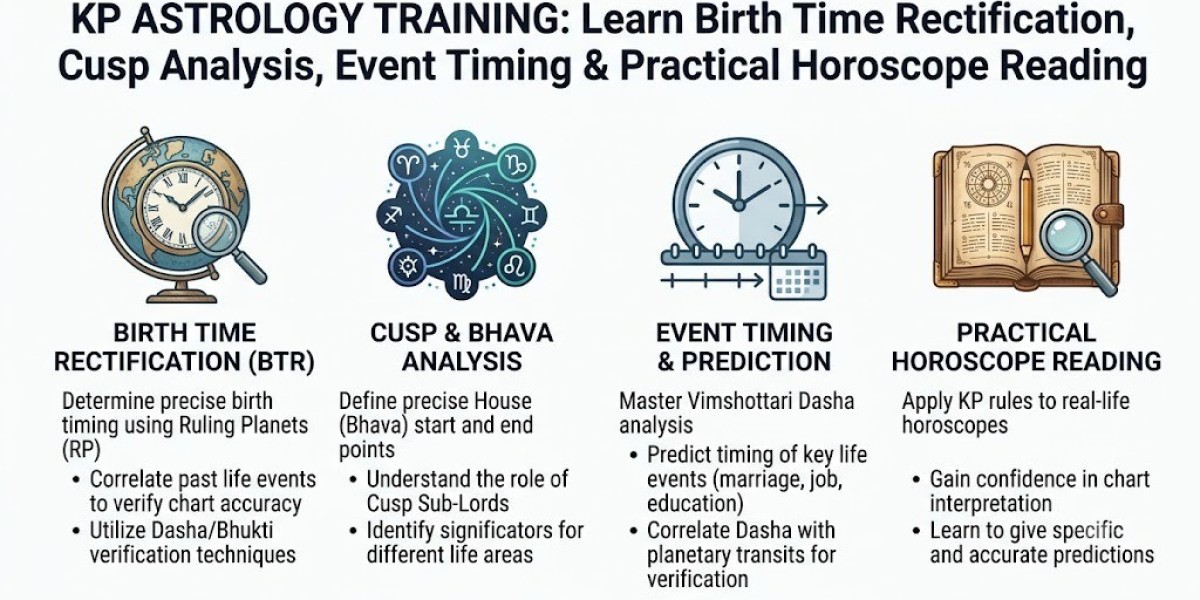


KP Astrology Training: Learn Birth Time Rectification, Cusp Analysis, Event Timing & Practical Horoscope Reading
KP Astrology, or Krishnamurti Paddhati, is a specialised approach to horoscope analysis that uses concepts such as cusps, sub-lords, significators, nakshatras, ruling planets, and planetary periods. For students who want to understand how astrologers systematically examine specific life events, KP Astrology offers a structured area of study.
One important part of advanced KP learning is birth time rectification. Even a small difference in recorded birth time can change house cusps and their sub-divisions, making accurate chart analysis more challenging. Learning how rectification is approached can therefore become an important part of advanced horoscope training.
A comprehensive KP astrology course can take students from basic principles to cusp analysis, birth time rectification, event timing, and practical horoscope reading.
What Does KP Astrology Training Teach?
KP Astrology training teaches students how to analyse a horoscope using the principles and terminology associated with the Krishnamurti Paddhati system.
A structured program may cover:
KP Astrology fundamentals
Nakshatras and star lords
Ruling planets
House significators
Cusps and cusp sub-lords
Birth time rectification
Event-oriented horoscope analysis
Planetary periods
Event timing techniques
Practical chart reading
Case studies
Consultation and communication skills
For beginners, the key is to learn these concepts progressively rather than attempting advanced timing techniques before understanding the basic KP framework.
Understanding KP Astrology Before Advanced Training
KP Astrology was developed by Prof. K. S. Krishnamurti and is known for its detailed use of nakshatras and sub-lords.
Traditional horoscope interpretation can involve planets, signs, houses, aspects, and other factors. KP introduces additional layers through which students examine planetary and house significations.
A simplified learning sequence can be understood as:
Planet → Nakshatra/Star Lord → Sub-Lord → House Significations → Cusp Analysis → Event Analysis
This sequence is useful for students because each stage builds upon the previous one.
Before attempting birth time rectification or detailed event timing, students should first understand how the KP framework identifies relevant houses and significators.
Why Is Birth Time Important in KP Astrology?
Birth time plays an important role in horoscope construction because the Ascendant and house cusps depend on the time and place of birth.
In KP Astrology, detailed cusp analysis makes accurate birth-time information particularly relevant.
If the recorded time is uncertain, students may study birth time rectification as a specialised technique for examining whether a different time better fits documented life events according to the methodology being used.
This should not be treated as a simple process of changing a birth time until a preferred interpretation appears.
A responsible training approach teaches students to:
Establish the available birth information
Identify the uncertainty in the recorded time
Examine significant life events
Study relevant house connections
Compare possible chart variations
Apply the rectification methodology consistently
Document the reasoning behind the selected working time
This makes birth time rectification an analytical exercise rather than guesswork.
What Is Taught in KP Astrology Classes?
A well-structured program can divide learning into foundational, intermediate, and practical stages.
1. KP Fundamentals
The first stage introduces the language and framework of KP Astrology.
Students may study:
Signs and houses
Planets
Nakshatras
Star lords
Sub-lords
House ownership
Planetary occupation
Basic significators
Ruling planets
This foundation makes later techniques easier to understand.
2. Cusp Analysis
Cusp analysis is one of the central areas of practical KP learning.
Students learn to examine the beginning point of each house and understand the role of its sub-lord.
Rather than interpreting a house only through its general meaning, students can learn to investigate:
Cusp → Cusp Star Lord → Cusp Sub-Lord → Significations → Relevant Houses
This method allows learners to approach event-related questions in a structured way.
For example, when studying a particular relationship or career question, the student first identifies the traditionally relevant houses and then examines their significations rather than making a conclusion from a single planetary position.
Understanding Cusp Sub-Lords
The cusp sub-lord is a particularly important concept in KP studies.
For beginners, the idea may seem technical because it requires understanding how nakshatras are subdivided.
A KP astrology course online should therefore introduce sub-lords gradually.
Students can learn:
How sub-divisions work
How cusp sub-lords are identified
How the sub-lord connects with houses
How significators are examined
How cusp analysis is applied to practical questions
Repeated chart exercises are especially useful here because the concept becomes easier to understand when students see several examples.
Birth Time Rectification in KP Astrology
Birth time rectification is generally studied after students have developed sufficient knowledge of houses, cusps, significators, and event analysis.
The reason is straightforward: rectification requires the student to understand how changes in birth time can affect the horoscope.
A structured training process can include:
Step 1: Examine the available birth information
Determine how reliable the recorded time is and identify any known uncertainty.
Step 2: Collect significant life events
Examples may include major educational milestones, career changes, marriage, relocation, or other clearly documented events.
Step 3: Examine relevant houses
The student identifies the houses traditionally connected with each event.
Step 4: Compare chart variations
Possible birth times can be examined to determine how the relevant cusps and sub-lords change.
Step 5: Apply KP principles
The student uses the methodology taught in the course to evaluate the chart against known events.
Step 6: Document the reasoning
A professional learning process should explain why a particular working time was selected rather than simply presenting the final time.
This is why birth time rectification is better learned through guided examples and practical assignments.
Event Timing: Moving From “What” to “When”
Another important area of advanced KP training is event timing.
Horoscope interpretation may involve identifying whether certain houses are connected with an event. Timing introduces another question:
When might the relevant planetary periods and transits become significant according to the methodology?
Students may learn to examine:
Relevant house significators
Planetary periods
Sub-periods
Ruling planets
Transits
Connections between timing factors and event-related houses
The exact technique depends on the KP methodology being taught.
For beginners, it is important to master house and significator analysis first. Timing techniques become easier to understand once students know how to identify the houses relevant to the question.
Practical Horoscope Reading
Theory becomes more meaningful when students start reading actual or practice horoscopes.
A practical learning module may ask students to follow a fixed process.
First: Understand the question
Identify exactly what the horoscope question is about.
Second: Identify relevant houses
Determine which houses are traditionally associated with that subject.
Third: Examine the significators
Study the planetary connections with the relevant houses.
Fourth: Analyse the relevant cusps
Examine cusp lords and sub-lords where appropriate.
Fifth: Consider timing factors
Once the event indicators are understood, timing techniques can be applied.
Sixth: Present the interpretation
The final step is communicating the analysis clearly without unnecessary certainty.
This method can help students develop a repeatable horoscope-reading workflow.
Case Studies: The Bridge Between Theory and Practice
Case studies are particularly useful in KP astrology classes because they demonstrate how several concepts work together.
A student may analyse sample cases involving:
Career developments
Education
Marriage
Relationships
Financial themes
Travel
Relocation
Professional changes
Instead of memorising isolated rules, learners can compare charts and ask:
Which houses are relevant?
Which planets signify those houses?
What role does the cusp sub-lord play?
Which ruling planets are relevant?
Which timing factors need to be examined?
How should the conclusion be communicated?
This type of practice helps students develop analytical discipline.
KP Astrology Training Institute: What Should You Look For?
When searching for a KP astrology training institute, it is useful to compare the educational structure rather than choosing solely on marketing language.
Look for a curriculum that includes both theory and application.
Curriculum depth
Check whether the program covers:
KP fundamentals
Significators
Ruling planets
Cusp analysis
Sub-lords
Birth time rectification
Event timing
Practical chart reading
Practical exposure
Ask whether students actually analyse charts or only watch theoretical lessons.
Instructor guidance
Advanced topics such as rectification and timing often require clarification. Access to instructors or mentors can therefore be useful.
Learning resources
Study material, practice charts, assignments, and recorded sessions can support revision.
Certification
If certification matters to you, understand what the certificate represents and what training or assessment is required to receive it.
KP Astrology Course Online: Is Online Training Effective?
A KP astrology course online can work well for students who need flexible learning schedules.
Online learning may provide:
Live classes
Recorded sessions
Digital notes
Chart demonstrations
Practice assignments
Online doubt-solving
Case-study discussions
However, technical astrology subjects require active participation.
Simply watching lessons is unlikely to develop strong chart-reading skills. Students should practise analysing charts, compare their reasoning with examples, and ask questions when concepts remain unclear.
For this reason, when comparing a KP astrology online course, pay attention to the amount of practical training included.
KP Astrology Course Fee: What Determines the Cost?
The KP astrology course fee can vary between programs.
Factors that may influence the fee include:
Course duration
Live or recorded format
Number of classes
Instructor involvement
Practical sessions
Study material
Assignments
Case studies
Mentorship
Assessments
Certification
Price should therefore be compared alongside the actual learning experience.
A course with extensive practical guidance may have a different structure from a short introductory program.
The right question is not simply “How much does the course cost?” but also “What learning support and practical training are included?”
Certification in KP Astrology
Some learners specifically look for an online astrology course with certificate because they want formal documentation of their training.
Depending on the program, students may encounter:
Astrology certification courses
Astrology certificate course online
Astrology diploma course online
Specialised KP Astrology certificates
A certificate can document completion of a course, but it does not automatically establish practical mastery.
Students should therefore consider certification alongside curriculum, practice, instructor support, and continued learning.
How KP Training Fits Into Broader Astrology Education
KP Astrology can be studied as a specialised methodology within a wider astrology education.
If you are researching the best astrology courses, best astrology courses online, or best astrology courses in India online, first identify whether you want general astrology knowledge or specialised KP training.
Similarly, people searching for the best online astrology courses in India may compare programs based on:
Curriculum
Practical training
Instructor experience
Course structure
Flexibility
Certification
Learning support
There is no single course format that suits every learner.
For someone specifically interested in KP Astrology, a focused program may provide a more structured path than a general introductory course.
The Best Way to Learn Astrology: Practice With Structure
Searching for the best online astrology classes or the best online course for astrology can provide many choices, but the learning process itself matters just as much.
The best way to learn astrology for a particular student may involve a combination of:
Structured lessons + practical charts + revision + feedback + continued study
For KP Astrology specifically, students should avoid rushing directly into complex event timing before mastering the fundamentals.
A useful progression is:
Basics → Nakshatras → Significators → Sub-Lords → Cusp Analysis → Rectification → Event Timing → Practical Reading
This creates a logical learning path.
Developing Responsible Consultation Skills
Technical knowledge is only one part of astrology education.
Students who eventually want to offer consultations should also develop communication skills.
A responsible consultation approach includes:
Listening carefully to the client's question
Explaining the reasoning behind an interpretation
Avoiding unnecessarily alarming statements
Not presenting predictions as guaranteed outcomes
Respecting individual decision-making
Maintaining appropriate professional boundaries
Recognising when specialised professional advice is more appropriate
Astrology education should encourage thoughtful interpretation rather than fear-based communication.
Who Should Consider KP Astrology Training?
KP training may interest:
Beginners exploring astrology
Existing astrology students
Vedic astrology learners
Practitioners wanting to study KP methodology
Students interested in event-oriented analysis
Learners interested in birth time rectification
People wanting to develop practical horoscope-reading skills
Those looking for structured online astrology education
Previous astrology knowledge can be helpful, but a well-designed beginner pathway can introduce the required concepts step by step.
Start Your KP Astrology Training Journey
KP Astrology becomes more understandable when students learn it as a connected system rather than a collection of isolated rules.
From birth time rectification and cusp analysis to significators, sub-lords, ruling planets, event timing, and practical horoscope reading, each stage builds on the previous one.
If you are comparing a KP astrology course, KP astrology online course, or a specialised KP astrology training institute, examine the curriculum and practical learning opportunities carefully.
A strong learning pathway should give you the opportunity to understand concepts, analyse charts, practise techniques, receive guidance, and continue developing your skills.
The Indian Institute of Vedic Science (IIVS) provides structured learning opportunities across astrology and related traditional subjects for learners looking to develop their knowledge progressively.
Want to understand KP Astrology through structured training and practical learning? Book your free counselling with IIVS to explore the available learning pathway and course options.
Frequently Asked Questions
1. What is KP Astrology training?
KP Astrology training teaches the principles of Krishnamurti Paddhati, including significators, ruling planets, nakshatras, sub-lords, cusps, event analysis, and practical horoscope reading.
2. What is birth time rectification in KP Astrology?
Birth time rectification is a specialised process in which possible birth times are examined against significant life events using the methodology being taught.
3. Why is cusp analysis important in KP Astrology?
Cusp analysis helps students examine the houses and their sub-lords when studying specific horoscope questions.
4. Can beginners learn KP Astrology online?
Yes. Beginners can study KP through an online program if it provides a structured curriculum, practical examples, and opportunities for questions and chart practice.
5. What is taught in KP astrology classes?
Classes can cover KP fundamentals, nakshatras, significators, ruling planets, sub-lords, cusp analysis, rectification, event timing, and practical horoscope reading.
6. How much does a KP astrology course cost?
The KP astrology course fee varies according to duration, curriculum, teaching format, practical training, instructor support, and certification.
7. Is certification necessary for learning KP Astrology?
No. Certification is not required simply to study the subject. It may be useful for documenting completion of a structured training program.
8. What should I look for in a KP astrology training institute?
Consider curriculum depth, practical chart analysis, instructor support, course structure, learning resources, case studies, and certification requirements.
9. How long does it take to learn KP Astrology?
The time varies depending on previous knowledge, course structure, study consistency, and how much practical chart analysis the student completes.
10. Can KP Astrology be studied after learning Vedic Astrology?
Yes. Students with a Vedic astrology foundation can explore KP as a specialised methodology while learning its distinct terminology and analytical techniques.






