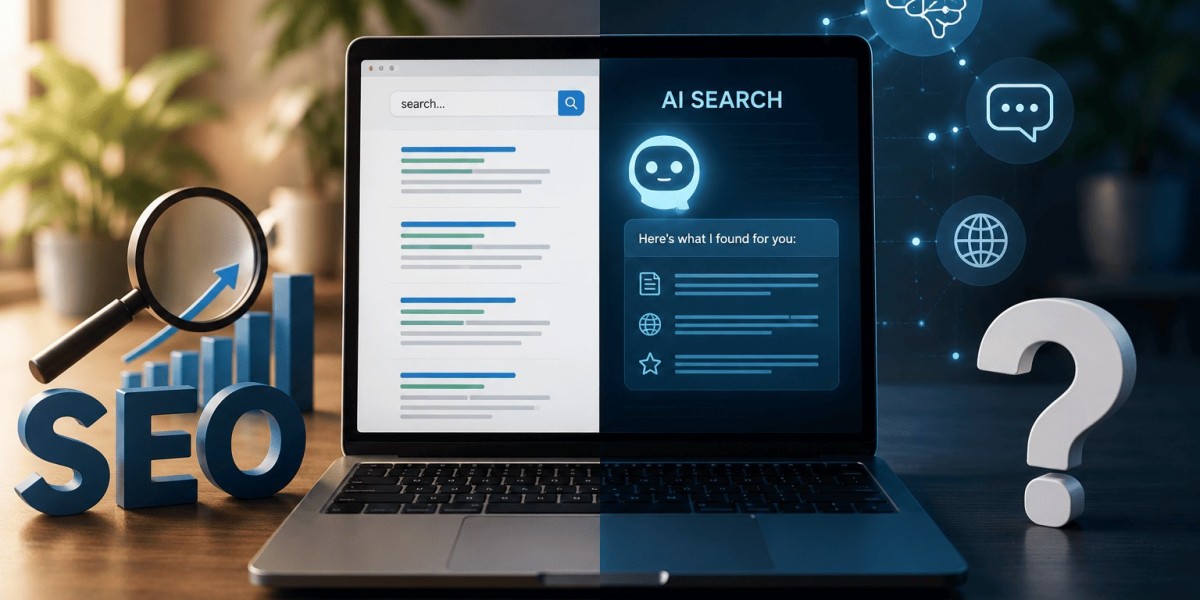


Search is changing faster than it has in years. People still use Google to find products, services, businesses, and answers, but the way they discover information is no longer limited to a list of blue links.
AI-powered search features can now summarize information, answer questions directly, compare options, and point users toward relevant sources. For businesses, this raises a question: does SEO still matter when AI is answering the search?
The short answer is yes. But the strategy is changing.
Search Is Becoming More Conversational
Traditional search often starts with a short keyword such as “B2B lead generation” or “SEO agency.” AI-powered search is more likely to handle a complete question such as, “What SEO strategies can help a B2B company generate more qualified leads?”
That difference matters.
Businesses can no longer build their entire SEO strategy around inserting specific keywords into pages. Content needs to address the underlying question and provide enough useful context for search engines and AI systems to understand what the page is actually about.
This makes search intent more important than ever. A page should answer what people are really trying to accomplish, not simply repeat the phrase they typed into a search box.
Keywords Still Matter, But They Are Not the Whole Strategy
The rise of AI does not mean keywords have become irrelevant. They still help search engines understand the subject of a page.
What has changed is how businesses should use them.
Instead of creating separate pages for every minor variation of a keyword, it often makes more sense to build comprehensive content around a topic. A page targeting “B2B SEO” might naturally cover keyword research, technical SEO, content strategy, internal linking, authority building, and measuring organic performance.
This creates a stronger connection between related concepts and gives both traditional search engines and AI systems more context.
Technical SEO Still Provides the Foundation
AI-generated answers may be changing how people interact with search, but websites still need to be accessible, crawlable, and understandable.
Technical problems can prevent important pages from being discovered or properly interpreted. Poor site structure, broken links, slow loading times, duplicate pages, incorrect indexing directives, and weak internal linking can all affect organic visibility.
That is why AI should not be treated as a replacement for traditional SEO.
A useful SEO strategy for businesses still needs a solid technical foundation. AI can help identify patterns, analyze large amounts of information, and speed up parts of the workflow, but it cannot compensate for a website that search engines cannot properly crawl or understand.
AI Is Changing Content Creation Too
Content production is another area where AI has had a major impact.
Businesses can now use AI tools to brainstorm topics, organize outlines, identify related questions, summarize research, and speed up repetitive tasks. This can make content teams more efficient.
But faster publishing does not automatically mean better SEO.
The internet is already full of generic articles that say roughly the same thing. Publishing another AI-generated article with no original insight does little to distinguish a business from its competitors.
Useful content still needs a reason to exist.
That could mean adding first-hand experience, original examples, practical recommendations, or a clearer explanation of a complicated topic. AI can help with the process, but the final content should still reflect real knowledge and a clear understanding of the audience.
AI Search Makes Authority More Important
When an AI system generates an answer, it needs information it can rely on. That makes credibility and topical authority increasingly important.
A website that consistently publishes useful content around a specific subject can build stronger connections between its pages and establish clearer expertise around that topic.
For example, a company targeting healthcare marketing might create useful resources covering healthcare SEO, Google Ads for healthcare providers, patient acquisition, local search, and related topics. These pieces can support one another through logical internal links while building a deeper topical footprint.
This is much more valuable than publishing unrelated articles simply because a particular keyword has search volume.
Businesses Should Think Beyond Rankings
For years, SEO success was often reduced to one question: “What position does this keyword rank at?”
That measurement still has value, but AI-driven search makes the picture more complicated.
A business may receive visibility through a traditional organic result, an AI-generated summary, a featured result, a branded search, or a combination of these. Users may also visit fewer websites for simple questions while spending more time researching before making a purchase.
This means businesses should look at a wider set of signals, including organic traffic, qualified leads, conversions, branded searches, visibility for important topics, and the performance of pages at different stages of the buying journey.
The Future of SEO Is Not SEO vs. AI
AI is changing search, but it is not making SEO obsolete.
Instead, it is pushing SEO toward a broader approach built around useful content, strong technical foundations, clear site architecture, genuine expertise, and a better understanding of search intent.
Businesses that adapt do not need to abandon everything they have learned about SEO. They need to build on those fundamentals while understanding how search behavior and AI-powered discovery are evolving.
The goal remains surprisingly familiar: create something useful, make it easy to understand, and give search systems a clear reason to trust it.
The tools may be changing. The need to be genuinely useful isn't.






