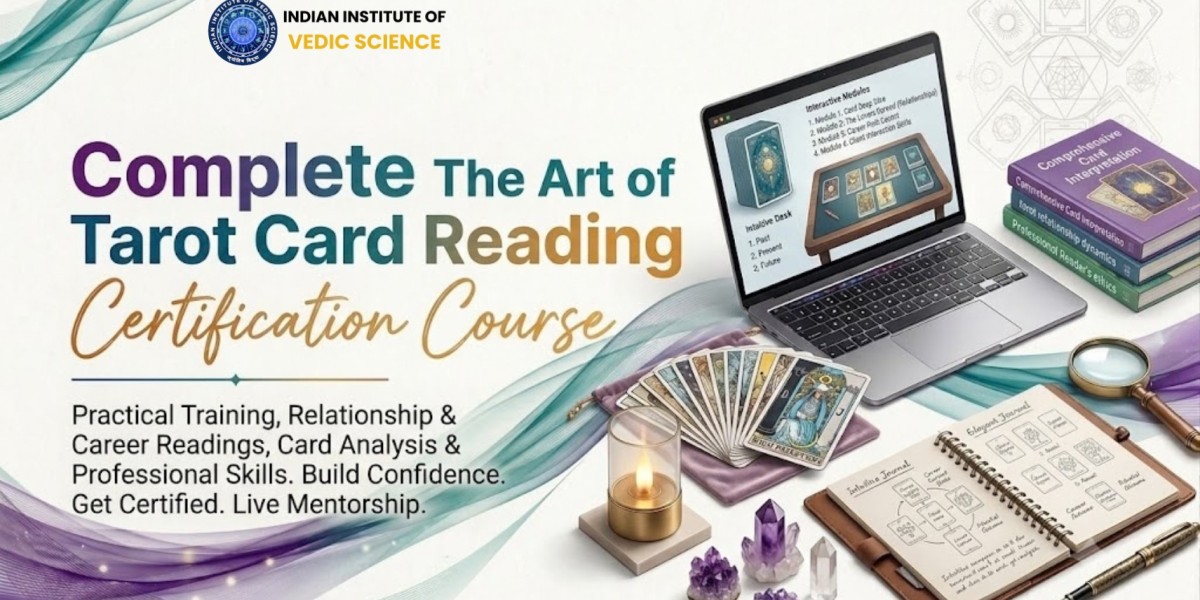


Tarot Card Reading Certification: Practical Training, Relationship & Career Readings, Card Analysis & Professional Skills
Tarot reading is not simply about memorising the meanings of 78 cards. Professional tarot reading involves understanding symbols, interpreting combinations, selecting suitable spreads, asking meaningful questions, and communicating insights responsibly. A structured tarot card reading course can help learners move from basic card familiarity to practical reading skills that can be applied in relationship, career and personal-growth sessions.
For beginners, one of the biggest challenges is knowing how to connect individual cards into a meaningful interpretation. For aspiring practitioners, another challenge is learning how to conduct an organised consultation while maintaining clarity, boundaries and professionalism. This is where certification-based training can provide a systematic learning path.
What Does Tarot Card Certification Training Actually Teach?
A good certification programme should go beyond card definitions. It should introduce learners to the complete process of conducting a reading—from preparing a question to interpreting cards and communicating the reading.
Depending on the curriculum, practical training may cover:
Major and Minor Arcana interpretation
Upright and reversed card meanings
Suits, numbers and symbolic patterns
Tarot combinations
Different types of Tarot spreads
Question formulation
Relationship readings
Career and professional readings
Intuitive interpretation
Client consultation techniques
Reading practice and case-based exercises
Ethical and responsible communication
The objective is not to predict every event with absolute certainty. Instead, learners develop a framework for interpreting symbolic information and presenting it thoughtfully.
Why Practical Training Matters in Tarot
Reading cards for yourself and conducting a session for another person are two different experiences.
When practising independently, you already know your emotions, circumstances and expectations. During a client session, however, the reader has to understand the question without making assumptions, select an appropriate spread and interpret the cards within the context provided.
Practical training helps learners develop this transition.
For example, a relationship question such as “Will this relationship work?” can be approached in several ways. Instead of treating the question as a simple yes-or-no prediction, a trained reader can explore communication patterns, emotional dynamics, current challenges, expectations and possible areas requiring attention.
Similarly, a career reading can examine current professional circumstances, obstacles, opportunities, decision-making patterns and possible directions.
This makes the reading more structured and useful.
Learn Tarot Card Reading Through Card Analysis
One of the most important skills to develop is card analysis.
Beginners often start by memorising keywords such as “success,” “conflict,” “change” or “completion.” Memorisation can provide a foundation, but professional interpretation requires deeper observation.
A reader may consider:
The imagery appearing on the card
The traditional symbolism
The card's position within the spread
The surrounding cards
The question being asked
The emotional context of the consultation
Repeated themes or patterns
For example, the meaning of a particular card can change considerably depending on whether it appears in a position representing the current situation, an obstacle, an underlying influence or a possible direction.
This is why learn tarot card reading should not mean learning isolated definitions alone. The real skill develops when learners begin connecting individual cards with the broader story presented by a spread.
Understanding Relationship Tarot Readings
Relationship readings are among the areas in which clients frequently seek guidance. However, they also require careful interpretation because relationships involve emotions, expectations and decisions.
A structured Tarot approach can explore questions such as:
What is influencing the current relationship dynamic?
What communication patterns are visible?
What challenges may need attention?
What expectations are affecting the connection?
What can the individual learn from the situation?
What factors should be considered before making a decision?
Instead of presenting a reading as an unavoidable future, responsible practitioners can frame Tarot as a reflective tool for exploring circumstances and possibilities.
During certification training, practising relationship spreads can help students understand how card positions interact and how the same card may carry different significance depending on the question.
Developing Career Reading Skills
Career-focused Tarot readings require a different approach from relationship readings.
A professional consultation might explore:
Current career circumstances
Professional strengths
Workplace challenges
Potential opportunities
Decision-making factors
Motivation and direction
Areas requiring development
For example, someone considering a career change may benefit from a spread designed around their current position, motivations, obstacles, available opportunities and possible consequences of different approaches.
The reader's role is not to make the person's professional decision for them. Instead, Tarot interpretation can provide a structured perspective that encourages reflection.
Learning this distinction is an important part of developing professional consultation skills.
Tarot Spreads: Turning Cards Into a Structured Reading
Tarot spreads provide the structure through which cards are interpreted.
A beginner may start with a simple one-card or three-card spread. As their understanding develops, they can explore more detailed layouts designed for specific questions.
Common learning areas include:
One-card readings
Three-card spreads
Situation–challenge–advice formats
Relationship spreads
Career spreads
Decision-making spreads
Timeline-oriented layouts
Larger multi-card spreads
The value of learning different spreads is not simply knowing how to place cards. Students should understand why a particular spread is appropriate for a particular question.
A practical course can therefore teach learners to match the structure of a reading with the client's objective.
Building Intuition Alongside Traditional Interpretation
Intuition is frequently discussed in Tarot, but it should complement rather than replace foundational knowledge.
A learner first develops familiarity with the Tarot system. With practice, they may begin noticing imagery, emotional impressions, recurring themes and connections between cards.
Intuitive development can involve exercises such as:
Drawing a daily card.
Recording the initial impression before checking traditional meanings.
Comparing intuitive observations with established symbolism.
Practising combinations of two or three cards.
Reviewing readings afterward.
Keeping a Tarot journal.
This approach helps learners identify how their interpretation develops over time while maintaining a structured foundation.
What Makes a Tarot Certification Course Practical?
Certification itself does not automatically indicate the quality of training. The curriculum and learning experience matter.
When comparing programmes, students can examine whether the course provides:
1. Complete Tarot foundations
The programme should introduce the Tarot system systematically rather than focusing only on popular cards or simplified meanings.
2. Advanced card interpretation
Students should have opportunities to understand combinations, context, symbolism and positional meanings.
3. Multiple reading formats
A useful programme should expose learners to different types of spreads and consultation scenarios.
4. Practice opportunities
Reading practice is essential. Learners need opportunities to interpret cards and receive feedback rather than only watching theoretical lessons.
5. Client consultation skills
Professional readers need communication skills as well as card knowledge. Training should therefore address questioning, listening, explaining and maintaining appropriate boundaries.
6. Ethical awareness
Tarot readings can involve sensitive personal topics. Responsible communication should avoid creating unnecessary fear, dependency or absolute certainty around major life decisions.
Can Tarot Be Learned Online?
Yes, online learning can provide a flexible way to study Tarot when the programme includes structured lessons and practical exercises.
For someone searching for tarot reading online, it is important to distinguish between casual videos and a systematic training programme.
A structured online programme can allow students to:
Study card meanings at their own pace
Revisit difficult concepts
Practise spreads regularly
Maintain a reading journal
Complete assignments
Attend guided sessions where available
Develop consultation skills gradually
The best learning experience depends more on curriculum, practice and guidance than on whether the classroom is physical or online.
How Tarot Connects With Broader Astrology Learning
Many learners interested in Tarot also explore astrology, numerology and other traditional knowledge systems.
Someone searching for the best astrology courses may eventually discover that astrology and Tarot involve different systems but can both develop observation, symbolic interpretation and consultation skills.
Students comparing the best astrology courses online may look at curriculum depth, practical training, certification, mentorship and accessibility. Those comparing the best astrology courses in India online or the best online astrology courses in India may also consider whether the programme provides structured learning suitable for their experience level.
Similarly, people researching the best online astrology classes, the best online course for astrology, or simply the best way to learn astrology should first identify what they actually want to learn—basic chart interpretation, advanced predictive techniques, consultation skills or professional practice.
Tarot and astrology can be studied independently or as complementary areas, depending on the learner's interests and long-term goals.
Developing Professional Tarot Skills Step by Step
Becoming confident with Tarot takes consistent practice.
A practical progression can look like this:
Stage 1: Learn the system
Understand the structure of the deck, Arcana, suits, numbers and core symbolism.
Stage 2: Study individual cards
Develop familiarity with traditional meanings while observing imagery and themes.
Stage 3: Practise combinations
Learn how two or more cards influence one another.
Stage 4: Learn spreads
Practise selecting spreads according to the question.
Stage 5: Conduct practice readings
Work through different relationship, career and personal-development scenarios.
Stage 6: Improve consultation skills
Practise asking questions, listening carefully and communicating interpretations clearly.
Stage 7: Develop your professional approach
Create a consistent process for preparing, conducting and concluding client sessions.
This gradual approach can be more useful than trying to memorise the entire system in a short period.
Career Possibilities After Tarot Training
A learner who develops strong Tarot skills may explore different professional and educational paths.
Possible applications include:
Independent Tarot consultations
Online Tarot sessions
Wellness and spiritual guidance environments
Workshops and introductory classes
Content creation
Personal development practices
Combining Tarot with other symbolic systems
However, professional growth depends on more than certification. Communication, practical experience, continuous learning, ethical conduct and the ability to understand client needs all contribute to building credibility.
Start Your Tarot Learning Journey With a Structured Approach
Learning Tarot professionally is a progressive process. The strongest foundation comes from combining card knowledge with interpretation, practical spreads, intuitive development, relationship and career reading techniques, and professional consultation skills.
If you are looking for a structured tarot card reading course, choosing a programme that balances theory with practical learning can help you develop confidence step by step. And if your interests extend toward astrology, you can later explore structured astrology education alongside Tarot.
At IIVS, learners can explore a broader approach to Vedic and occult studies while developing practical knowledge through structured training.
Ready to explore the right learning path for you? Book your free counselling with IIVS to understand the available course options, learning approach and next steps for your Tarot and spiritual-study journey.
Frequently Asked Questions
Is a tarot card reading course suitable for beginners?
Yes. Beginners can start with foundational card meanings and gradually progress toward spreads, combinations, intuitive interpretation and consultation practice.
How long does it take to learn Tarot?
The basics can be learned relatively quickly, but developing confident interpretation and professional consultation skills requires continued practice.
Can I learn Tarot reading online?
Yes. Online training can be effective when it combines structured lessons, practical exercises, guided learning and opportunities to practise readings.
Is Tarot certification necessary to read Tarot professionally?
Certification is not the only factor that determines practical ability, but structured training can provide a systematic learning path and demonstrate completion of a defined curriculum.
Can Tarot be used for relationship readings?
Yes. Relationship spreads can be used to explore dynamics, communication patterns, challenges, expectations and possible areas for reflection.
Can Tarot be used for career readings?
Yes. Career-focused readings can explore professional circumstances, opportunities, obstacles and decision-making factors.
Do I need strong intuition to learn Tarot?
No. Intuition can develop through practice. A strong foundation in card symbolism and structured interpretation provides an important starting point.
Should I memorise all 78 Tarot cards?
Understanding the cards is important, but professional reading requires more than memorisation. Context, combinations, positions and the client's question also influence interpretation.
Can Tarot and astrology be learned together?
Yes. They are different systems, but learners interested in spiritual and symbolic studies may choose to explore both.
What should I look for in a Tarot certification programme?
Look for a clear curriculum, card interpretation, spreads, practical exercises, relationship and career readings, consultation training, ethical guidance and opportunities to practise.






