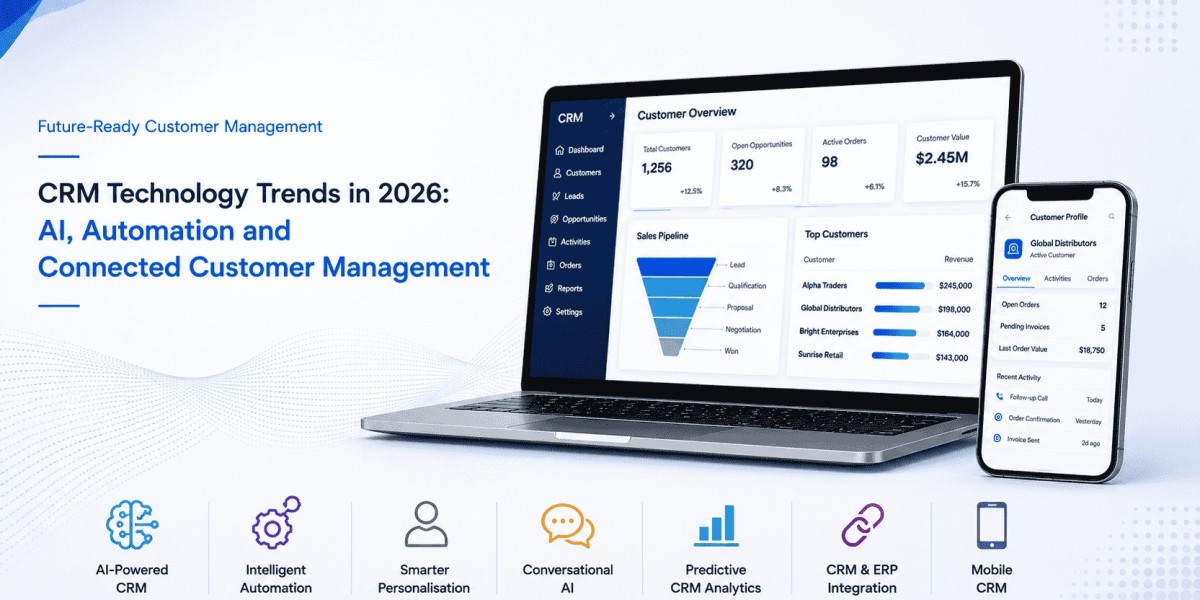


A CRM was once primarily used to store customer details, track sales activities, and maintain contact records. Today, businesses expect much more from their CRM technology. They want systems that can understand customer behaviour, automate repetitive work, connect departments, and help teams make faster decisions.
As businesses become more digitally connected, CRM technology is moving from being a record-keeping system to becoming an operational intelligence layer.
Here are seven CRM technology trends shaping the way businesses manage customers and sales in 2026.
1. AI Is Moving CRM From Data Storage to Decision Support
One of the biggest changes in CRM technology is the growing role of artificial intelligence.
Traditional CRM systems depend heavily on employees to enter information, review records, identify opportunities, and decide what action to take next.
AI can help reduce that manual effort.
Modern AI-powered CRM platforms can analyse customer interactions, identify patterns, summarise conversations, assist with lead qualification, suggest follow-up actions, and help sales teams prioritise opportunities.
The important shift is not simply adding an AI chatbot to a CRM.
It is making customer data more useful.
Instead of asking a salesperson to search through multiple records before a customer call, AI can help bring relevant information together and turn it into an actionable summary.
2. CRM Automation Is Becoming More Connected
Sales teams rarely work inside the CRM alone.
They may use email, messaging platforms, accounting systems, marketing tools, ecommerce platforms, ERP systems, and customer-support applications throughout the customer lifecycle.
This creates a major challenge: information can become fragmented across different systems.
CRM automation is therefore moving toward connected workflows.
For example:
Lead captured → qualification → follow-up → quotation → order → customer communication → reporting
When these steps are connected, teams spend less time moving information manually between systems.
This is particularly valuable for growing businesses where increasing sales volume would otherwise increase administrative work at the same rate.
3. Customer Data Is Becoming More Real-Time
A customer record that is updated days after an interaction is considerably less useful than one that reflects what is happening now.
Real-time data is becoming increasingly important in CRM.
Sales representatives may need to know whether a prospect recently opened an email, requested information, placed an order, contacted support, or interacted with a previous quotation.
Bringing these signals together allows businesses to understand the customer journey more clearly.
This is one reason modern CRM systems are increasingly connected with other business applications rather than operating as isolated databases.
4. Predictive Insights Are Changing Sales Planning
Historical CRM data can tell businesses what happened.
Predictive technologies can help businesses identify what may happen next.
For example, CRM analytics can be used to identify patterns associated with:
- Higher-value customers
- Sales opportunities requiring attention
- Leads showing stronger engagement
- Customers approaching potential churn
- Products generating repeat purchases
- Sales stages where opportunities frequently slow down
These insights don’t eliminate human decision-making.
Instead, they can help sales and management teams focus their attention where it is most useful.
The quality of these predictions, however, depends heavily on the quality and completeness of the underlying data.
5. Personalisation Is Moving Beyond First Names
Adding a customer’s first name to an email is no longer what businesses mean by personalisation.
Customers increasingly expect companies to understand their actual context.
A modern CRM can bring together information such as previous purchases, interactions, preferences, sales history, service requests, and engagement patterns.
That information can support more relevant communication.
For example, instead of sending the same product message to every customer, a business can segment customers according to their previous activity and communicate based on their actual relationship with the company.
This turns CRM data into a foundation for more meaningful customer experiences.
6. CRM and ERP Are Becoming More Closely Connected
For many businesses, customer management does not end with the sales team.
A customer order can affect inventory, purchasing, finance, fulfilment, invoicing, and reporting.
When CRM and ERP systems operate separately, employees may need to transfer information between platforms manually.
That creates opportunities for delays, duplicate data, and inconsistent information.
Connecting CRM with broader business operations can provide a more complete view of the customer.
A sales representative can understand not only the opportunity but also relevant information such as product availability, order history, payment status, or transaction details.
This is especially important for trading, distribution, and other businesses where customer relationships are directly connected to operational processes.
7. CRM Is Becoming an Operating System for Revenue Teams
Perhaps the biggest change is conceptual.
CRM technology is no longer simply about managing contacts.
It is becoming a central environment for coordinating revenue-related activities.
Marketing generates demand.
Sales converts opportunities.
Customer service supports relationships.
Finance manages transactions.
Operations fulfils requirements.
The more connected these activities become, the more valuable the CRM becomes as a source of business intelligence.
This is where modern CRM technology begins to overlap with broader business automation.
What Should Businesses Look for in a Modern CRM?
Technology alone does not make a CRM valuable.
Businesses should consider whether their CRM can actually support the way their teams work.
Some practical questions include:
Can it reduce repetitive manual work?
Can it integrate with existing business systems?
Can teams access reliable customer information quickly?
Can it provide useful insights rather than simply more reports?
Can it scale as customer and transaction volumes increase?
Can it support automation without making workflows unnecessarily complicated?
These questions are often more important than simply counting the number of features available.
The Direction of CRM Technology
The future of CRM is not about replacing people with technology.
It is about giving people better information and removing unnecessary operational friction.
AI can help interpret data.
Automation can handle repetitive processes.
Integrations can connect disconnected systems.
Analytics can reveal patterns.
And a unified customer view can help teams understand the relationship beyond individual transactions.
For businesses exploring how CRM technology is evolving, Axiever has also covered the broader landscape of CRM technology trends and how emerging technologies are changing modern customer management.
The companies that get the most value from CRM technology will not necessarily be those with the longest feature list.
They will be the ones that connect customer data, business processes, and decision-making into a system that people can actually use every day.
That is where CRM is heading: from a database of customer information to an intelligent layer connecting the customer journey with the wider business.






