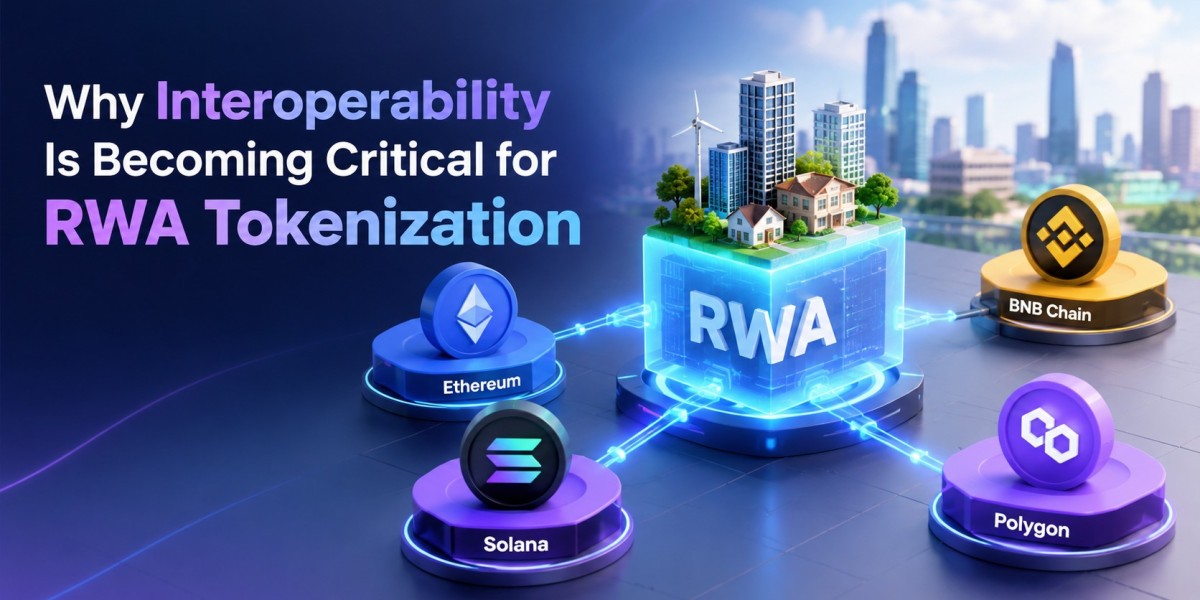


Real-World Asset (RWA) tokenisation is changing the face of managing and representing physical and financial assets digitally. The value of a tangible asset like private funds, real estate, commodities, securities or other traditionally illiquid investments can be determined through a blockchain-based token that enables new ownership opportunities through fractionalization and digital asset management.
But the tokenization of an asset doesn't stop there. As RWA ecosystems grow, these assets must be able to participate in other blockchain networks, finance apps, custodians, markets or databases, and identity systems.
However, with the proliferation of connected infrastructure, the importance of interoperability is growing as well. This isolation of tokens could succeed to hinder their usage, liquidity and their seamless incorporation into the existing monetary framework.
What Is Interoperability in RWA Tokenization?
Blockchain Interoperability is the interoperability of various blockchain networks, protocols, applications, and external systems.
RWA tokenization extends beyond merely moving tokens between different blockchains. There are numerous sources of information and services that can be relied upon during a tokenized asset's lifecycle.
For example, a tokenized property may require connections with:
Property and ownership databases
Valuation providers
KYC and identity platforms
Custodians
Banking and payment systems
Investor management applications
Secondary marketplaces
Legal and compliance systems
An interoperable architecture enables these components to interact rather than being disjointed systems.
Why RWA Tokenization Creates an Interoperability Challenge
Multiple Blockchain Networks
The blockchain network used will vary among projects, depending on different factors like transaction fees, speed, security, support from the network ecosystem, and technical needs.
This is the setting that enables fragmenting of the environment and allowing tokenized assets to operate on various networks.
Without effective communication between these networks, it may be necessary for them to have their own infrastructures within their respective ecosystems. There is also added complexity when dealing with assets across networks for investors.
The use of interoperability can mitigate these limitations by establishing communication links between different compatible blockchain environments.
Fragmented Asset Data
Much more information is involved in RWA tokenization than token ownership.
Information about its valuation, legal status, ownership, income, compliance status and other off-chains are required for an asset.
Having this information in siloed systems makes it more difficult to have consistent records. Therefore, the interoperability of RWA becomes of importance, and data synchronization plays an important part.
Connection With Traditional Finance
There are indeed real world assets in the traditional financial and legal environment, which also use tokens.
Real estate may still, for instance, be accompanied by property paperwork, legal verification, banking services, valuation, taxation, real estate custody, and regulatory check.
It does not imply that blockchain systems have to replace all current systems, just that they need to integrate with them in order to do so.
How Interoperability Can Improve RWA Tokenization
Expanding Liquidity Across Networks
Interoperability may be vital to lessening liquidity fragmentation, enabling tokenized belongings to connect with various compatible blockchain ecosystems.
An interoperable infrastructure could possibly integrate an asset with other applications and marketplaces, instead of confining it to a single network.
This added connectivity also can enable companies to strengthen and expand their ecosystems while not needing to re-construct whole new ecosystems of their tokenizations across all the networks.
Improving the Investor Experience
Blockchain technology can complicate the technology for users, especially those using multiple assets running on different blockchain networks.
Some of this can be abstracted away when an interoperable architecture is used with a common interface for the investors.
Users might be able to interact with assets and manage them without having to know each network, wallet standard or integration layer in which the transactions take place.
Improving Data Synchronization
Data is a key component of RWA platforms.
Property valuation data, commodity prices, ownership records, and compliance data, among other external data points, may possibly be interfacing with the blockchain applications.
External data sources can be connected with smart contracts and tokenization platforms via APIs, middlewares, and oracles that support blockchain.
Advanced sync can minimize manual recon & aid in consistency across on-chain and off-chain data.
Supporting Institutional Integration
This is where institutional participants will likely be using custodial, compliance, accounting, reporting and settlement systems in place.
To thrive in these settings, blockchain apps must be able to interface with legacy tech stacks.
The hardware, software, and messaging systems could be brought together via "interoperability.
Technologies Supporting RWA Interoperability
Cross-Chain Protocols
Cross-chain protocols can provide support for the data exchange or cross-chain transfer between different blockchain networks.
RWA applications are particularly sensitive to security due to the economic value that may exist behind the tokens. These issues need to be considered regarding the cross-chain message validation and cross-chain transaction security.
Blockchain Oracles
Oracle are services that are used to link APs with off-chain data.
A tokenization platform for real estate, for instance, might require information on property valuations. An oracle can provide external data to a smart contract that is stored on the blockchain with instructions to respond to the new data.
APIs and Middleware
APIs and middleware can serve as intermediaries between blockchain infrastructure and applications.
They can be used to connect to tokenization systems and identity providers, to databases, to payment services, to enterprise software, and to other applications.
Smart Contracts
Programmable rules of tokens known as smart contracts.
They can set up various functions, such as ownership transfer, distribution, access rights and compliance conditions among other things, which can be automated.
With interoperability infrastructure in place, smart contracts can play a role in coordinating between different systems.
Security Risks of Interoperability
In today's world, enhanced connectivity via interoperability is a benefit, but there may be more systems to connect and more security issues to consider.
An attack surface is the possibility of an integration point becoming a point from which an attack can be launched. Safeguards should be in place for both cross-chain bridges and smart contracts, APIs, external data sources, and messaging protocols.
Potential risks include:
Smart-contract vulnerabilities
Manipulated external data
Unauthorized access
Cross-chain exploits
Private-key compromise
Incorrect transaction validation
Data inconsistencies
In this respect, security needs to be regarded as a set of requirements that should be designed into the architecture and not seen as an integration project.
A smart-contract audit, access controls, secure key management, transaction monitoring, testing, and continuous security evaluations can all help to fortify the infrastructure.
Compliance and Interoperability in RWA Markets
When you start connecting RWA infrastructure, there are other considerations, such as compliance.
The eligibility to buy, hold and redeem and sell may come with limitations on tokenized assets. These requirements can change depending on the asset, investor and jurisdiction.
Thus, an interoperable system must keep vital compliance data throughout interactions and networks.
For instance, one shouldn't assume that rules for eligible investors would be lifted when a token is moved from one compatible network onto another. Various risk controls such as KYC, AML, ID checks, transfer controls and transaction surveillance might have to continue across the asset lifecycle.
Compliance-aware interoperability is especially significant for companies trying to go into institutional and regulated markets.
How Businesses Can Build an Interoperable RWA Platform
Ideally, the concept of interoperability should be taken into account throughout the architecture phase and not in a phase that comes after the deployment of a tokenization platform.
A practical approach includes several steps.
1. Define the Asset and Market
It is important for businesses to determine what asset is being tokenized, who the investors they're seeking will be, whom they are targeting, and the jurisdictions where they will be able to operate.
2. Select Suitable Blockchain Networks
They will determine the networks that are selected, depending on the requirements of the project, including scalability, security, transaction fees, smart contracts, ecosystem compatibility, and integration with future networks.
3. Map On-Chain and Off-Chain Data
Identify data that is critical to ensure it is illustrated on-chain and data that is not critical so that it can be maintained within external databases or trusted systems.
4. Plan the Integration Architecture
Determine which APIs, middleware, oracles, identity providers, custodians, payment systems and marketplaces require integration with the platform.
5. Integrate Compliance Controls
Platform architecture should include KYC, AML, investor eligibility, transfer restrictions and transaction monitoring.
6. Test Cross-System Workflows
It's important to test transactions and data flows from various networks and external systems before launching the platform.
7. Monitor and Upgrade the Infrastructure
Interoperability is a continuing need. Blockchain networks and protocols may evolve, as can regulations and security concerns, so the infrastructure must be monitored and maintained continuously.
For organizations that want to accelerate development while retaining flexibility for customization, a white label tokenization platform can provide an existing technological foundation that can be adapted to specific asset and business requirements.
What Happens Without Proper Interoperability?
As an RWA ecosystem expands, lack of interoperability can lead to operational and technical constraints.
One concern is that tokens could end up being trapped in other separate blockchain ecosystems with a limited ability to integrate other applications or marketplaces.
There can also be multiple non-integrated systems, requiring more development and maintenance efforts.
Common challenges include:
Fragmented liquidity
Duplicate asset records
Difficult data reconciliation
Higher integration costs
Complicated investor experiences
Limited marketplace connectivity
Increased manual processes
Reduced scalability
As more assets, investors, networks, and service providers enter into the ecosystem, these issues may be made even more challenging.
The Future of Interoperable RWA Markets
Looking forward, blockchains are poised to become even more intertwined within the traditional financial system which will lead to improved connectivity between RWA networks and traditional finance.
When tokenized assets get into the mainstream, investors and institutions can anticipate engaging with a range of marketplaces, custody providers, payment providers, identity establishments and financial functions.
In real estate, this connectivity can be of paramount significance in some cases. The tokenized property ecosystem includes asset managers, property owners, investors, custodians, valuations, compliance platforms and marketplaces. These components can help link up to form a more seamless digital asset lifecycle.
Businesses developing property-focused tokenization infrastructure can therefore explore white label real estate tokenization solutions when they need customizable technology for managing tokenized property assets and related investor workflows.
This standardization will be key as well. When everyone agrees on a standard for tokens, data formats, identity systems, messaging standards and compliance, it becomes easier for systems to communicate.
Conclusion
The assets operated as part of RWAs don't happen in isolation, hence the importance of interoperability for RWA tokenization. These rely on blockchain networks, external data, money infrastructure, compliance systems, custodians, marketplaces, and investor applications.
A connected architecture can play a role in addressing fragmentation, coordination challenges with data, seamless user interface, and tighter integration between various blockchain economies and traditional financial systems.
As the RWA market grows, interoperability is expected to also be a crucial factor for companies aiming to create scalable tokenization infrastructure. Planning these connections early can result in platforms that are more ready to accommodate the new asset, network, investor and financial app.