

Healthcare is undergoing a major digital transformation, with artificial intelligence (AI) playing a growing role in clinical documentation, medical transcription, virtual assistants, telemedicine, and patient engagement. However, the effectiveness of these AI-powered speech applications depends on one critical factor: high-quality annotated audio data. Without accurately labeled speech datasets, even the most sophisticated AI models struggle to understand medical terminology, diverse accents, overlapping conversations, and noisy clinical environments.
This is where audio annotation becomes indispensable. By carefully labeling speech recordings with transcripts, speaker identities, timestamps, emotions, and medical entities, healthcare organizations can train AI systems that deliver more reliable and clinically relevant outcomes.
As a trusted data annotation company, Annotera provides high-quality audio annotation services that help healthcare organizations build intelligent speech applications capable of delivering accurate and secure patient experiences.
Why Audio Annotation Matters in Healthcare AI
Healthcare conversations are significantly more complex than everyday speech. Doctors frequently use technical medical terminology, abbreviations, drug names, and specialty-specific vocabulary. Additionally, conversations often occur in busy clinical settings where background noise, interruptions, and multiple speakers make speech recognition increasingly challenging.
Audio annotation transforms raw clinical recordings into structured datasets that AI models can learn from. Annotators accurately label spoken words, identify different speakers, mark pauses, capture pronunciation variations, and classify contextual information. These detailed annotations enable AI systems to better understand healthcare conversations and improve prediction accuracy over time.
As healthcare organizations increasingly adopt AI, investing in professional data annotation outsourcing ensures consistently high-quality datasets while reducing operational complexity.
Types of Audio Annotation Used in Healthcare
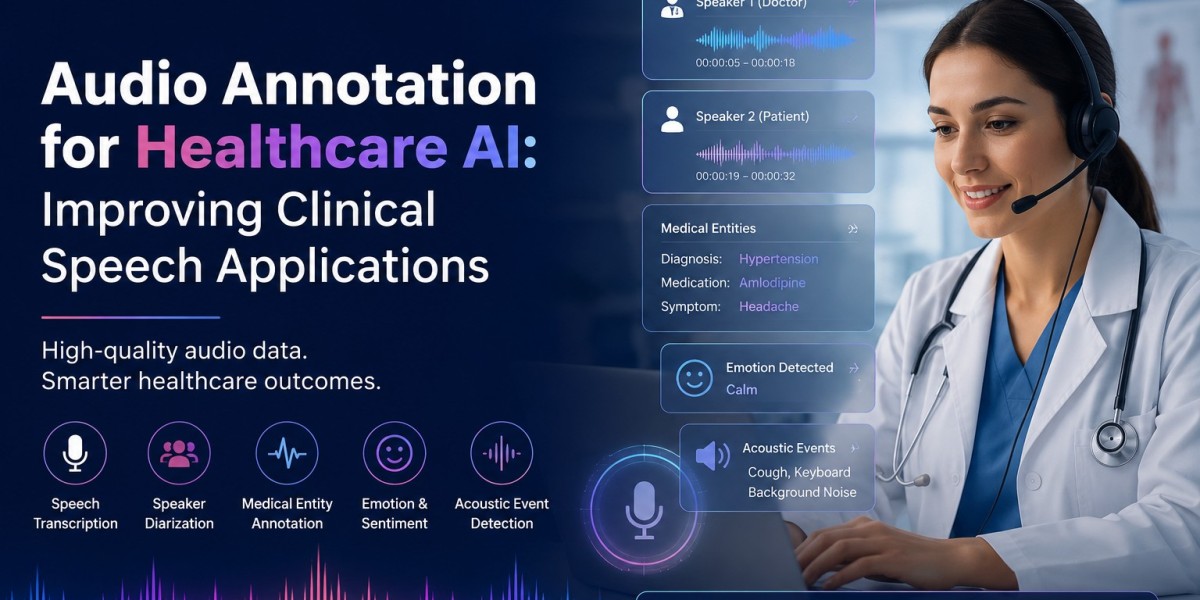
Healthcare AI applications require multiple layers of annotation depending on the intended use case.
Speech Transcription
Medical conversations are converted into highly accurate text transcripts while preserving clinical terminology, abbreviations, medications, and diagnoses.
Speaker Diarization
AI models learn to distinguish between physicians, nurses, patients, caregivers, and other participants in multi-speaker clinical conversations.
Timestamp Annotation
Each spoken phrase is synchronized with exact timestamps, enabling efficient search, playback, and automated documentation.
Medical Entity Annotation
Important clinical entities such as diseases, symptoms, medications, procedures, laboratory values, and anatomical references are identified and labeled for downstream AI tasks.
Emotion and Sentiment Annotation
Healthcare conversations often contain emotional cues that can support behavioral health applications, patient satisfaction analysis, and mental health monitoring.
Acoustic Event Annotation
Background noises including alarms, coughing, medical equipment, keyboard clicks, and interruptions are labeled to improve noise-robust speech recognition systems.
Key Applications of Audio Annotation in Healthcare AI
AI Medical Transcription
One of the fastest-growing healthcare AI applications is automated clinical documentation. Physicians spend significant time documenting patient visits, reducing valuable face-to-face interaction.
Well-annotated audio datasets allow AI transcription systems to accurately recognize medical vocabulary, punctuation, speaker changes, and contextual information, significantly reducing administrative burden.
Clinical Decision Support
Healthcare AI systems increasingly analyze physician-patient conversations to identify symptoms, recommend follow-up questions, and generate structured clinical summaries.
High-quality annotations provide the training data necessary for these intelligent decision-support models.
Telemedicine Platforms
Virtual healthcare consultations have become increasingly common. Audio annotation helps AI understand conversations despite variable internet quality, environmental noise, and diverse accents.
This improves automatic transcription, note generation, and patient record management during remote consultations.
Healthcare Voice Assistants
Voice-enabled assistants assist healthcare professionals by retrieving patient records, scheduling appointments, documenting observations, and answering clinical questions.
Accurate annotated speech data enables these assistants to understand specialized medical language with greater precision.
Mental Health Assessment
Behavioral health applications increasingly analyze vocal characteristics, speech patterns, pauses, and emotional tone to assist clinicians in identifying depression, anxiety, stress, and cognitive disorders.
Audio annotation provides the labeled datasets needed to train these sensitive AI models responsibly.
Challenges in Healthcare Audio Annotation
Healthcare audio annotation requires significantly higher standards than general speech annotation because even small labeling errors can affect downstream clinical applications.
Complex Medical Terminology
Medical conversations contain thousands of specialized terms that require trained annotators familiar with healthcare vocabulary.
Multiple Speakers
Clinical discussions often involve physicians, patients, nurses, specialists, and family members speaking simultaneously, making speaker identification particularly challenging.
Noisy Clinical Environments
Hospitals and clinics contain constant background sounds including medical devices, conversations, footsteps, and alarms that complicate speech recognition.
Diverse Languages and Accents
Healthcare providers serve multilingual populations with varying accents and pronunciation styles. Annotation teams must accommodate this diversity to build inclusive AI models.
Data Privacy
Healthcare audio frequently contains protected health information (PHI). Annotation workflows must follow strict security measures, anonymization procedures, and regulatory compliance requirements.
An experienced data annotation company implements robust quality assurance and secure annotation workflows to address these challenges effectively.
Best Practices for High-Quality Healthcare Audio Annotation
Organizations developing healthcare AI should follow several best practices to maximize annotation quality.
Develop comprehensive annotation guidelines tailored to medical terminology and clinical workflows.
Employ trained annotators familiar with healthcare vocabulary.
Perform multi-level quality assurance and expert reviews.
Standardize medical abbreviations and terminology across datasets.
Use secure data handling processes to protect patient confidentiality.
Continuously update annotation guidelines as AI applications evolve.
Many healthcare organizations prefer audio annotation outsourcing because experienced service providers already maintain trained annotation teams, secure infrastructure, scalable workflows, and rigorous quality control systems.
Why Audio Annotation Outsourcing Makes Strategic Sense
Building an in-house healthcare annotation team requires significant investments in recruitment, medical training, infrastructure, compliance, and quality management.
Professional audio annotation outsourcing offers several advantages:
Access to trained medical annotation specialists
Faster project turnaround
Scalable workforce for growing datasets
Consistent quality assurance processes
Lower operational costs
Strong data security and confidentiality practices
Support for multilingual healthcare datasets
By leveraging data annotation outsourcing, healthcare organizations can focus on AI innovation while trusted specialists handle the complex data preparation process.
Why Choose Annotera for Healthcare Audio Annotation
Annotera combines human expertise with scalable annotation workflows to deliver high-quality healthcare datasets that support reliable AI development.
Our healthcare audio annotation capabilities include:
Clinical speech transcription
Speaker diarization
Medical terminology annotation
Timestamp synchronization
Emotion and sentiment labeling
Acoustic event detection
Multilingual speech annotation
Human-in-the-loop quality assurance
Every project undergoes rigorous validation to ensure annotation consistency, accuracy, and compliance with client-specific requirements. As an experienced data annotation company, Annotera works closely with healthcare AI developers to create datasets that improve model performance across clinical speech applications.
Conclusion
Healthcare AI is transforming clinical workflows, patient interactions, and medical documentation. However, these innovations rely on accurately labeled speech data that enables AI systems to understand complex healthcare conversations with confidence.
Professional audio annotation provides the structured foundation required for medical transcription, virtual assistants, telemedicine, clinical decision support, and behavioral health applications. As healthcare datasets continue to grow in volume and complexity, partnering with a trusted data annotation company becomes increasingly important for ensuring data quality, scalability, and regulatory compliance.
Whether you're building next-generation clinical speech recognition systems or enhancing existing healthcare AI platforms, Annotera's expert audio annotation outsourcing services and comprehensive data annotation outsourcing solutions help transform raw healthcare audio into reliable training data that powers intelligent, accurate, and patient-centric AI solutions.