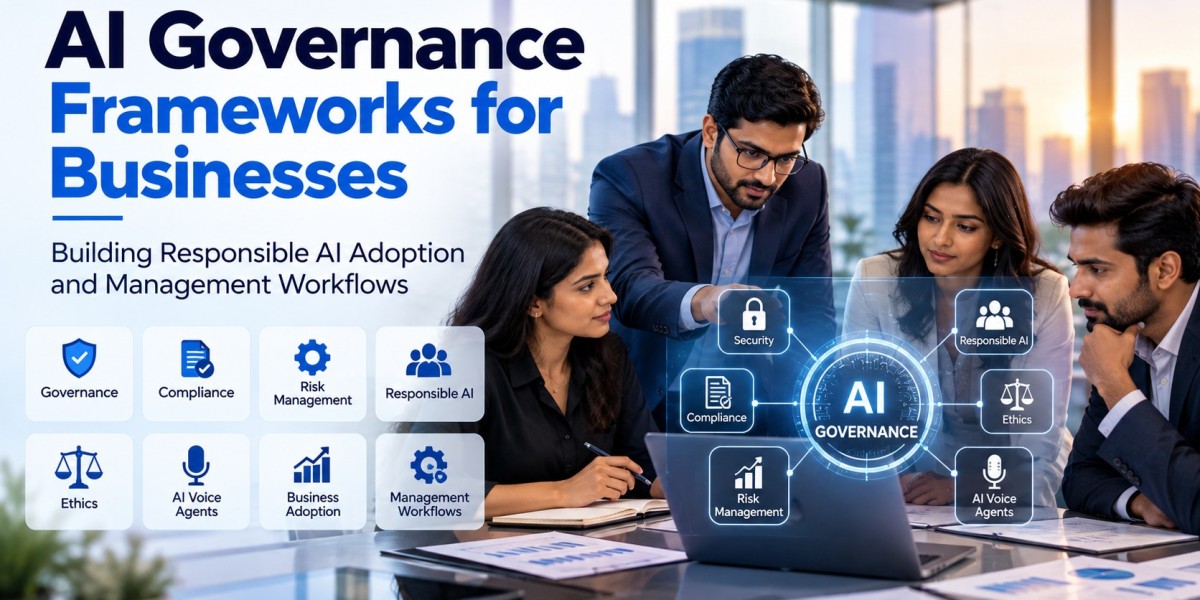


Artificial intelligence is becoming part of everyday business operations, from customer support and data analysis to fraud detection and automation. As adoption expands, companies need clear rules for how AI is selected, developed, deployed, and monitored. AI Governance Consulting Services can help businesses create practical frameworks that support responsible adoption without putting unnecessary brakes on innovation.
AI governance is not simply a compliance exercise. It is an operating structure that connects technology, security, legal teams, business leaders, and employees. When these groups work from the same framework, AI projects become easier to evaluate, manage, and improve.
What Is an AI Governance Framework?
An AI governance framework is a set of policies, workflows, responsibilities, and controls used to manage AI throughout its lifecycle. It defines who can approve an AI system, what information can be processed, how risks are assessed, and what happens when something goes wrong.
For smaller organizations, governance may begin with a basic approval process. Larger businesses often need a more detailed structure because they may have multiple AI applications, vendors, departments, datasets, and regulatory obligations.
A practical framework usually covers:
AI system ownership
Data collection and usage
Model testing and validation
Security requirements
Risk classification
Privacy controls
Compliance checks
Human oversight
Performance monitoring
Incident response
Retirement procedures
The framework should be documented clearly enough for employees to use it in real situations. A policy that sits in a shared folder and is never consulted does little to manage risk.
Why Businesses Need AI Management Workflows
AI projects can move quickly. That is useful for experimentation, but speed can create problems when there is no consistent approval or review process.
AI Governance Consulting can help businesses turn broad governance principles into repeatable workflows. For example, a new AI project might move through an initial use-case review, data assessment, risk classification, security check, testing stage, approval, deployment, and ongoing monitoring.
This creates a predictable path for teams.
It also prevents common questions from appearing late in development. Teams know earlier who owns the system, what information can be used, which controls are required, and when additional review is necessary.
Start With an AI Inventory
Before creating complicated controls, businesses need visibility into their existing AI environment.
An AI inventory records the systems being used across the organization. Useful fields include:
Application or model name
Business purpose
Department and owner
Data sources
External vendors
User groups
Deployment environment
Risk level
Review date
This inventory can expose systems that were introduced independently by different departments. It can also reveal duplicate tools, unsupported applications, or AI systems processing sensitive information without sufficient oversight.
Visibility is the starting point for effective governance.
Build a Risk-Based Classification System
Not every AI application deserves the same level of scrutiny. A tool that summarizes internal meeting notes presents a different risk profile from an application supporting financial decisions.
AI Risk Management helps organizations classify AI systems according to their potential impact and determine which safeguards are appropriate.
Risk assessments can examine:
Sensitivity of the data involved
Potential effect on customers or employees
Level of automation
Security exposure
Accuracy requirements
Regulatory obligations
Human intervention
Consequences of incorrect outputs
A risk-based model keeps governance practical. Low-risk applications can follow streamlined processes, while high-impact systems receive deeper testing and review.
Make Responsible AI Part of Development
Responsible AI should begin before an application reaches production. Development teams need guidance on how to handle data, evaluate outputs, document decisions, and identify potential issues.
Responsible AI Services can support processes such as fairness evaluation, model testing, transparency, documentation, human oversight, and lifecycle monitoring.
Consider a customer-facing AI assistant. Testing should not stop at whether the assistant gives useful answers. Teams should also examine how it handles sensitive questions, inappropriate requests, confidential information, and unexpected inputs.
These checks become much easier when they are built into the development workflow instead of added just before launch.
Connect Governance With Compliance
Regulatory expectations around AI can vary by industry, location, and use case. Businesses operating across markets may also need to track different obligations.
AI Compliance Solutions can help organizations translate external requirements into internal procedures and technical controls.
A useful compliance workflow should identify:
Which requirements apply to the AI system.
What data the system processes.
Which controls are required.
Who is responsible for each control.
What evidence should be retained.
When the system needs another review.
Documentation matters here. Businesses should maintain records showing how systems were assessed, approved, tested, and monitored.
Create Clear Ethical Review Workflows
An AI system can be technically accurate and still create difficult questions about fairness, transparency, privacy, or human impact.
Ethical AI Consulting helps businesses establish structured processes for addressing these questions before and after deployment.
An ethical review might ask:
Could the system affect people differently?
Can users understand its role in a decision?
Is human intervention available?
Are users informed when they interact with AI?
Is the data appropriate for the intended purpose?
What happens when the system produces an incorrect result?
The answers should be documented. This turns ethical considerations into operational decisions rather than leaving them as broad statements.
Add Human Oversight Where It Matters
Automation works best when people know when to step in.
Businesses should define situations where human review is required. These may include high-impact decisions, unusual model behavior, customer complaints, security incidents, or outputs that fall outside established thresholds.
Human oversight also needs authority. A reviewer should have enough information to understand the AI output and enough control to reject, correct, or escalate it.
Simply placing a person in the workflow does not guarantee meaningful oversight.
Governance for AI-Powered Customer Experiences
New applications such as AI Voice Agents can create additional governance considerations because they interact directly with customers through natural conversations.
Businesses should consider consent, data retention, authentication, escalation to human agents, conversation monitoring, and handling of sensitive information.
The same principle applies to chatbots, recommendation engines, automated document processing, and other AI-enabled services. Governance needs to reflect how the system is actually used.
Connect AI Governance With Technology Architecture
AI rarely operates as an isolated application. It often connects with cloud infrastructure, databases, APIs, analytics platforms, automation tools, and emerging technologies.
That makes architecture an important part of governance.
Businesses evaluating technology partners may also work with a Blockchain Development Company when distributed systems or blockchain capabilities form part of a broader technology strategy. The important consideration is how each technology fits the business requirement and how its associated risks will be managed.
HyprForge's broader technology capabilities can be considered within this context, with governance remaining focused on responsible implementation rather than technology adoption for its own sake.
Automate Governance Where Possible
Manual governance processes can become difficult to manage as AI adoption grows. Automation can reduce repetitive administrative work while improving visibility.
Businesses can automate tasks such as:
Risk assessment reminders
Approval routing
Review schedules
Model documentation
Policy acknowledgements
Access reviews
Monitoring alerts
Incident escalation
Automation does not replace human judgment. It handles repeatable tasks so specialists can focus on decisions that require context and experience.
Measure Governance Performance
A governance program should be measurable. Useful indicators include the number of documented AI systems, completed assessments, unresolved incidents, overdue reviews, compliance exceptions, and systems with assigned owners.
Businesses can also track how quickly issues are identified and resolved.
Near misses deserve attention too. An incident that was caught before causing harm can reveal a weakness in testing or workflow design. Reviewing these events helps organizations strengthen controls before a similar problem occurs.
Building a Sustainable AI Governance Culture
Governance works best when employees understand their role in it. Training should explain approved AI tools, data handling requirements, security expectations, escalation procedures, and responsible usage.
Leadership support matters as well. When governance is treated as part of normal technology management, employees are more likely to follow the process instead of viewing it as administrative overhead.
The goal is a workflow that teams can actually use. It should be clear, proportional to risk, and adaptable as technology changes.
Conclusion
AI governance frameworks give businesses a practical way to manage responsible AI adoption. They bring structure to decisions around risk, security, compliance, ethics, human oversight, and ongoing monitoring.
The strongest frameworks are not built as rigid checklists. They evolve with the organization. New AI applications, vendors, regulations, and business requirements can all trigger updates.
For businesses working with HyprForge, the focus can remain on building technology that is useful, scalable, and responsibly managed. A strong governance workflow provides the foundation needed to expand AI adoption while keeping accountability and risk management firmly in view.
Frequently Asked Questions
1. What is an AI governance framework?
An AI governance framework is a structured set of policies, workflows, controls, and responsibilities used to manage artificial intelligence from planning through retirement.
2. What are the main components of AI governance?
The main components include AI inventory, risk assessment, data governance, security, compliance, ethical review, human oversight, documentation, monitoring, and incident management.
3. How can small businesses implement AI governance?
Small businesses can start with an AI inventory, assigned system owners, basic risk assessments, approved-use policies, data protection rules, and periodic reviews. Controls can become more detailed as AI adoption grows.
4. Why should AI governance be risk-based?
A risk-based approach allows organizations to apply stronger controls to systems that could have greater business, financial, privacy, security, or human impact while keeping low-risk projects easier to manage.
5. How often should an AI governance framework be reviewed?
A framework should be reviewed periodically and whenever there is a significant change in an AI system, dataset, vendor, business process, technology architecture, or applicable regulatory requirement.






