

Introduction
Business decisions often depend on financial information.
Owners and managers may need to decide whether to hire, increase spending, reduce costs, invest in inventory, expand a location, seek financing, or change pricing.
These decisions become harder when financial reports are delayed.
A slow month-end close can leave management working with old information. A better close process can help businesses receive accurate financial reports sooner and use them while the information is still relevant.
This is where monthly close process improvement can make a difference.
The goal is not simply to close the books faster. The goal is to create a reliable process that gives management useful financial information sooner.
What Is a Monthly Close Process?
The monthly close is the process used to review and finalize a company's financial activity for the month.
It may include:
Recording transactions
Reconciling bank accounts
Reconciling credit cards
Reviewing accounts receivable
Reviewing accounts payable
Recording accruals
Updating prepaid expenses
Recording depreciation
Reviewing payroll
Preparing journal entries
Reconciling balance sheet accounts
Preparing financial statements
Reviewing financial results
Once these activities are completed, management can review the company's financial performance.
The quality and timing of this process can affect how quickly management receives reliable information.
Why Decision Speed Depends on Financial Information
Business decisions rarely happen in isolation.
Management may need financial information before making a decision.
For example:
Should we hire another employee?
Management may need to understand current payroll costs, revenue, cash flow, and expected profitability.
Should we purchase more inventory?
The decision may depend on sales trends, inventory levels, cash availability, and customer demand.
Should we expand?
Management may need to review revenue, margins, operating costs, and available cash.
If these reports are several weeks behind, the decision may be based on information that no longer reflects current conditions.
How a Slow Close Can Delay Decisions
A slow close does more than delay financial statements.
It can delay the decisions that depend on those statements.
Consider a business that finishes its monthly close 20 days after month-end.
By the time management reviews the results, the company may already be well into the next month.
If the reports show that expenses increased or margins declined, management has less time to respond.
A faster close can shorten this information gap.
What Makes a Monthly Close Slow?
Several issues can extend the close process.
Manual Data Entry
When employees enter the same information into multiple systems, the close can take longer.
Delayed Reconciliations
Bank, credit card, and balance sheet reconciliations often need to be completed before financial statements can be finalized.
Missing Information
Accounting teams may need to wait for invoices, payroll data, expense reports, sales information, or other records.
Unclear Responsibilities
If employees are unsure who owns each task, work can be delayed.
Spreadsheet-Heavy Processes
Spreadsheets can be useful, but too many manual spreadsheets can increase review time and create errors.
Disconnected Accounting Systems
When systems do not share data effectively, accounting teams may need to export, compare, and manually combine information.
Late Adjustments
Frequent corrections near the end of the close can extend the timeline.
What Monthly Close Process Improvement Looks Like
Monthly close process improvement means reviewing the current close and finding practical ways to make it more efficient and reliable.
This may involve:
Creating a close calendar
Assigning clear task owners
Setting deadlines
Standardizing recurring tasks
Improving reconciliations
Reducing duplicate data entry
Automating routine processes
Improving accounting system integrations
Using consistent review procedures
Documenting accounting policies
Tracking close performance
The goal is not to remove every review step.
The goal is to reduce unnecessary work while maintaining accuracy and appropriate controls.
A Clear Close Calendar Can Save Time
A close calendar gives everyone a clear schedule.
For example:
Day 1–2
Complete routine transaction processing
Begin bank and credit card reconciliations
Collect missing information
Day 3–5
Complete reconciliations
Record recurring journal entries
Review accounts payable and receivable
Day 6–7
Complete remaining adjustments
Review balance sheet accounts
Prepare financial statements
Day 8–10
Management reviews results
Prepare management reports
Discuss significant changes
The exact timeline will vary by business.
What matters is that employees know what needs to happen and when.
Faster Does Not Mean Less Accurate
A common concern is that speeding up the close could increase errors.
That does not have to happen.
A well-designed close process focuses on both speed and accuracy.
For example, businesses can use:
Standardized checklists
Automated reconciliations
Recurring journal entries
Review procedures
Approval workflows
Account reconciliation schedules
Clear task ownership
The objective is to remove unnecessary delays rather than skip important controls.
Faster Reports Can Improve Management Reporting
A faster close can also support better monthly management reporting.
Management reports may include:
Revenue
Gross profit
Operating expenses
Net income
Cash flow
Accounts receivable
Accounts payable
Budget versus actual results
Key performance indicators
When these reports are available sooner, management has more time to review the results and respond.
This is especially useful when financial performance changes quickly.
Faster Reporting Helps Identify Problems Earlier
Timely financial reports can help management spot changes before they become larger problems.
For example, monthly reporting may show:
A decline in gross margin
Rising operating expenses
Slower customer payments
Increasing debt
Lower sales
Higher labor costs
Unexpected vendor costs
Weak performance in a specific location
The closure itself does not solve these problems.
But timely reporting gives management an opportunity to investigate them sooner.
Better Close Processes Support Cash Flow Decisions
Cash flow is one area where timing matters.
A business may need to know:
How much cash is available
Which customers have outstanding balances
Which bills are due
How much payroll will cost
Whether upcoming spending is affordable
Whether financing may be needed
A reliable monthly close can provide a stronger starting point for cash flow analysis.
For businesses that need more detailed planning, cash flow forecasting can extend this process beyond historical reporting.
Better Close Processes Support Budget Decisions
Management also needs current financial information when reviewing budgets.
A timely close allows the business to compare:
Actual results vs. budget
This can help identify:
Revenue differences
Expense increases
Margin changes
Staffing costs
Project performance
Location performance
Management can then investigate significant variances while there is still time to respond.
This is where SMB budgeting and variance reporting can complement the monthly close.
Better Close Processes Support KPI Reporting
Financial statements are important, but many businesses also track operational KPIs.
Examples include:
Sales growth
Customer acquisition
Average transaction value
Gross margin
Labor costs
Customer retention
Accounts receivable days
Inventory turnover
When financial data is finalized on time, KPI and financial information can be reviewed together.
This can provide management with a broader view of business performance.
Technology Can Improve the Close
Technology can reduce repetitive work.
Depending on the business, improvements may include:
Bank feed automation
Automated transaction imports
Accounting software integrations
Expense management integrations
Automated reconciliation tools
Recurring journal entries
Approval workflows
Standardized reporting
However, technology should support a good process.
Adding software to a poorly designed workflow may not solve the underlying problem.
This is why an Accounting systems and tech stack evaluation can be useful when reviewing the monthly close.
Reduce Disconnected Accounting Workflows
Businesses often use several financial and operational systems.
For example:
Accounting software
Payroll software
CRM
Payment platforms
Inventory systems
Expense management tools
Banking platforms
If these systems do not work together effectively, accounting teams may need to move information manually.
This can slow the close and increase the time needed to verify data.
Reviewing system connections can therefore be an important part of Monthly close process improvement.
Track the Close Process Itself
Businesses can improve the close by measuring it.
Useful measures may include:
Number of days to close
Number of late tasks
Number of post-close adjustments
Number of unreconciled accounts
Time spent on manual work
Number of recurring errors
Time required to prepare management reports
Tracking these measures can show whether process changes are actually helping.
For example, reducing the close from 15 business days to 10 may be useful, but management should also confirm that accuracy and reporting quality remain strong.
Faster Close, Faster Questions
A useful monthly close does more than produce financial statements.
It helps management ask better questions sooner.
For example:
Why did gross margin change?
Why did expenses increase?
Which customers are paying more slowly?
Which products are most profitable?
Which location is performing below budget?
Can we afford the planned hiring?
Do we need additional working capital?
The faster management receives reliable information, the sooner these questions can be investigated.
Monthly Close and Management Reporting Work Together
The monthly close creates the financial foundation for management reporting.
The process can be viewed as:
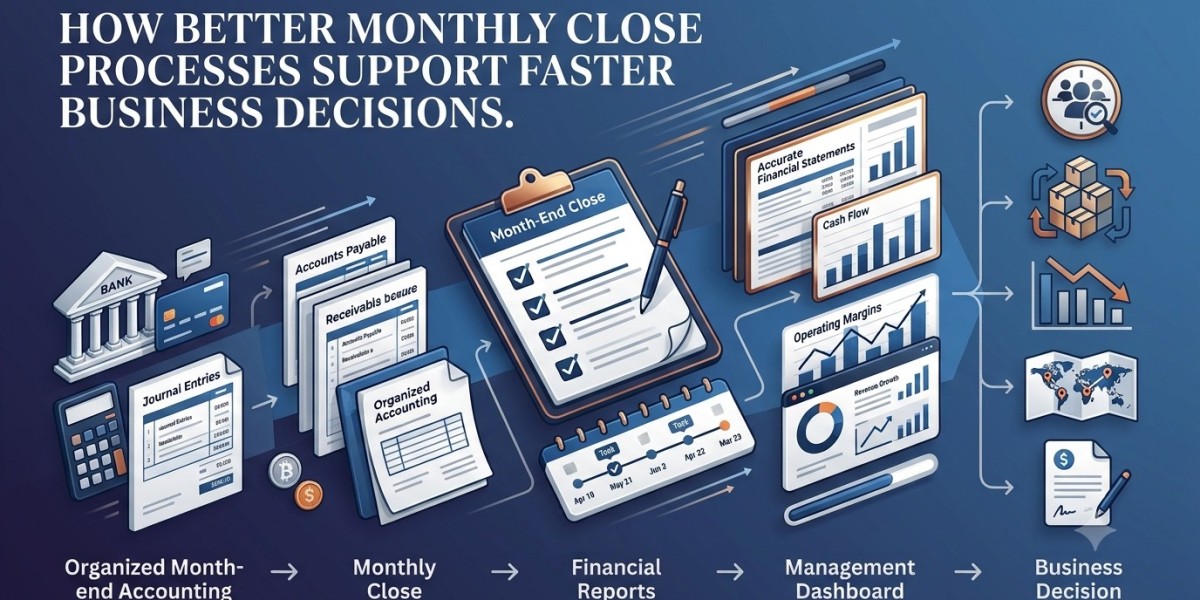
Daily Transactions → Month-End Close → Financial Statements → Management Reporting → Business Decisions
If the close is delayed, everything after it may also be delayed.
Improving the close can therefore improve the entire reporting cycle.
When a Faster Close May Not Be the Answer
Speed should not be the only goal.
A business should not rush the close if important information is missing or controls are weak.
For example, management may need to address:
Incomplete bookkeeping
Unreconciled accounts
Incorrect account coding
Missing approvals
Poor documentation
Weak internal controls
Inaccurate inventory records
Disconnected systems
Fixing these issues may be necessary before the close can become both faster and more reliable.
How Cube Accounting Solutions Can Help
Cube Accounting Solutions is a professional accounting firm based in Santa Ana, California, serving businesses across the U.S.
Our Accounting Services can support businesses with:
Full-cycle bookkeeping
Accounts payable
Accounts receivable
Bank and credit card reconciliation
Month-end and year-end closing
Financial statement preparation
Payroll support
For businesses that need additional financial management support, our Fractional CFO Services include:
Cash flow forecasting
Budgeting and variance analysis
KPI and management dashboard reporting
Fundraising and capital strategy
M&A support and exit planning
These services can help businesses improve recurring accounting processes, strengthen monthly reporting, and provide management with financial information that supports timely decisions.
Learn more about Accounting Services and Fractional CFO Services.
Frequently Asked Questions
How does a better monthly close support faster decisions?
A better close helps management receive reliable financial information sooner. This gives owners and managers more time to review results and respond to changes in revenue, expenses, cash flow, and profitability.
How long should a monthly close take?
There is no universal timeline. The appropriate close period depends on the size, complexity, systems, and reporting needs of the business. The goal should be a timely and reliable close rather than a specific number of days.
Does a faster close increase the risk of errors?
Not necessarily. Businesses can improve speed by reducing manual work, standardizing processes, automating routine tasks, and using clear review procedures without removing important controls.
What is monthly close process improvement?
Monthly close process improvement is the process of reviewing and improving the steps used to complete financial records each month. It can include better workflows, clearer responsibilities, automation, technology improvements, and stronger review procedures.
Can technology make the month-end close faster?
Yes. Properly configured integrations, automated reconciliations, recurring journal entries, bank feeds, and approval workflows can reduce manual work. Technology should be combined with a well-designed accounting process.
How does the close support management reporting?
The close provides finalized financial information that can be used for management reports. Faster and more reliable financial data can help management review revenue, expenses, cash flow, budgets, and KPIs sooner.
Conclusion
A better monthly close process can do more than improve accounting efficiency.
It can shorten the time between financial activity and management action.
When financial records are completed sooner, owners and managers can review current results, identify changes, investigate problems, and make decisions with more timely information.
Monthly close process improvement can support this goal by reducing manual work, clarifying responsibilities, improving reconciliations, strengthening technology, and creating a consistent close schedule.
For businesses in Santa Ana, California, and across the U.S., Cube Accounting Solutions provides accounting and Fractional CFO support for businesses that want stronger financial processes and reporting.
Contact Cube Accounting Solutions to discuss your monthly close process, management reporting, and financial reporting needs.






