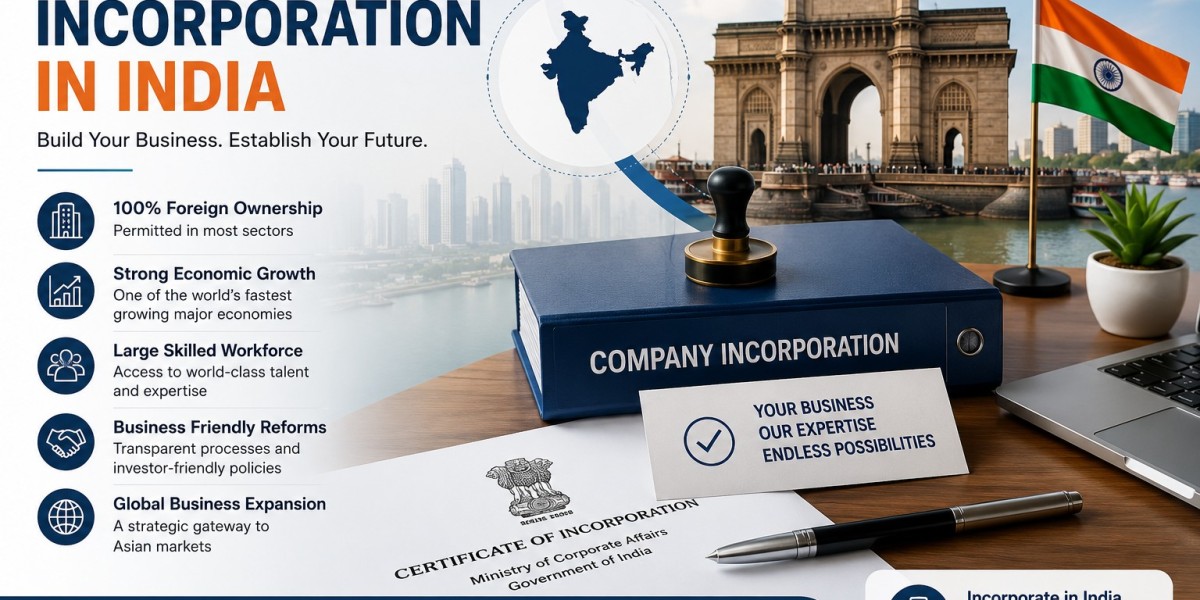


For UK businesses looking to expand internationally, India has become a market full of opportunity. Its growing economy, strong consumer demand, business-friendly reforms, and skilled workforce make it an attractive destination for companies across sectors such as technology, manufacturing, healthcare, financial services, and professional consulting. However, before entering this market, one important question needs to be answered: How can I incorporate a company in India from the UK?
The process is much more straightforward today than it was a decade ago. Most incorporation formalities can be completed online through the Ministry of Corporate Affairs (MCA), allowing overseas investors to establish an Indian company without being physically present for every stage of the process. Still, successful company incorporation in India requires careful planning, the right documentation, and compliance with Indian corporate laws.
For UK entrepreneurs, incorporating a business is not simply about legal registration—it is about creating a solid platform for long-term growth in one of the world's fastest-growing economies.
According to Invest India, the country continues to attract thousands of foreign investors every year because of its stable regulatory environment, expanding infrastructure, and large domestic market.
Why Should UK Companies Establish a Presence in India?
Many businesses initially enter India through exports or partnerships. As customer demand grows, establishing a local company often becomes the next logical step.
Some of the major benefits include:
Direct access to Indian customers.
Improved credibility with local partners.
Ability to hire employees in India.
Easier participation in government and private-sector tenders.
Greater operational control.
Better understanding of the local market.
Long-term scalability.
A registered company also simplifies future business expansion and investment opportunities.
Selecting the Right Business Structure
The first strategic decision is choosing the legal structure that best fits your business goals.
| Business Structure | Suitable For | Main Benefit |
|---|---|---|
| Private Limited Company | Startups, SMEs, and overseas investors | Limited liability and strong business credibility |
| Limited Liability Partnership (LLP) | Professional service firms | Flexible management |
| Branch Office | Existing overseas companies | Extension of the parent company |
| Liaison Office | Market research and business development | No commercial operations |
| Wholly Owned Subsidiary | Businesses seeking complete ownership | Full operational control where permitted |
For many UK companies, a Private Limited Company or a wholly owned subsidiary in India is the preferred option because it allows greater flexibility while supporting long-term growth.
Step 1: Understand the Applicable FDI Rules
Before registering a company, it is important to confirm whether your business sector allows foreign investment under the automatic route or requires government approval.
Many industries permit up to 100% foreign ownership, making India an attractive destination for overseas investors.
Understanding these regulations early helps prevent delays during the incorporation process.
Step 2: Arrange the Required Documents
The incorporation process generally requires:
Passport copies of directors and shareholders.
Residential address proof.
Passport-sized photographs.
Registered office proof in India.
Memorandum of Association (MoA).
Articles of Association (AoA).
Parent company documents, where applicable.
Board Resolution authorising overseas investment.
Documents issued outside India usually need to be notarised and apostilled before submission.
Step 3: Obtain Digital Registration Credentials
Directors must secure:
Digital Signature Certificate (DSC).
Director Identification Number (DIN).
These digital credentials enable secure online filing and electronic signatures through the MCA portal.
Step 4: Complete the Company Registration
Once the documents are verified, the incorporation application is filed electronically.
Following approval, the company receives:
Certificate of Incorporation.
Corporate Identification Number (CIN).
Permanent Account Number (PAN).
Tax registrations where required.
The company is then legally recognised and can begin completing operational formalities.
Step 5: Set Up Your Business Operations
After incorporation, businesses generally proceed with:
Opening an Indian corporate bank account.
GST registration where applicable.
Accounting and bookkeeping setup.
Employee registrations.
Industry-specific licences and approvals.
Completing these steps ensures the business is ready to commence commercial operations.
Real-Life Case Study
A Newcastle-based engineering company specialised in industrial automation solutions and wanted to expand into India to support manufacturing clients. Instead of managing projects through distributors, the company established its own Indian subsidiary.
By preparing documentation in advance and working with incorporation specialists, the business completed registration efficiently. Within months, it hired local engineers, opened a regional office, and secured contracts with several manufacturing companies.
Its Indian presence improved customer confidence and significantly increased project opportunities.
Example
Imagine a UK-based cloud computing company experiencing growing demand from Indian enterprises.
Rather than serving customers remotely, the business establishes an Indian company to provide local technical support, recruit software engineers, and collaborate with Indian technology partners.
This local presence improves customer satisfaction while creating opportunities for future expansion across Asia.
Common Challenges During Incorporation
Although digital registration has simplified the process, businesses may still encounter challenges such as:
Selecting an inappropriate legal structure.
Preparing incomplete documentation.
Delays in document authentication.
Understanding Indian compliance requirements.
Managing post-incorporation obligations.
Professional support helps businesses navigate these challenges with confidence.
Why Businesses Choose Professional Advisors
Expanding into another country involves legal, financial, and regulatory considerations that extend well beyond registration.
Experienced consultants help businesses:
Select the right incorporation structure.
Review documentation.
Manage government filings.
Ensure regulatory compliance.
Plan tax registrations.
Support long-term business growth.
Their expertise helps businesses avoid delays while maintaining compliance from the very beginning.
Why Choose Stratrich?
Stratrich provides specialist consulting services for businesses across the UK and Europe that want to establish operations in India. From advising on business structures and handling company incorporation in India to managing compliance, taxation, documentation, and post-incorporation support, Stratrich offers a complete solution for international investors.
With practical experience and deep knowledge of Indian regulations, Stratrich helps businesses build a strong foundation for successful expansion.
Conclusion
Expanding from the UK into India is a strategic investment that offers access to one of the world's largest and fastest-growing markets. By understanding the incorporation process, preparing the right documents, and selecting the most appropriate legal structure, businesses can establish a compliant and scalable operation.
Whether your goal is setting up a company in India for the first time or expanding an existing international business, company incorporation in India is an important step towards long-term success. With Stratrich as your trusted consulting partner, your journey into the Indian market becomes simpler, faster, and more efficient.








