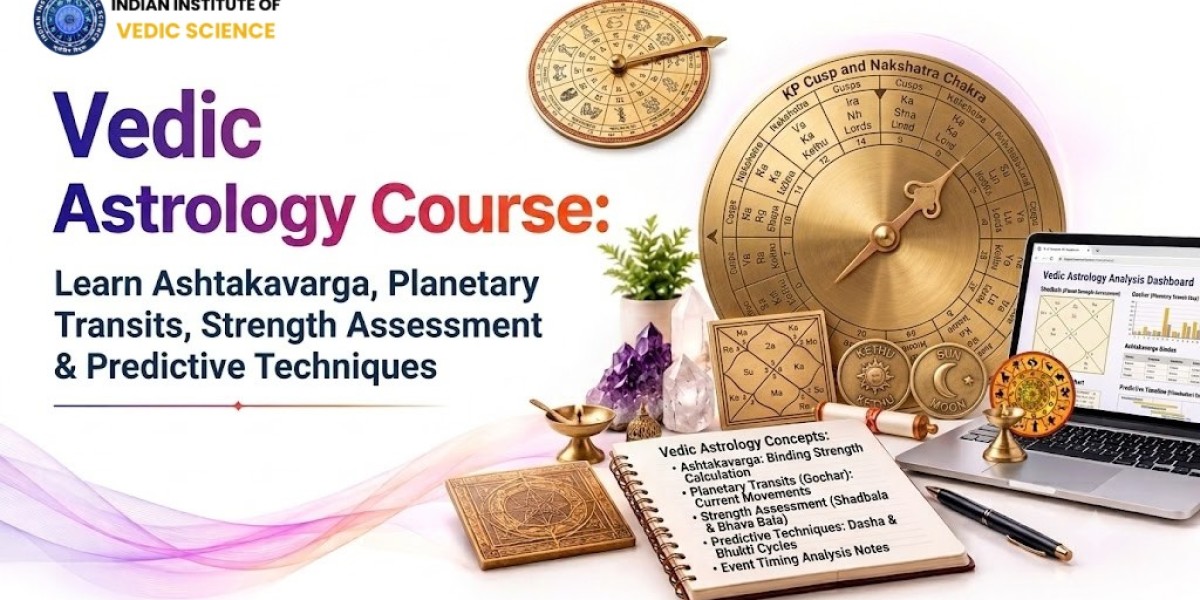


Vedic Astrology Course: Learn Ashtakavarga, Planetary Transits, Strength Assessment & Predictive Techniques
Vedic Astrology is a traditional Indian system of horoscope interpretation that studies planets, signs, houses, Nakshatras, planetary strengths, Dashas and transits to understand different areas of life. For students who want to move beyond basic horoscope reading, advanced concepts such as Ashtakavarga, planetary transits, strength assessment and predictive techniques provide a deeper framework for chart analysis.
A structured Vedic astrology course can help learners understand these concepts step by step and develop practical skills in interpreting a Vedic astrology chart.
Whether you are a beginner searching for an online Vedic astrology course or an existing astrology student looking for advanced predictive techniques, the right learning structure can make the subject easier to approach.
What Does a Vedic Astrology Course Teach?
A Vedic Astrology course generally introduces students to the fundamentals of planets, signs, houses and Nakshatras before progressing toward horoscope interpretation, planetary strengths, Dashas, transits and predictive methods.
Advanced training may include:
Vedic astrology chart interpretation
Planetary strength assessment
Ashtakavarga
Planetary transits
Dashas and timing techniques
Yogas and planetary combinations
House analysis
Nakshatra interpretation
Predictive horoscope analysis
Practical chart-based learning
The objective is to help students develop a structured method of interpreting a horoscope rather than relying on isolated planetary placements.
What Is Vedic Astrology?
Vedic Astrology, traditionally associated with the Jyotisha tradition, is an astrological system that examines the relationship between planetary positions and different areas represented in a birth chart.
A Vedic astrology chart contains information about planetary placements, houses, signs and other factors used for interpretation.
Students beginning their journey generally learn:
Nine traditional planetary influences used in Jyotisha
Twelve zodiac signs
Twelve houses
Nakshatras
Ascendant or Lagna
Planetary aspects
Planetary combinations
Dashas
Transits
Once these foundations are clear, learners can gradually move into advanced analytical techniques.
Why Study a Vedic Astrology Course?
Learning astrology casually can provide basic familiarity with planets and zodiac signs, but structured training can help students understand how multiple chart factors are interpreted together.
A Vedic astrology course online can be especially useful for learners who want flexibility while maintaining a systematic curriculum.
Advanced Vedic Astrology study can help students explore questions related to:
Career and professional direction
Education
Relationships and marriage
Financial themes
Property
Family matters
Major life periods
Planetary transits
Timing of significant events
These interpretations belong to the traditional astrological framework and should be approached as a system of study rather than as a scientifically established method of predicting guaranteed outcomes.
Understanding Planetary Strength
Planetary strength is an important part of advanced horoscope interpretation.
A planet's placement alone does not necessarily provide the complete picture. Students learn to consider different factors that can contribute to how a planet is traditionally assessed within a horoscope.
Depending on the curriculum, learners may study concepts such as:
Dignity of planets
House placement
Sign placement
Aspects
Conjunctions
Divisional charts
Shadbala or planetary strength calculations
Functional relationships
Planetary periods
Strength assessment helps students move from simply asking, “Where is the planet?” to examining the broader condition and role of that planet in the chart.
What Is Ashtakavarga?
Ashtakavarga is an important predictive technique studied in advanced Vedic Astrology.
It provides a point-based framework associated with planetary and house analysis. Students may learn how different planetary contributions are organized and how these calculations can be used alongside other horoscope factors.
One of the practical applications of Ashtakavarga involves studying planetary transits.
Rather than interpreting a transit in isolation, learners can examine it alongside Ashtakavarga indicators, natal planetary positions and other relevant factors.
This makes Ashtakavarga an important topic for students who want to develop a more analytical approach to predictive astrology.
Learning Planetary Transits
Planetary transits describe the movement of planets through the zodiac in relation to a birth chart.
Transit analysis is commonly used within Vedic Astrology to study changing planetary influences over time.
For example, students may learn to examine:
Natal chart + Current transit + Relevant houses + Planetary periods
This creates a broader framework for understanding why the same transit may be interpreted differently for different birth charts.
A good online Vedic astrology classes curriculum should therefore teach students how to connect transit analysis with the natal chart rather than treating every planetary transit as an independent prediction.
Predictive Techniques in Vedic Astrology
Prediction is one of the areas that attracts many learners to Vedic Astrology.
However, responsible predictive learning requires understanding multiple chart factors rather than making conclusions from one planetary placement.
A structured predictive process may include:
Understanding the question or life area.
Identifying the relevant houses.
Studying the planets connected with those houses.
Examining planetary strength.
Reviewing relevant Dashas.
Studying planetary transits.
Using supporting techniques such as Ashtakavarga where appropriate.
Comparing multiple indicators.
Developing a measured interpretation.
This approach helps students understand why advanced horoscope analysis requires practice.
Vedic Astrology Online Course: What Should You Look For?
With many online astrology courses available today, students should carefully compare the curriculum before enrolling.
A strong Vedic astrology online course should ideally progress from basic concepts to advanced applications.
Look for modules covering:
Astrology fundamentals
Birth chart construction
Houses and signs
Planetary meanings
Nakshatras
Planetary aspects
Yogas
Divisional charts
Dashas
Transits
Planetary strength
Ashtakavarga
Predictive techniques
Practical horoscope analysis
The availability of live sessions, study material, case studies and doubt-solving support can also influence the learning experience.
Who Can Learn Vedic Astrology?
A structured course can be suitable for different learners.
Beginners
Students with no previous experience can begin with the fundamentals and gradually progress toward advanced concepts.
Existing Astrology Students
Learners who already understand basic astrology can use advanced training to improve their chart interpretation and predictive skills.
Practicing Astrologers
Those already working with traditional astrology may explore advanced techniques such as Ashtakavarga, strength assessment and transit analysis to expand their knowledge.
Working Professionals
An online format can provide flexibility for learners who cannot attend regular classroom sessions.
The important factor is regular practice. Vedic Astrology contains numerous interconnected concepts, and practical chart analysis is essential for developing confidence.
How to Choose the Best Vedic Astrology Course Online
Searching for the best Vedic astrology course online or best online Vedic astrology course can produce many options.
Instead of selecting a course based only on promotional claims, compare the actual learning structure.
Consider:
Curriculum depth
Course duration
Beginner-to-advanced progression
Practical chart analysis
Instructor guidance
Study material
Live or recorded sessions
Doubt-solving support
Certification
Advanced predictive modules
The best way to learn Vedic astrology is not necessarily the same for every student. Some learners prefer classroom interaction, while others benefit from flexible online classes.
The right choice depends on your existing knowledge, learning goals and preferred study format.
Choosing a Vedic Astrology Institute
Students researching an institute of Vedic astrology should investigate the educational approach before enrolling.
If you are specifically looking for an Indian Vedic astrology institute, evaluate whether the program provides structured learning rather than only introductory information.
Look for an institute that:
Explains concepts progressively
Includes practical horoscope analysis
Covers both fundamentals and advanced techniques
Provides opportunities to ask questions
Uses real or educational case studies
Clearly explains its certification process
Maintains responsible communication around predictive claims
For learners comparing the best astrology institute in India, curriculum quality and learning support are more useful evaluation factors than promotional rankings alone.
Vedic Astrology Course Online in India
An astrology course online India learners can access from home may be particularly convenient for students balancing education, employment or other responsibilities.
Online learning can also make it possible for students from different cities to access specialized astrology education without relocating.
Students searching for:
online Vedic astrology classes
online Vedic astrology course
Vedic astrology online classes
astrology classes online
online astrology courses in India
should compare course content, teaching format, practical sessions and learner support.
The format matters, but the quality and structure of the curriculum remain equally important.
A Practical Vedic Astrology Learning Roadmap
If you want to learn Vedic astrology, following a progressive roadmap can help.
Stage 1: Build the Foundation
Learn signs, planets, houses, Lagna, Nakshatras and basic chart structure.
Stage 2: Understand Horoscope Interpretation
Practice reading planetary placements, house relationships and aspects.
Stage 3: Study Advanced Chart Factors
Move into Yogas, divisional charts, planetary relationships and other advanced concepts.
Stage 4: Learn Timing Techniques
Study Dashas and understand how planetary periods are traditionally used for timing analysis.
Stage 5: Study Planetary Strength
Learn how planetary strength is assessed and how different strength factors influence interpretation.
Stage 6: Master Transits
Practice comparing current planetary movements with the natal chart.
Stage 7: Learn Ashtakavarga
Understand its calculations, interpretation and relationship with transit analysis.
Stage 8: Practice Predictive Analysis
Combine multiple techniques and analyze complete case studies rather than relying on one isolated placement.
Why Consider IIVS for Vedic Astrology Learning?
The Indian Institute of Vedic Science (IIVS) offers structured learning opportunities for students interested in Vedic Astrology and related Vedic science disciplines.
For learners who want to progress from fundamental astrology concepts toward advanced horoscope interpretation, a structured educational environment can provide a clearer learning path.
Students can explore concepts such as planetary analysis, horoscope interpretation, predictive methods and other astrology-related subjects according to their learning level.
Before enrolling, it is useful to discuss your current knowledge, preferred learning format and long-term objectives with the counselling team.
Start Your Vedic Astrology Learning Journey
Vedic Astrology becomes more meaningful as students learn how individual techniques work together. Understanding the Vedic astrology chart is only the beginning; advanced study can involve planetary strength, Dashas, transits, Ashtakavarga and systematic predictive analysis.
Whether you are a beginner searching for an online astrology course or an existing student looking for advanced Vedic astrology online classes, choose a learning program that gives you a structured path from theory to practice.
Ready to explore your options? Book your free counselling with IIVS to discuss your learning goals, course structure and the right starting point for your Vedic Astrology journey.
Frequently Asked Questions
1. What is a Vedic Astrology course?
A Vedic Astrology course teaches the fundamentals and advanced concepts used in traditional Jyotisha, including planets, signs, houses, Nakshatras, Dashas, transits and predictive techniques.
2. Can I learn Vedic Astrology online?
Yes. An online Vedic astrology course allows students to study from home through online classes, depending on the institute's teaching format.
3. What is Ashtakavarga in Vedic Astrology?
Ashtakavarga is a traditional point-based technique used in Vedic Astrology and is often studied alongside planetary transits and other predictive methods.
4. Why is planetary strength important?
Planetary strength helps students assess the condition and influence of planets using multiple traditional astrological factors.
5. Can beginners join a Vedic Astrology course?
Yes. Beginners can start with fundamental concepts and gradually progress toward advanced techniques.
6. What should I look for in online Vedic astrology classes?
Check the curriculum, practical chart analysis, instructor guidance, study material, doubt support, course duration and certification requirements.
7. Is certification available with astrology courses?
Some institutes offer certificates after students meet their course requirements. The exact certification process should be confirmed with the institute.
8. What are planetary transits?
Planetary transits refer to the movement of planets through the zodiac and are traditionally analyzed in relation to a person's natal chart.
9. What is the best way to learn Vedic Astrology?
A structured progression from fundamentals to practical chart interpretation, followed by regular case-study practice, can provide a strong learning foundation.
10. Can I study advanced predictive techniques online?
Yes. Depending on the curriculum, online astrology courses may include advanced topics such as Dashas, transits, planetary strength and Ashtakavarga.






