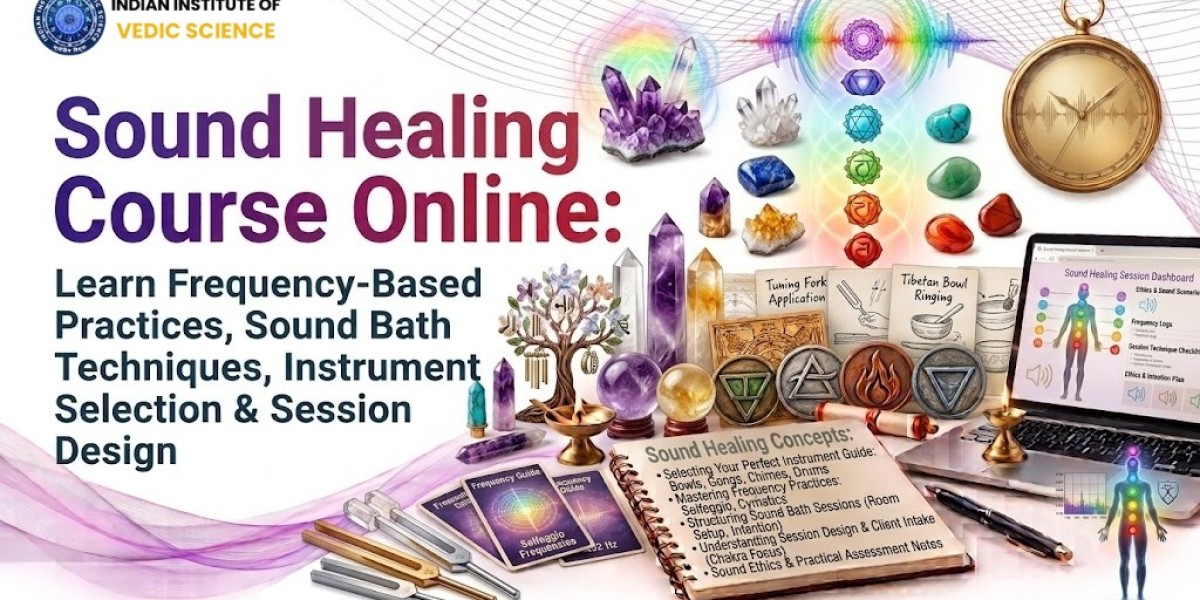


Sound Healing Course: Learn Frequency-Based Practices, Sound Bath Techniques, Instrument Selection & Session Design
Sound has been used in meditation, spiritual traditions, cultural ceremonies, and relaxation practices for centuries. In modern holistic wellness, sound-based practices are often explored through singing bowls, gongs, tuning instruments, vocal practices, rhythm, and guided sound meditation.
A structured sound healing course can help learners understand how sound is incorporated into relaxation and mindfulness practices, how different instruments are traditionally used, and how to design a structured sound session.
For beginners, the subject can initially seem simple: choose an instrument, produce sound, and guide a session. However, effective learning involves much more. Students may need to understand instrument selection, sound patterns, session preparation, sound bath techniques, practitioner communication, and responsible use of wellness terminology.
Online learning has also made this field more accessible. Learners can explore sound healing certification online programs while studying from home and developing their understanding through guided demonstrations and practice.
What Can You Learn in a Sound Healing Course?
A sound healing course can introduce learners to frequency-based practices, sound meditation, instrument selection, sound bath techniques, session preparation, grounding, and personalised session design.
Depending on the curriculum, students may work with singing bowls, gongs, chimes, tuning instruments, drums, voice, or other sound-producing tools.
A comprehensive program may also cover practitioner communication, session flow, space preparation, and responsible wellness practice.
Sound-based wellness practices should be presented as complementary approaches for relaxation or personal wellbeing rather than as replacements for medical diagnosis or treatment.
What Is Sound Healing?
Sound healing is a broad term used for practices that incorporate sound as part of relaxation, meditation, mindfulness, spiritual practice, or holistic wellness.
Different practitioners and traditions use different instruments and techniques. Some focus on sustained tones, while others use rhythm, resonance, vocal sounds, or combinations of instruments.
The term “healing” can have different meanings depending on the practitioner and tradition. For responsible education, it is important to distinguish between traditional or complementary wellness practices and clinically established medical treatments.
A sound practitioner can facilitate a relaxation-focused experience without claiming that particular sounds can cure diseases or guarantee specific health outcomes.
Why Take a Sound Healing Course?
Many people begin exploring sound healing after experiencing a sound bath, meditation session, or singing bowl practice.
A structured course can take that initial interest and turn it into a more organised learning process.
A sound healing curriculum may include:
Foundations of sound-based practices
Frequency and vibration concepts
Sound meditation
Singing bowl techniques
Gong practices
Sound bath methods
Instrument selection
Session preparation
Practitioner positioning
Session sequencing
Grounding and closing techniques
Client communication
Ethical and responsible practice
Learning these elements together can help students understand how a complete sound session is designed rather than focusing only on individual instruments.
Understanding Frequency-Based Practices
Frequency is one of the most commonly discussed concepts in sound-based wellness.
In physics, frequency describes the number of cycles of a periodic wave occurring per unit of time. In sound, frequency is related to perceived pitch.
In holistic sound practices, particular frequencies may also be associated with meditation, relaxation, chakras, or other spiritual concepts.
Students should learn to distinguish these different contexts.
A frequency can be measured scientifically, while claims that a particular frequency produces a specific medical or biological outcome may require separate evidence.
A responsible sound healing course can teach learners about sound and frequency while clearly distinguishing established acoustics from traditional or spiritual interpretations.
Singing Bowls and Sound Bath Techniques
Singing bowls are among the instruments frequently associated with modern sound baths.
A sound bath generally involves participants resting or sitting while a practitioner creates an immersive sound environment using instruments such as bowls, gongs, chimes, or other tools.
Learning sound bath techniques can involve:
Preparing the environment
Creating a calm atmosphere
Introducing participants to the session
Beginning with gentle sounds
Gradually developing the sound sequence
Allowing periods of quieter listening
Bringing the session toward closure
Guiding participants back to normal awareness
The exact structure varies between practitioners and traditions.
The goal is generally to create a focused listening and relaxation experience rather than to promise a particular therapeutic result.
Instrument Selection for Sound Healing
Choosing an instrument is an important part of practitioner training.
Different instruments produce different sounds, timbres, volumes, resonances, and playing requirements.
A course may introduce:
Singing Bowls
These can produce sustained tones and resonances and are frequently used in meditation and sound baths.
Gongs
Gongs can produce complex, layered sounds and may be used to create a deeper immersive sound environment.
Chimes
Chimes can introduce lighter, shorter tones and may be used during transitions or session closure.
Drums
Drums can introduce rhythm and grounding elements into certain sound-based practices.
Voice
Vocal toning, humming, chanting, or guided vocal practices may also form part of some sound traditions.
Instrument choice should consider the purpose of the session, the space, participant comfort, and the practitioner's skill level.
How to Design a Sound Healing Session
Learning to conduct a session requires more than knowing how to play an instrument.
A structured session design may include five stages.
1. Preparation
Prepare the space, instruments, seating or mats, and overall environment.
2. Introduction
Explain the session structure and provide participants with practical guidance.
3. Relaxation
Use breathing, meditation, or gentle sounds to help participants settle.
4. Sound Experience
Introduce instruments progressively according to the planned session sequence.
5. Grounding and Closure
Reduce the intensity gradually and allow participants time to return to normal awareness.
A good session should feel intentional rather than random. The practitioner needs to understand pacing, transitions, volume, and participant comfort.
Learning Sound Bath Practitioner Techniques
A sound healing certification course may include practical training in sound bath facilitation.
Students can learn how to:
Position instruments
Control playing intensity
Create transitions
Combine instruments
Manage session timing
Observe participant comfort
Maintain a calm environment
Close the session appropriately
These skills can take practice. A certificate may document course completion, but practical confidence develops through repeated learning and supervised or guided practice.
Sound Healing Certification: What Should You Look For?
A sound healing certification can be useful as documentation of completing a particular training program.
However, learners should evaluate the education behind the certificate.
Look for:
Clear curriculum
Practical demonstrations
Instrument training
Session-design exercises
Instructor guidance
Assessment or practice requirements
Ethical guidelines
Clear explanation of certification status
A certified sound healing course should clearly explain what the certification represents.
It should not imply that a short wellness course provides a medical qualification.
Sound Healing Certification Online
For learners who prefer flexible education, sound healing certification online can be an accessible option.
Online programs may include live classes, recorded demonstrations, digital study material, assignments, practice sessions, and instructor interaction.
Before enrolling, check how practical instrument training is delivered.
For a subject that involves physical instruments, sound production, positioning, and session facilitation, demonstrations and opportunities for feedback can add significant value.
Sound Healing Certification Programs and Sound Therapy Certification Online
There are different types of sound healing certification programs, ranging from introductory courses to more detailed practitioner-focused training.
Students may also encounter the term sound therapy certification online.
These terms can describe different educational approaches, so it is important to examine the actual curriculum rather than relying on the course title.
Ask:
What instruments are included?
Is practical training provided?
Is sound bath facilitation taught?
Does the course cover session design?
Is practitioner communication included?
What does the certification actually document?
Is the program intended for personal learning or practitioner training?
These questions can help learners choose a course that matches their objectives.
Sound Healing Course in Delhi and Online Learning Options
Students searching for a sound healing course Delhi may compare classroom-based programs with online learning.
Offline learning can provide direct access to instruments and in-person demonstrations, while online learning may offer greater flexibility.
The right format depends on factors such as:
Location
Schedule
Learning preference
Instructor availability
Access to instruments
Practical training requirements
If you are based in or around Delhi NCR, comparing both learning formats can help you understand which environment suits your goals.
Is Sound Healing Suitable for Beginners?
Yes, beginners can explore sound-based wellness practices without necessarily having previous experience.
A beginner can start with:
Basic sound concepts
Listening exercises
Simple meditation
Singing bowl fundamentals
Instrument awareness
Session preparation
Basic sound bath structure
More advanced practitioner techniques can be introduced gradually.
Students should focus on developing listening skills, instrument control, session awareness, and responsible communication instead of rushing toward advanced techniques.
Sound Healing and Astrology
Some learners interested in sound healing also explore astrology and other traditional sciences.
Students looking to expand their knowledge may choose to learn astrology online after developing a foundation in their primary subject.
Astrology education can include different levels of structured learning, such as:
Astrology certification courses
Astrology certificate course online
Astrology diploma course online
Online astrology course with certificate
Sound healing and astrology have different frameworks. While some practitioners may combine concepts from different traditions, learners should first understand each subject independently.
How to Choose Among Astrology Courses
Learners exploring traditional sciences often search for:
Best astrology courses
Best astrology courses online
Best astrology courses in India online
Best online astrology courses in India
Best online astrology classes
Best online course for astrology
Best way to learn astrology
Instead of choosing a program based only on a “best” label, compare curriculum depth, practical learning, instructor support, course structure, duration, certification, and learning outcomes.
Your ideal course depends on your existing knowledge and what you want to achieve through learning.
A Practical Sound Healing Learning Roadmap
If you are starting from the beginning, follow a progressive learning path.
Step 1: Understand Sound Fundamentals
Learn basic concepts related to sound, pitch, frequency, resonance, rhythm, and listening.
Step 2: Explore Different Instruments
Become familiar with singing bowls, gongs, chimes, drums, and other instruments included in your chosen course.
Step 3: Develop Listening Skills
Practise focused listening and become familiar with the sound characteristics of different instruments.
Step 4: Learn Individual Techniques
Develop basic playing techniques and learn how different instruments can be incorporated into a session.
Step 5: Study Sound Bath Techniques
Learn how to sequence instruments, manage transitions, control volume, and create a comfortable listening environment.
Step 6: Learn Session Design
Create structured sessions with preparation, relaxation, sound immersion, and grounding.
Step 7: Practise Practitioner Communication
Learn how to explain the session, establish appropriate boundaries, and respond responsibly to participant experiences.
Step 8: Develop Your Practice
Continue practising, refining your sound techniques, and building confidence through structured learning.
Why Consider IIVS for Sound Healing Learning?
The Indian Institute of Vedic Science (IIVS) provides structured learning opportunities for students interested in traditional Vedic, occult, and holistic subjects.
For learners exploring a sound healing course, structured education can help create a clear pathway from sound fundamentals and instrument selection to sound bath techniques and complete session design.
IIVS also provides learning opportunities across related areas, including astrology and other traditional sciences. This can be useful for students who want to explore multiple disciplines while maintaining a structured approach to learning.
If you are unsure whether sound healing, astrology, Reiki, tarot, numerology, or another subject is the right starting point, counselling can help you understand the available learning pathways.
Begin Your Sound Healing Journey with IIVS
Sound healing is not simply about producing relaxing sounds. A structured learning process can help you understand frequency concepts, instrument selection, sound bath techniques, session preparation, participant communication, and complete session design.
Whether your interest is personal learning or developing practitioner skills, choosing an appropriate educational pathway can make the process more systematic.
With the Indian Institute of Vedic Science (IIVS), you can explore sound healing and related traditional subjects while understanding the learning options available to you.
Ready to explore sound healing? Book your free counselling with IIVS today and discover the right course for your learning goals.
Frequently Asked Questions
1. What is taught in a sound healing course?
A sound healing course may cover sound fundamentals, frequency concepts, instruments, singing bowls, sound bath techniques, session preparation, session design, and practitioner communication.
2. Can beginners learn sound healing?
Yes. Beginners can start with basic sound concepts and instrument techniques before progressing to structured sound bath facilitation.
3. What is a sound bath?
A sound bath is a guided relaxation or listening experience in which a practitioner uses instruments such as singing bowls, gongs, chimes, or other sounds to create an immersive sound environment.
4. Can I study sound healing online?
Yes. Sound healing certification online programs can provide flexible learning, although learners should check how practical instrument training is delivered.
5. What is sound healing certification?
A sound healing certification generally documents completion of a particular training program. It should not be confused with a medical qualification.
6. What is sound therapy certification online?
It generally refers to an online training program focused on sound-based therapeutic or wellness practices. Learners should carefully review the curriculum and the meaning of the certification.
7. What instruments are used in sound healing?
Depending on the tradition and course, instruments may include singing bowls, gongs, chimes, drums, tuning instruments, and the human voice.
8. How important is instrument selection?
Instrument selection can affect the tone, volume, resonance, and overall structure of a session. Students should learn how to select instruments according to the session's purpose and participant comfort.
9. Does sound healing replace medical treatment?
No. Sound-based wellness practices should not be presented as replacements for qualified medical diagnosis or treatment.
10. What should I look for in sound healing certification programs?
Compare curriculum depth, practical training, instrument instruction, session design, instructor support, assessment, certification details, and ethical guidelines.
11. Can sound healing be studied with astrology?
Yes. Some learners explore sound healing alongside astrology and other traditional disciplines, although each subject should be studied according to its own framework.
12. Is a sound healing certification enough to become an experienced practitioner?
Certification documents completion of a particular program. Developing practical skill requires continued practice, learning, and experience.






