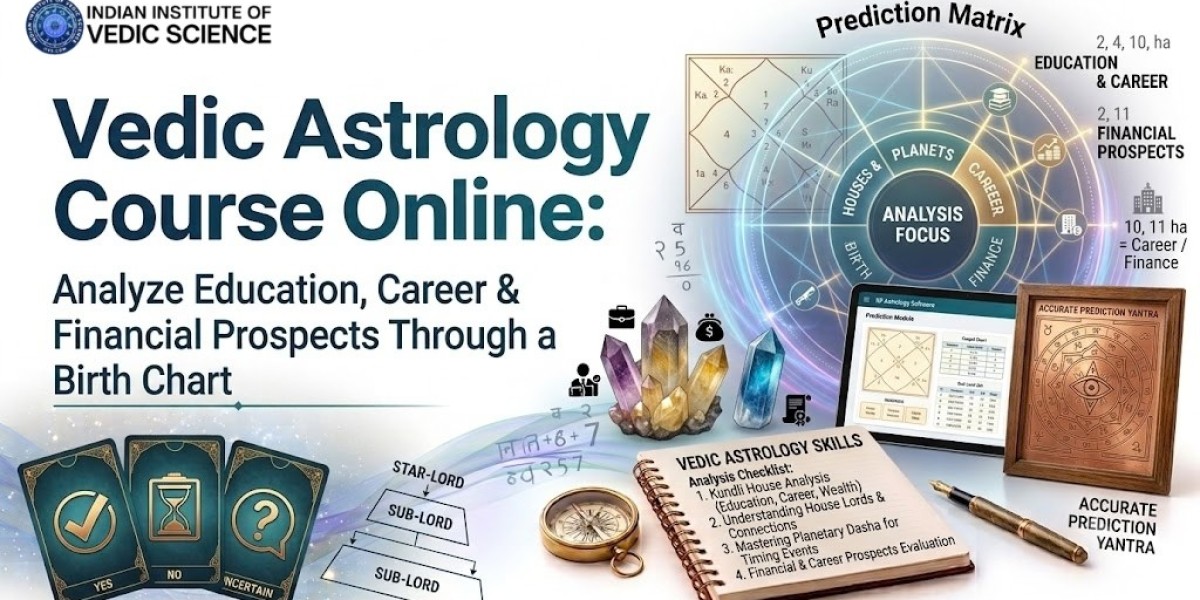


Vedic Astrology Course Online: How to Analyze Education, Career & Financial Prospects Through a Birth Chart
A birth chart, or Janam Kundli, is traditionally used in Vedic astrology to study different areas of life through planetary positions, houses, signs, nakshatras, dashas, and transits. Education, career, and financial prospects are among the most commonly studied areas because they involve important life decisions and long-term planning.
Learning to interpret these areas requires more than knowing the meanings of individual planets. A student needs to understand how houses interact, how planetary strength is assessed, how dashas and transits are considered, and how multiple chart factors are synthesized before reaching an interpretation.
For learners who want structured training, a Vedic astrology course can provide a systematic path from foundational concepts to practical birth-chart analysis. Online programs also make it possible to study these concepts through online Vedic astrology classes, guided practice, case discussions, and structured coursework.
How Does Vedic Astrology Analyze Education, Career and Finances?
In traditional Vedic astrology, education is commonly examined through the 4th and 5th houses along with relevant planets and their strength. Career analysis gives importance to the 10th house, its lord, the 6th and 11th houses, planetary combinations, dashas, and other supporting factors. Financial analysis may consider the 2nd, 5th, 9th, 10th, and 11th houses along with Jupiter, Venus, Mercury, and other relevant chart factors.
A proper interpretation should consider the complete birth chart rather than one planet, house, or combination in isolation. Dashas and transits may then be studied to understand periods traditionally associated with particular developments.
Understanding the Foundation of Vedic Astrology
Vedic astrology is a traditional astrological system that uses a birth chart to interpret planetary placements and their relationships. The chart is divided into twelve houses, with each house representing different areas of life.
For a beginner, the first step is understanding:
The 12 houses
The nine traditional planetary influences used in Jyotish
Zodiac signs
Nakshatras
House lords
Planetary aspects
Planetary strength
Yogas and combinations
Dashas
Transits
Divisional charts
These concepts form the foundation for anyone who wants to learn Vedic astrology systematically.
Rather than memorizing isolated meanings, students should learn how different factors work together. For example, career analysis cannot be based only on the 10th house. The condition of its lord, planets influencing it, relevant dashas, the 6th and 11th houses, and supporting chart factors can all contribute to the interpretation.
How Is Education Analyzed Through a Birth Chart?
Education is traditionally examined through several chart factors rather than one single indicator.
The 4th house is commonly associated with foundational education, learning environment, comfort, and academic development. The 5th house is associated with intelligence, learning ability, creativity, memory, and higher intellectual development.
The planets connected with these houses can also become relevant.
For example, Mercury is traditionally associated with learning, communication, reasoning, and analytical abilities, while Jupiter is associated with knowledge, wisdom, teaching, and higher learning.
A student learning through an online Vedic astrology course should therefore practice looking at:
The condition of the 4th house.
The condition of the 5th house.
The respective house lords.
Planets placed in these houses.
Planetary aspects and relationships.
Relevant divisional charts where appropriate.
The running dasha.
Supporting transit influences.
The goal is not to make a conclusion from a single placement but to synthesize multiple indicators.
How Is Career Analyzed Through Vedic Astrology?
Career analysis is one of the most practical applications studied in Vedic astrology.
The 10th house is traditionally one of the primary houses considered for profession, responsibilities, status, achievement, and public activity. However, professional interpretation generally involves several additional factors.
The 10th lord, planets occupying or influencing the 10th house, the 6th house, the 2nd house, and the 11th house can all become relevant depending on the question being studied.
A structured analysis may involve:
10th house and its lord
6th house and service-related themes
2nd house and income-related resources
11th house and gains
Planetary strength
Relevant yogas
Dashas
Transits
Divisional charts where applicable
This approach helps students move beyond generic statements such as “this planet gives a particular career.”
Someone pursuing learn Vedic astrology training should instead develop the ability to compare several chart indicators before forming an interpretation.
What Does Vedic Astrology Examine for Financial Prospects?
Financial analysis also requires a broader chart perspective.
Traditionally, the 2nd house is associated with accumulated resources, wealth, family resources, and speech. The 11th house is associated with gains, income, networks, and fulfilment of desires. The 5th and 9th houses can also become relevant when studying certain financial themes, while the 10th house connects professional activity with earning potential.
Students may therefore examine:
2nd house
5th house
9th house
10th house
11th house
Their respective lords
Jupiter and Venus
Relevant planetary combinations
Dashas and transits
However, astrology should not be presented as a guaranteed method for predicting financial outcomes. Financial decisions should be based on practical information, professional advice where appropriate, and individual circumstances.
Why Dashas Matter in Education, Career and Financial Analysis
One of the important areas students encounter when learning Vedic astrology is the dasha system.
A birth chart provides a broad framework, but traditional Jyotish uses planetary periods to examine when certain chart themes may become more prominent.
For example, a dasha connected with the 5th house may be examined during an educational question, while periods involving the 10th or 11th houses may be studied during career or professional questions.
The important skill is understanding the relationship between the running dasha and the natal chart.
This is why simply memorizing planetary meanings is not enough. Students need to learn how to connect:
Planet → House → Lordship → Placement → Relationship → Dasha → Transit → Overall chart context
This analytical process is an important part of structured Vedic astrology online classes.
The Role of Transits in Birth Chart Analysis
Transits describe the current or moving positions of planets relative to the natal chart.
Traditional practitioners may study transits alongside the natal chart and dasha system when examining periods related to education, career, or finances.
For example, a student may compare a major transit with the natal 10th house while studying a career-related question. Similarly, transits may be considered alongside dashas when examining changes in educational or professional circumstances.
However, transits should not be interpreted independently. A good learning process teaches students to use them as one layer of analysis rather than treating one transit as a guaranteed event.
Practical Birth Chart Analysis: A Step-by-Step Method
A structured method makes astrology easier to learn and apply.
Step 1: Establish the Birth Details
Accurate birth date, time, and place are important for generating the chart. Even small differences in birth time can sometimes affect chart calculations and divisional charts.
Step 2: Understand the Ascendant
The ascendant provides the starting point for house interpretation and helps establish the overall structure of the chart.
Step 3: Identify the Relevant Houses
For education, begin with the 4th and 5th houses.
For career, examine the 6th, 10th, and 11th houses along with supporting factors.
For financial questions, examine the 2nd, 5th, 9th, 10th, and 11th houses as relevant to the question.
Step 4: Examine the House Lords
Check where the relevant house lords are positioned and what relationships they have with other planets and houses.
Step 5: Assess Planetary Strength
Students should learn how dignity, placement, aspects, relationships, and other traditional measures contribute to interpretation.
Step 6: Study Dashas and Transits
Once the natal framework is understood, examine the relevant planetary periods and transits.
Step 7: Synthesize the Chart
Finally, bring all indicators together instead of relying on a single placement.
This structured process is one of the best ways to learn Vedic astrology because it develops analytical thinking rather than simple memorization.
What Should You Look for in a Vedic Astrology Course Online?
The quality of an astrology program depends heavily on how systematically it teaches the subject.
When comparing an online Vedic astrology course, look for a curriculum that covers both theory and practical interpretation.
A useful course may include:
Birth-chart fundamentals
Houses and signs
Planetary meanings
Nakshatras
House lord analysis
Planetary aspects
Yogas
Dashas
Transits
Divisional charts
Education analysis
Career analysis
Financial analysis
Practical case studies
Ethical interpretation
Learners comparing the best Vedic astrology course online should also check whether the program provides opportunities to practice real chart interpretation under guidance.
Online Vedic Astrology Classes vs Self-Study
Self-study can help beginners understand basic terminology, but structured instruction can make the learning process more organized.
Vedic astrology online classes can provide a learning sequence where concepts are introduced progressively. Students can ask questions, work through charts, review examples, and receive guidance when they encounter difficult combinations.
Similarly, online classes for astrology can be useful for learners who cannot attend classroom-based programs.
The important factor is not simply whether the course is online or offline. It is whether the curriculum provides sufficient depth, practical training, instructor guidance, and opportunities for application.
Choosing the Right Astrology Certification Program
Students may encounter several options while searching for astrology certification courses, including short-term certificates, structured professional programs, and diploma-level courses.
An astrology certificate course online may suit someone looking for a structured introduction or focused learning experience.
An astrology diploma course online may be more appropriate for learners looking for a broader curriculum with greater depth and systematic study.
Similarly, those searching for an astrology course online India should compare:
Curriculum depth
Faculty experience
Practical training
Course duration
Learning support
Certification structure
Case-study exposure
Course format
Student guidance
The term “best” is subjective, so learners should choose a program based on their learning objectives rather than relying only on promotional claims.
Why Choose an Online Astrology Course?
An online astrology course offers flexibility for working professionals, students, and learners who want to study from home.
Online learning can also make it easier to revisit lessons and practice chart interpretation at a comfortable pace.
For beginners searching for online astrology courses in India, the most useful approach is to compare programs based on learning outcomes rather than simply course length or certificate availability.
If your goal is to learn astrology online, start with foundational concepts and gradually move toward practical birth-chart analysis.
Learning Vedic Astrology with IIVS
At the Indian Institute of Vedic Science (IIVS), learners can explore structured education in Vedic astrology and related traditional knowledge systems.
A well-designed learning journey should help students understand the principles behind chart interpretation, practice analytical techniques, and develop the confidence to approach different types of birth-chart questions systematically.
For someone comparing the best online Vedic astrology course, it is worth evaluating whether the program combines foundational knowledge with practical application rather than focusing only on theory.
The objective should be to build a strong conceptual foundation first and then progressively develop interpretation skills.
A Practical Roadmap to Learn Vedic Astrology
If you are starting from the beginning, follow this progression:
Stage 1 — Foundation
Learn signs, houses, planets, ascendant, and basic chart structure.
Stage 2 — Interpretation
Study house lords, planetary relationships, aspects, dignity, and nakshatras.
Stage 3 — Prediction Techniques
Learn dashas, transits, yogas, and relevant traditional techniques.
Stage 4 — Practical Analysis
Practice education, career, relationship, and financial chart questions.
Stage 5 — Advanced Study
Explore divisional charts and advanced interpretive frameworks.
Stage 6 — Responsible Practice
Learn how to communicate interpretations carefully without presenting astrology as a guaranteed outcome.
This progression can help beginners understand the best way to learn Vedic astrology in a structured manner.
Learning to analyze education, career, and financial prospects through a birth chart requires a systematic understanding of houses, planets, signs, house lords, dashas, transits, and chart synthesis.
Rather than memorizing isolated combinations, students should focus on how different chart factors interact and how interpretations can be communicated responsibly.
Whether you are exploring vedic astrology online course options for personal interest or looking for structured professional learning, choose a program that combines conceptual clarity with practical chart analysis.
If you are ready to build your foundation in Vedic astrology and explore structured learning with guidance, book your free counselling with IIVS and understand which learning path best matches your goals.
Frequently Asked Questions
1. What is Vedic astrology used for?
Vedic astrology is traditionally used to interpret birth charts and study themes such as education, career, relationships, finances, and life patterns.
2. Can beginners learn Vedic astrology online?
Yes. Beginners can start with structured online Vedic astrology classes that teach chart fundamentals before progressing to advanced interpretation.
3. What should I learn first in Vedic astrology?
Start with planets, signs, houses, ascendant, house lords, aspects, and basic birth-chart construction.
4. How long does it take to learn Vedic astrology?
The time varies according to the depth of study and practice. Basic concepts can be learned relatively quickly, while developing strong interpretation skills requires continued practice.
5. Can a birth chart be used to analyze education?
Traditional Vedic astrology considers factors such as the 4th and 5th houses, their lords, relevant planets, dashas, and supporting chart factors when studying education.
6. Which houses are important for career analysis?
The 10th house is a major career indicator, while the 6th, 2nd, and 11th houses can provide additional context depending on the question.
7. Which houses are considered for financial analysis?
The 2nd and 11th houses are commonly examined, with the 5th, 9th, and 10th houses also becoming relevant in different financial questions.
8. Is an astrology certificate course online useful?
It can be useful if it provides structured learning, practical application, and a curriculum appropriate to the learner's goals.
9. What is the difference between a certificate and diploma course?
A certificate program is generally more focused, while a diploma course may offer broader and deeper subject coverage. The actual curriculum should always be checked before enrolling.
10. Can I learn astrology online without prior knowledge?
Yes. Beginners can start with foundational lessons and gradually progress toward complete chart interpretation.
11. What should I check before joining an astrology course?
Check the syllabus, teaching approach, practical training, faculty guidance, course duration, certification structure, and opportunities for chart-based practice.
12. Are online Vedic astrology classes suitable for working professionals?
Yes. Online classes can provide flexibility for learners balancing professional or personal commitments.
13. Is Vedic astrology scientifically proven to predict financial outcomes?
Astrological interpretations are part of a traditional belief and interpretive system and should not be treated as guaranteed financial predictions or substitutes for professional financial advice.






