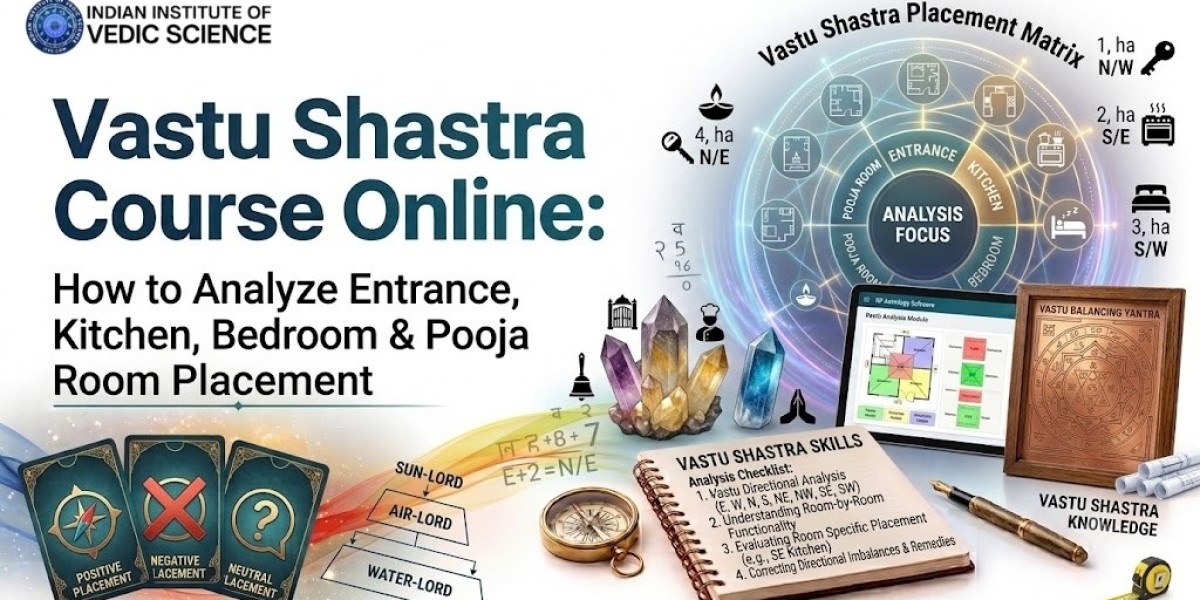


Vastu Shastra Course Online: How to Analyze Entrance, Kitchen, Bedroom & Pooja Room Placement
The entrance, kitchen, bedroom, and pooja room are some of the most discussed areas when studying Vastu Shastra for home. Traditional Vastu principles consider factors such as direction, space arrangement, proportions, movement, and the placement of different functional areas while planning or evaluating a property.
However, learning Vastu is not simply about memorizing which room should be placed in which direction. A proper Vastu analysis involves understanding the layout as a whole, identifying directional zones, studying the relationship between spaces, and suggesting practical considerations without unnecessarily disrupting the structure.
For learners who want to develop these skills systematically, a Vastu Shastra course can provide a structured introduction to traditional principles, charting methods, property analysis, and practical case studies. Online learning also makes it possible to study through an online Vastu course while continuing professional or personal commitments.
How Do You Analyze a Home Using Vastu Shastra?
A traditional Vastu analysis generally begins by examining the property's orientation, entrance, floor plan, directional zones, room placement, proportions, ventilation, circulation, and functional use of different spaces. The entrance, kitchen, bedroom, and pooja room are then evaluated according to the Vastu framework being followed.
The analysis should consider the complete floor plan rather than judging one room or direction independently. Practical factors such as building regulations, structural safety, ventilation, accessibility, and the actual needs of occupants should also remain important.
Understanding the Basics of Vastu Shastra
Vastu Shastra is a traditional Indian architectural and spatial planning system. It provides principles for organizing built spaces in relation to directions, proportions, zones, movement, and functions.
Before analyzing individual rooms, students should understand the basic framework:
Four primary directions
Intercardinal directions
Vastu Purusha Mandala
Directional zones
Plot orientation
Entrance positioning
Room functionality
Space distribution
Proportions and layout
Practical Vastu assessment
A learner should first understand how a property is oriented before making conclusions about individual rooms.
This is one reason a structured Vastu Shastra course online can be more useful than learning isolated tips from short articles or social media posts.
Step 1: Start With the Property Orientation
The first stage of a Vastu assessment is understanding the orientation of the property.
Students generally learn how to determine:
North
South
East
West
Northeast
Southeast
Southwest
Northwest
A floor plan should then be aligned with the appropriate directional framework.
This matters because the same room placement may be interpreted differently depending on the property's overall orientation.
For someone studying an online course for Vastu Shastra, learning how to correctly read a floor plan is therefore an important foundational skill.
How to Analyze the Main Entrance
The entrance is one of the first areas considered during a traditional Vastu analysis because it represents the primary access point into the property.
Rather than simply saying that one direction is always “good” and another is always “bad,” a learner should examine the entrance in the context of the entire property.
Important factors can include:
Direction of the entrance
Exact location within the directional zone
Placement in relation to the floor plan
Door proportions
Movement into the property
Obstructions
Natural light
Ventilation
Relationship with internal spaces
Students should also learn to distinguish between an entrance's direction and its exact zone or placement.
A practical Vastu course should teach learners how to examine these factors systematically instead of relying on generalized rules.
Vastu Analysis of the Kitchen
The kitchen is another important area when studying Vastu Shastra for home.
Traditional Vastu frameworks commonly associate the kitchen with the fire element and examine its placement in relation to directional zones.
During an analysis, students may study:
Kitchen direction
Cooking platform placement
Stove positioning
Sink location
Windows and ventilation
Storage arrangement
Relationship between fire and water-related areas
Kitchen entrance
Overall circulation
The objective should be to understand how these elements interact within the floor plan.
For example, simply changing the position of one appliance may not address a broader layout issue. A trained learner should first understand the overall spatial relationship before suggesting any correction.
How to Analyze Bedroom Placement
Bedrooms require a different approach because their function is different from that of the kitchen or entrance.
A Vastu analysis may consider:
Bedroom direction
Position within the house
Bed placement
Head direction while sleeping
Door location
Windows
Ventilation
Storage
Attached bathroom placement
Relationship with other rooms
The master bedroom, children's bedroom, and guest bedroom may be evaluated according to their purpose and the overall layout.
This is where practical training becomes valuable. A student can learn general principles, but applying them to an actual floor plan requires understanding how multiple factors interact.
Pooja Room Placement in Vastu
The pooja room is traditionally treated as a spiritually significant space in many Indian homes.
When studying its placement, learners may examine:
Direction
Location within the floor plan
Entrance
Height and arrangement of the platform
Ventilation and natural light
Relationship with bathrooms and other functional spaces
Overall cleanliness and accessibility
A Vastu practitioner should communicate such principles respectfully as part of a traditional system rather than presenting them as scientifically guaranteed outcomes.
For learners studying an online course of Vastu Shastra, understanding the cultural and traditional context of these recommendations is just as important as memorizing placement rules.
Why the Complete Floor Plan Matters
One of the biggest mistakes beginners make is analyzing individual rooms independently.
For example:
“Kitchen should be in this direction.”
“Bedroom should be in that direction.”
“Pooja room should be here.”
These statements may be useful as basic learning points, but real properties are rarely designed around isolated rules.
A practical analysis considers:
Plot → Orientation → Entrance → Zones → Room placement → Circulation → Functional relationships → Practical constraints
This approach helps learners develop stronger analytical skills.
Learning Vastu Through Practical Case Studies
Theory becomes easier to understand when students practice with real or simulated floor plans.
A structured advance Vastu course online may include exercises such as:
Identifying property orientation.
Marking directional zones.
Locating the main entrance.
Assessing kitchen placement.
Reviewing bedroom arrangements.
Identifying the pooja area.
Observing structural limitations.
Prioritizing possible corrections.
Preparing a clear analysis.
Explaining recommendations to a client.
Case studies can also teach students that every property has different constraints.
For example, a person living in an apartment may not be able to relocate a kitchen or bathroom. In such situations, practical and proportionate recommendations are more useful than suggesting major structural changes without considering feasibility.
What Makes a Good Vastu Shastra Course Online?
When comparing a Vastu Shastra course online, learners should look beyond the course title.
A well-structured program should ideally cover:
Fundamentals of Vastu
Directions and zones
Vastu Purusha Mandala
Plot analysis
Entrance analysis
Kitchen analysis
Bedroom analysis
Pooja room placement
Commercial spaces
Apartment analysis
Floor-plan reading
Practical case studies
Traditional correction methods
Client communication
An online Vastu certificate course can be useful for learners who want structured documentation of their training, but the actual curriculum and practical exposure should remain the primary considerations.
Choosing the Best Online Vastu Course
The phrase best online Vastu course can mean different things for different learners.
Someone learning Vastu for personal knowledge may want a beginner-friendly curriculum. A learner interested in professional consulting may need deeper practical training and case-based learning.
Before choosing a program, compare:
Course syllabus
Faculty expertise
Practical sessions
Case studies
Learning support
Course duration
Certification
Advanced modules
Application-based training
Similarly, people searching for the best Vastu Shastra course in India should evaluate the actual learning experience rather than relying only on rankings or promotional claims.
Finding the Best Institute to Learn Vastu Shastra
When evaluating the best institute to learn Vastu Shastra, look for an institution that teaches principles systematically and provides opportunities for practical application.
The best institute for Vastu Shastra in India will ultimately depend on the learner's goals, preferred learning format, curriculum expectations, and level of practical training required.
An institution should ideally help students move from:
Basic concepts → Directional understanding → Floor-plan analysis → Practical cases → Advanced interpretation
This progression is more valuable than simply completing a short course without sufficient practice.
Understanding Vastu Shastra Course Fees
Vastu Shastra course fees can vary depending on factors such as course duration, curriculum depth, live classes, practical sessions, instructor support, certification, and advanced modules.
Rather than choosing solely on price, learners should compare the total learning value.
A lower-cost introductory course may be appropriate for someone exploring the subject, while a more comprehensive program may be better suited to someone seeking structured professional-level training.
Students should also verify what is included in the fee before enrolling, including study materials, practical sessions, assessments, and certification.
Vastu Course Online: Who Can Learn It?
A Vastu course online can be suitable for:
Beginners interested in traditional Vastu
Homeowners wanting foundational knowledge
Interior and architecture enthusiasts
Astrology students
Wellness and holistic-learning enthusiasts
Aspiring Vastu consultants
Professionals adding Vastu knowledge to their existing skill set
No single background is mandatory for introductory study. What matters most is consistent learning and practical application.
The Connection Between Vastu and Astrology Learning
Vastu and astrology are distinct traditional systems, although they are often studied together.
This explains why learners may also search for online astrology courses, an astrology course online, or astrology classes online while exploring Vastu education.
Similarly, online classes for astrology may appeal to students who want to develop broader knowledge of traditional Indian knowledge systems.
However, students should understand that Vastu and astrology have different frameworks and should be learned as distinct subjects before exploring their traditional connections.
Learning Vastu with IIVS
The Indian Institute of Vedic Science (IIVS) provides structured learning opportunities in Vastu and other traditional knowledge systems.
For someone comparing an online Vastu certificate course, the focus should be on whether the curriculum provides conceptual clarity, practical application, and sufficient guidance.
A structured learning environment can help students understand how to approach different floor plans rather than relying on isolated Vastu tips.
The goal is to develop an analytical process that can be applied consistently while keeping practical considerations in mind.
A Practical Roadmap to Learn Vastu Shastra
If you are beginning your Vastu learning journey, follow a progressive approach.
Stage 1: Learn the Fundamentals
Understand directions, zones, elements, Vastu Purusha Mandala, and basic spatial principles.
Stage 2: Learn Property Analysis
Practice identifying orientation, plot shape, entrances, zones, and major structural areas.
Stage 3: Study Individual Spaces
Learn how traditional Vastu approaches entrances, kitchens, bedrooms, pooja rooms, bathrooms, living rooms, and other areas.
Stage 4: Practice Floor Plans
Work with different residential layouts and identify potential areas for analysis.
Stage 5: Study Advanced Applications
Explore apartments, offices, commercial properties, irregular plots, and complex layouts.
Stage 6: Develop Client Communication Skills
Learn to explain observations clearly and responsibly without creating unnecessary fear or making guaranteed claims.
This roadmap can help transform theoretical knowledge into practical Vastu analysis skills.
Learning how to analyze an entrance, kitchen, bedroom, and pooja room requires more than memorizing directional rules. A strong foundation in Vastu Shastra teaches students how to understand orientation, zones, room relationships, floor plans, and practical constraints as part of one complete property.
Whether you are exploring a Vastu Shastra course online for personal knowledge or considering structured professional learning, choose a program that balances traditional principles with practical application.
IIVS can help you explore a structured learning path based on your goals and current level of knowledge.
Ready to start learning Vastu systematically? Book your free counselling with IIVS today and understand which Vastu learning path is right for you.
Frequently Asked Questions
1. What is Vastu Shastra?
Vastu Shastra is a traditional Indian system of spatial planning that considers directions, proportions, layout, and the relationship between built spaces and their functions.
2. What is studied in a Vastu Shastra course?
A course may cover directions, Vastu zones, property orientation, entrances, room placement, floor-plan analysis, traditional principles, corrections, and practical case studies.
3. Which areas are important in Vastu for home?
The entrance, kitchen, bedrooms, pooja room, living areas, bathrooms, and overall spatial arrangement can be considered during a traditional home Vastu analysis.
4. How do you analyze a home's entrance?
The entrance can be examined by considering its direction, exact location, surrounding layout, movement, proportions, light, ventilation, and relationship with other spaces.
5. How is a kitchen analyzed according to Vastu?
Traditional analysis may consider the kitchen's directional zone, cooking platform, stove, sink, ventilation, storage, and relationship between fire- and water-related areas.
6. Where should a pooja room be placed?
Traditional Vastu provides principles for pooja-room placement, but the exact recommendation should be evaluated according to the complete floor plan rather than applying one universal rule.
7. Is an online Vastu course suitable for beginners?
Yes. Beginners can start with foundational concepts and progressively move toward floor-plan analysis and practical case studies.
8. Is an online Vastu certificate course enough to become a consultant?
A certificate alone does not determine practical competence. Learners should also develop knowledge, chart/floor-plan analysis skills, practical experience, and responsible client communication.
9. What affects Vastu Shastra course fees?
Course duration, syllabus depth, practical training, faculty guidance, certification, and advanced modules can influence course fees.
10. What is the difference between a basic and advanced Vastu course?
A basic course generally introduces fundamental principles, while an advanced program may focus more heavily on practical property analysis, complex layouts, commercial spaces, and case studies.
11. Can Vastu be learned online?
Yes. Online learning can provide structured lessons, demonstrations, assignments, and practical floor-plan exercises.
12. Should Vastu recommendations involve major structural changes?
Not necessarily. Recommendations should consider feasibility, safety, building regulations, cost, and the actual needs of the occupants.






