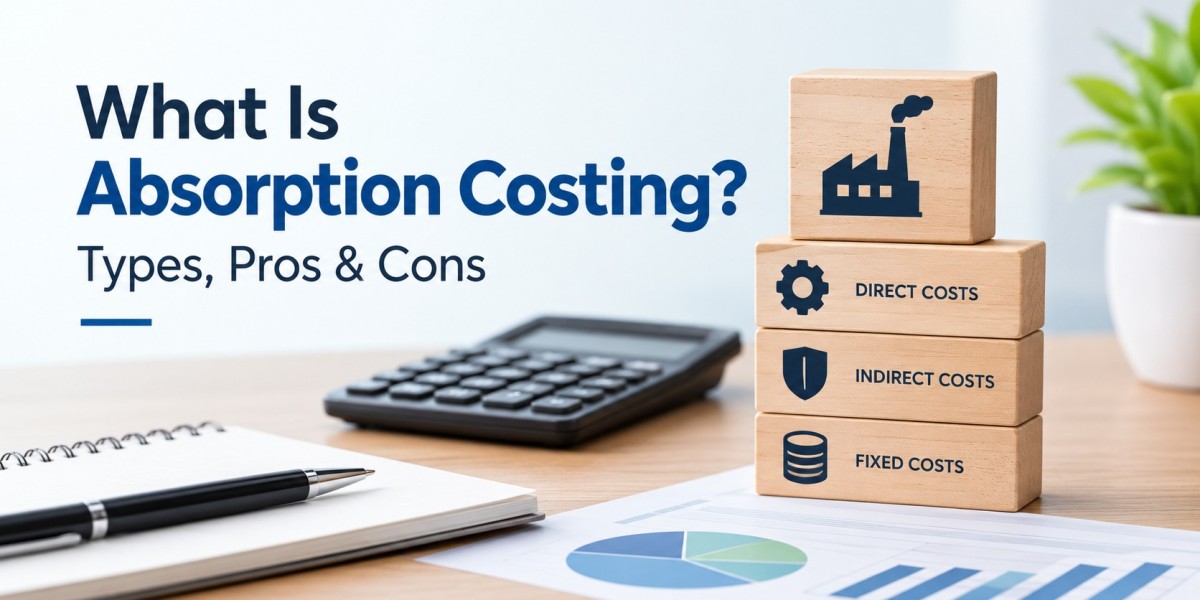


Absorption costing is an accounting method for calculating the total cost of producing a product. It includes both fixed and variable manufacturing costs in each product produced.
Under this method, costs such as raw materials, direct labour, factory overhead, rent, utilities, and equipment depreciation are assigned to products. This gives businesses a clear view of the total cost involved in production.
Absorption costing is commonly used for financial reporting and helps businesses understand product costs, pricing, and profitability.
Types of Absorption Costing
Absorption costing can be applied in different ways depending on how a business allocates its overhead costs. Common approaches include:
1. Traditional Absorption Costing
This method allocates overhead costs using a single rate or a few cost drivers, such as labour hours or machine hours. It is simple and suitable for businesses with relatively straightforward production processes.
2. Activity-Based Absorption Costing
This approach assigns overhead costs based on specific activities of those costs. It can provide more accurate product costing, especially when a business has multiple products and complex operations.
3. Full Cost Absorption
Under this approach, all manufacturing costs, including fixed and variable overheads, are included in the cost of goods produced. It provides a complete picture of production costs.
Pros & Cons of Absorption Costing
Pros of Absorption Costing
- Complete cost view: It includes both fixed and variable manufacturing costs.
- Useful for pricing: Knowing the full product cost can support better pricing decisions.
- Supports financial reporting: It is widely used for external financial reporting.
- Helps measure profitability: Businesses can better understand the cost and profit associated with products.
- Simple for many businesses: Traditional absorption costing can be relatively easy to implement.
Cons of Absorption Costing
- Overhead allocation can be complex: Indirect costs must be distributed across products.
- Less useful for short-term decisions: Fixed costs can sometimes make decision-making less clear.
- May affect reported profits: Inventory levels can influence how much fixed overhead is included in the cost of goods sold.
- Can be less accurate: Using broad allocation rates may not reflect the actual resources used by each product.
Difference Between Absorption Costing & Variable Costing
The main difference is how fixed manufacturing overhead is treated.
| Absorption Costing | Variable Costing |
| Includes fixed and variable manufacturing costs in product cost | Includes only variable manufacturing costs in product cost |
| Fixed manufacturing overhead becomes part of inventory cost | Fixed manufacturing overhead is treated as a period expense |
| Commonly used for external financial reporting | Mainly used for internal management decisions |
| Focuses on the full production cost | Focuses on variable production costs and contribution margin |
Therefore, absorption costing shows the full manufacturing cost of a product, while variable costing focuses on costs that change with production levels.
Why There Is a Need for ERP Software for Absorption Costing
Managing absorption costing manually can become difficult as a business grows. There may be large amounts of data related to materials, labour, production, inventory, and overhead expenses.
ERP software can bring these activities together in one system. It can help businesses:
- Track direct and indirect production costs.
- Allocate overhead costs more efficiently.
- Maintain accurate inventory and cost records.
- Automate costing calculations and reduce manual errors.
- Provide real-time financial and production information.
- Generate reports to support better business decisions.
By connecting accounting, inventory, purchasing, and production data, ERP software can make absorption costing more organised, consistent, and easier to manage.
Conclusion
Absorption costing is a useful method for understanding the complete cost of manufacturing a product. By including both fixed and variable manufacturing costs, it gives businesses a broader view of production costs and profitability.






