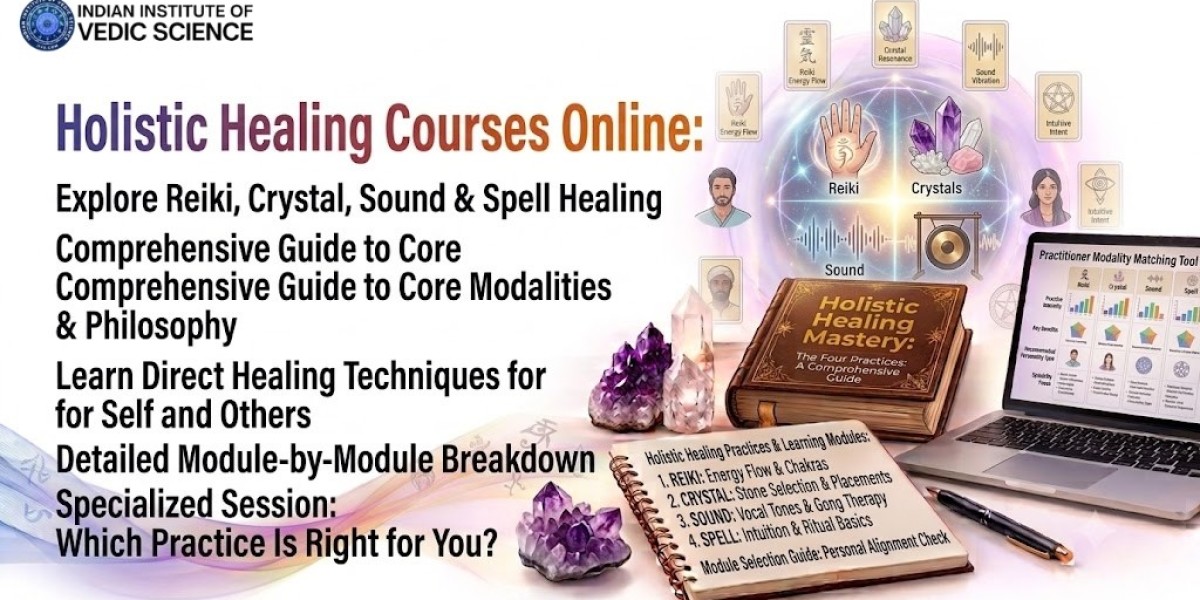


Holistic Healing Courses Online: Reiki, Crystal, Sound & Spell Healing — What Will You Learn and Which Practice Is Right for You?
Holistic healing is becoming an increasingly popular area of learning for people who want to explore wellness practices, energy-based traditions, meditation, relaxation techniques, and spiritual self-development. But with so many options available, choosing the right course can be confusing.
Should you start with Reiki? Would a sound healing course be better if you are interested in meditation and sound? Is crystal healing more suitable if you are drawn to crystals and energy work? Or should you explore spell casting as a spiritual practice?
The answer depends on what you want to learn, how you want to use the practice, and the type of training you are looking for.
Today, holistic healing courses online can provide structured learning in practices such as Reiki, sound healing, crystal healing, and spell work. A good course should go beyond simply introducing techniques. It should help you understand the principles behind the practice, develop responsible habits, learn how to conduct sessions, and understand where the limits of a complementary wellness practice lie.
Which Holistic Healing Course Should You Choose?
If you are interested in energy work and hands-on or distance-based relaxation practices, a Reiki healing course can be a good starting point.
If you are especially interested in sound, vibration, meditation, and relaxation, consider a sound healing course.
If you feel drawn to crystals, symbolism, intention-setting, and energy-focused practices, a crystal healing course may be more suitable.
If your interest is in traditional spiritual practices, intention, symbolism, rituals, and spell work, you may explore a spell casting course.
Rather than choosing a course only because it is described as the “best,” look at its curriculum, practical training, certification structure, instructor experience, learning support, and ethical approach.
What Are Holistic Healing Courses Online?
Holistic healing courses online are structured educational programs that introduce students to complementary wellness and spiritual practices.
Depending on the course, students may learn about energy work, meditation, relaxation, sound, crystals, intention-setting, symbolic practices, session preparation, client communication, and practical techniques.
The word holistic generally refers to looking at a person's experience more broadly rather than focusing on one isolated aspect. In wellness education, this can involve practices designed around relaxation, mindfulness, self-awareness, emotional balance, or spiritual exploration.
However, it is important to maintain realistic expectations.
Holistic healing practices should not be presented as replacements for qualified medical or mental-health treatment. A responsible practitioner understands the difference between complementary wellness support and healthcare.
Reiki Healing Course: What Will You Learn?
Reiki is one of the most widely explored energy-based wellness practices. A structured Reiki healing course generally introduces students to Reiki principles, energy awareness, hand positions, meditation, session preparation, and practical methods of working with Reiki.
Someone who wants to learn Reiki healing should ideally look for a course that combines theoretical understanding with guided practice.
A comprehensive program may cover:
Introduction to Reiki and its traditional background
Reiki principles and practitioner mindset
Energy awareness and grounding
Hand positions and session structure
Self-Reiki practices
Meditation and relaxation techniques
Distance Reiki concepts, where included in the curriculum
Preparing a comfortable session environment
Practitioner-client communication
Ethical boundaries
Practical demonstrations and supervised practice
The purpose of structured learning is not simply to memorize hand positions. Students should understand how to approach a session calmly, responsibly, and consistently.
Reiki Healing Classes vs Self-Learning
You can find plenty of information online about Reiki, but Reiki healing classes provide something self-study often cannot: structured progression and feedback.
A guided learning environment can help students understand techniques in the correct sequence, practise them, ask questions, and develop confidence.
For students who cannot attend physical classes, Reiki healing certification online programs can offer a flexible alternative, provided the program includes meaningful instruction and practical guidance.
What About Reiki Healing Course Fees?
Reiki healing course fees can vary considerably depending on the level, duration, instructor, practical training, certification, and learning format.
Instead of comparing courses only by price, check what the fee actually includes.
Ask:
How long is the program?
Is practical training included?
Is certification provided?
Is there instructor support?
Are study materials included?
Is there post-course guidance?
What level of Reiki is covered?
A lower fee does not automatically mean better value, and a higher fee does not automatically mean better training.
Sound Healing Course: Learn Through Sound, Rhythm and Vibration
A sound healing course is another popular option for students interested in meditation, relaxation, sound-based practices, and holistic wellness.
Sound-based practices can involve instruments such as singing bowls, gongs, tuning-based instruments, bells, percussion instruments, or the human voice, depending on the curriculum.
A good course can introduce students to:
Fundamentals of sound-based wellness practices
Different sound instruments
Basic playing techniques
Creating a calming session environment
Breath and relaxation practices
Meditation with sound
Session planning
Individual and group sessions
Practitioner awareness and boundaries
Practical demonstrations
Someone searching for a sound healing certification course should look for a curriculum that includes both theoretical concepts and hands-on instrument practice.
Sound Healing Certification Online
Online learning has made sound-based education more accessible. A sound healing certification online program may allow students to study theoretical modules remotely and practise instruments independently.
However, students should carefully check whether practical demonstrations, instructor feedback, live sessions, or guided practice are included.
A certificate alone does not create practical competency.
For learners considering sound healing certification programs, the quality of training, practical exposure, instructor guidance, and learning outcomes should be more important than the certificate title itself.
Sound Therapy Certification Online
You may also encounter programs marketed as sound therapy certification online.
When evaluating these programs, understand exactly what the term “therapy” means within the course. A wellness certification should not imply that completing a short course qualifies someone to diagnose or medically treat health conditions.
Responsible training clearly explains the scope of practice.
Sound Healing Course Delhi
Students searching for a sound healing course Delhi may compare classroom and online options.
A local course can be useful if you want direct access to instruments and face-to-face practice. An online course may be more convenient if your schedule, location, or work commitments make physical attendance difficult.
If you are comparing options, focus on curriculum quality rather than location alone.
Crystal Healing Course: Understanding Crystals, Symbolism and Energy Practices
A crystal healing course introduces students to the traditional and contemporary use of crystals within holistic and spiritual practices.
Crystal-focused learning often explores the symbolism associated with different crystals, methods of cleansing or preparing them according to the tradition being taught, meditation, intention-setting, layouts, and session practices.
A structured program may teach:
Introduction to crystal healing
Crystal properties and traditional associations
Identification and selection of crystals
Cleansing and preparation methods
Meditation with crystals
Crystal layouts
Intention-setting
Creating a personal crystal practice
Conducting a basic session
Responsible communication with clients
Students looking to learn crystal healing should understand that crystal traditions contain many different systems and interpretations. A good course should make clear which framework it teaches.
Crystal Healing Classes and Online Learning
Crystal healing classes can be useful for students who prefer demonstrations and practical interaction.
At the same time, crystal healing courses online can work well for learners who want flexible study. Because many foundational concepts can be taught through demonstrations, visual lessons, guided exercises, and assignments, online learning can be convenient.
Those interested in professional training may encounter options such as a crystal healing certification course, crystal healing certification online, or even a crystal healing diploma.
Again, the title alone should not determine your choice.
Look at:
Course duration
Curriculum
Practical modules
Instructor support
Assessment
Certification requirements
Session training
Ethical guidelines
You may also come across courses on crystal healing that focus primarily on personal use rather than practitioner training. Decide whether your goal is personal learning or professional skill development before enrolling.
What Makes the Best Crystal Healing Course?
There is no universal answer to which is the best crystal healing course.
The right program is the one that matches your learning objective.
For personal exploration, a shorter introductory course may be enough. For practitioner-oriented learning, you may want a more structured curriculum with demonstrations, assignments, supervised practice, and guidance.
Spell Casting Course: What Does It Teach?
A spell casting course belongs to a different category of holistic and spiritual learning.
Spell work can involve symbolism, intention, rituals, meditation, traditional practices, visualization, correspondences, and structured ceremonial methods, depending on the tradition being taught.
A beginner-focused spell casting class may introduce:
Historical perspectives on ritual practices
Intention-setting
Symbolism
Ritual preparation
Meditation and visualization
Correspondences used within a particular tradition
Personal spiritual practices
Ethical considerations
Creating structured rituals
Someone searching for spell casting online should first understand the tradition and framework being taught.
Spell work is not a single standardized system. Different cultures and traditions may have substantially different approaches, terminology, symbolism, and practices.
Therefore, students should avoid courses that make exaggerated promises or guarantee specific real-world outcomes.
A responsible course treats spiritual practices as practices of learning and personal exploration rather than guaranteed solutions to medical, financial, relationship, or other serious problems.
Reiki vs Sound Healing vs Crystal Healing vs Spell Work
Choosing between these practices becomes easier when you compare what attracts you to each one.
Choose Reiki if:
You are interested in energy-based practices.
You want to learn structured hands-on techniques.
Meditation and relaxation appeal to you.
You want to develop a personal energy-work practice.
Choose Sound Healing if:
You enjoy music and sound.
You are interested in meditation and relaxation.
You want to work with sound instruments.
You enjoy practical, sensory learning.
Choose Crystal Healing if:
You are naturally interested in crystals.
Symbolism and energy traditions appeal to you.
You enjoy meditation and intention-setting.
You want to explore crystal-based practices.
Explore Spell Work if:
You are interested in rituals and symbolism.
Spiritual traditions fascinate you.
You enjoy intention-setting and visualization.
You want to study ritual practices within a specific tradition.
You can eventually explore multiple disciplines, but it is usually better to develop a foundation in one practice before attempting to combine several systems.
How to Choose the Right Holistic Healing Course Online
With the increasing number of online programs, choosing a course requires more than searching for “best” and enrolling in the first result.
Use this checklist:
1. Define Your Goal
Are you learning for:
Personal growth?
Meditation and relaxation?
Spiritual exploration?
Complementary wellness practice?
Practitioner-oriented training?
Your goal should determine your course level.
2. Check the Curriculum
Look beyond marketing claims.
A useful curriculum should clearly explain what you will learn, how lessons are structured, and whether practical training is included.
3. Check Practical Training
For Reiki, sound, and practitioner-oriented crystal work, practical learning can be particularly important.
Ask whether you will receive demonstrations, assignments, guided practice, or instructor feedback.
4. Understand Certification
A certificate documents completion of training, but it does not automatically establish professional competence in every setting.
Check what the certification actually represents.
5. Look at Instructor Experience
Research the instructor's background, teaching experience, and area of specialization.
6. Check Ethical Guidelines
A responsible course should avoid guaranteed claims and should teach students when to refer people to qualified healthcare or mental-health professionals.
7. Compare Support
Online learning becomes much more useful when students have access to instructor guidance, doubt resolution, assignments, and post-course support.
What Can You Do After Completing a Holistic Healing Course?
The opportunities depend on your training, experience, local requirements, and the exact practice you study.
Students may use their knowledge for:
Personal wellness practices
Meditation sessions
Complementary relaxation sessions
Workshops
Wellness communities
Spiritual education
Content creation and educational work
Practitioner-oriented services, where appropriate
However, students should never represent complementary practices as medical treatment unless they hold the appropriate professional qualifications and legal authority to do so.
The strongest practitioners combine knowledge with responsible communication, realistic expectations, client boundaries, and continuous learning.
Why Study Holistic Healing at IIVS?
The Indian Institute of Vedic Science (IIVS) provides structured learning opportunities across Vedic science, spiritual studies, holistic wellness, and related disciplines.
For someone comparing holistic healing courses online, the advantage of a structured institute is that you can explore different systems within a broader learning environment rather than treating every practice as an isolated technique.
Depending on your interests, you can explore areas such as Reiki, sound healing, crystal healing, spell work, astrology, numerology, Vastu, Tarot, and other complementary disciplines.
The objective should not simply be collecting certificates.
It should be developing a clear understanding of the practice, learning its methods responsibly, gaining confidence through structured study, and knowing how to communicate its role appropriately.
If you are unsure whether Reiki, sound healing, crystal healing, or another holistic discipline is right for you, counselling can help you understand the available learning path before you make a decision.
A Simple Roadmap for Beginners
If you are completely new to holistic healing, use this roadmap:
Step 1: Identify your primary interest — energy, sound, crystals, ritual, meditation, or spiritual learning.
Step 2: Choose one foundational course instead of trying to learn everything simultaneously.
Step 3: Study the concepts and terminology behind the practice.
Step 4: Practise the techniques consistently.
Step 5: Learn ethical boundaries and responsible communication.
Step 6: Complete the required training and assessment.
Step 7: Continue practising and developing your knowledge.
Step 8: Explore advanced disciplines only after establishing a strong foundation.
This approach helps prevent information overload and allows you to understand which practice genuinely suits your interests.
Holistic healing is not one single practice. Reiki, sound healing, crystal healing, and spell work each have different concepts, techniques, traditions, and learning approaches.
The right course is therefore not necessarily the one with the biggest claims or the most impressive certificate. It is the course that matches your interests, provides structured learning, includes appropriate practical guidance, and teaches you to approach the practice responsibly.
If you are exploring Reiki healing certification, sound healing certification, crystal healing certification, or spell casting online, start by understanding what you actually want to learn.
At IIVS, you can explore holistic and Vedic learning pathways with structured guidance and counselling support to help identify a suitable direction.
Ready to explore the right holistic healing path for you?
Book your free counselling with IIVS and discuss your interests, learning goals, and suitable course options before you begin.
Frequently Asked Questions
1. What is the best holistic healing course for beginners?
There is no single best course for everyone. Reiki may suit people interested in energy practices, sound healing may suit those drawn to sound and meditation, while crystal healing may appeal to people interested in crystals and symbolism.
2. Can I learn Reiki healing online?
Yes. A structured Reiki healing certification online program can provide theoretical lessons, guided practice, demonstrations, and instructor support depending on the course.
3. How much do Reiki healing course fees usually vary?
Reiki healing course fees vary according to the level, duration, instructor, practical training, certification, and support provided. Compare the complete course structure rather than price alone.
4. Is sound healing certification online useful?
It can be useful for foundational and theoretical learning, particularly when the program includes demonstrations, live guidance, instrument practice, and instructor feedback.
5. What does a sound healing course teach?
A sound healing course may cover sound-based relaxation practices, instruments, meditation, session preparation, basic techniques, and practitioner responsibilities.
6. Can I complete a crystal healing course online?
Yes. Crystal healing courses online can introduce crystal traditions, symbolism, meditation, cleansing methods, layouts, intention-setting, and session practices depending on the curriculum.
7. Is a crystal healing diploma better than a certificate?
Not necessarily. The quality and depth of the curriculum, practical training, assessment, instructor support, and learning outcomes matter more than the name of the credential.
8. What is taught in a spell casting course?
It depends on the tradition. A spell casting course may explore rituals, symbolism, intention-setting, visualization, meditation, correspondences, and ethical considerations.
9. Can I learn multiple holistic healing practices?
Yes, but beginners generally benefit from developing a strong foundation in one practice before combining multiple systems.
10. Is holistic healing a replacement for medical treatment?
No. Complementary wellness and spiritual practices should not be presented as substitutes for qualified medical or mental-health care.
11. How do I choose between Reiki and sound healing?
Consider your interests. Reiki may appeal to people interested in energy-focused practices, while sound healing may be better suited to people drawn to sound, instruments, meditation, and relaxation.
12. Are online holistic healing courses suitable for beginners?
They can be, provided the course clearly explains prerequisites, curriculum, practical requirements, instructor support, and certification.






